
If you've watched a lizard on a fence or wall, you've probably seen it stop, straighten its front legs and bob up and down at you. So why do lizards do push-ups? The short answer is that the push-up is a message. Lizards can't call to each other the way birds do, so many species talk with movement.
The message changes with the audience. A push-up aimed at another male means something different from one aimed at a female, and some lizards even use push-ups on predators. Here's what researchers have found.
Quick facts
Many male lizards turn metallic blue, green or yellow in breeding season, and push-ups show off those patches, says the Arizona Game and Fish Department.
In a 1997 study, Puerto Rican crested anoles did significantly more push-ups when shown a model snake (Leal and Rodríguez-Robles, Animal Behavior).
In a 1999 follow-up with 21 male anoles, the lizards that did the most push-ups at the snake also had the most running stamina (Leal, Animal Behavior).
A 2008 Harvard study of 38 male yellow-chinned anoles found they add push-ups to grab attention in dim or cluttered conditions (NBC News).
Green anoles use three distinct head-bob patterns, and both males and females perform them, according to Virginia Tech biologist Tom Jenssen's research pages.
Why do lizards do push-ups?
Lizards do push-ups mainly to send visual signals to other lizards about territory, dominance and mating. An Arizona Republic article on Arizona's lizards describes the push-up display as a form of communication used to defend territory, warn rivals and attract mates. Males do it more often and more dramatically than females.
The motion is simple. The lizard straightens and bends its front legs, so its head and chest rise and fall, sometimes in a quick series. Many species add head bobs, and some puff out a flap of throat skin at the same time.
Push-ups are common in North American spiny lizards (the genus Sceloporus), which includes the western fence lizard and the desert spiny lizard. Anoles, the small tree lizards of the Southeast and the Caribbean, are famous for them too.
What does it mean when a lizard does push-ups at another lizard?
When a lizard does push-ups at another lizard, it's usually saying "this spot is mine" or "look at me." The same display can work as a threat and as an advertisement.
Bright color is a big part of the message. The Arizona Game and Fish Department notes that males of most lizard species get brighter in breeding season, often with patches on the throat, sides or belly. A push-up lifts the body so those patches show. Combined with head bobbing and a puffed-out throat, the display lets females judge a male's health, age and ability to hold good ground.
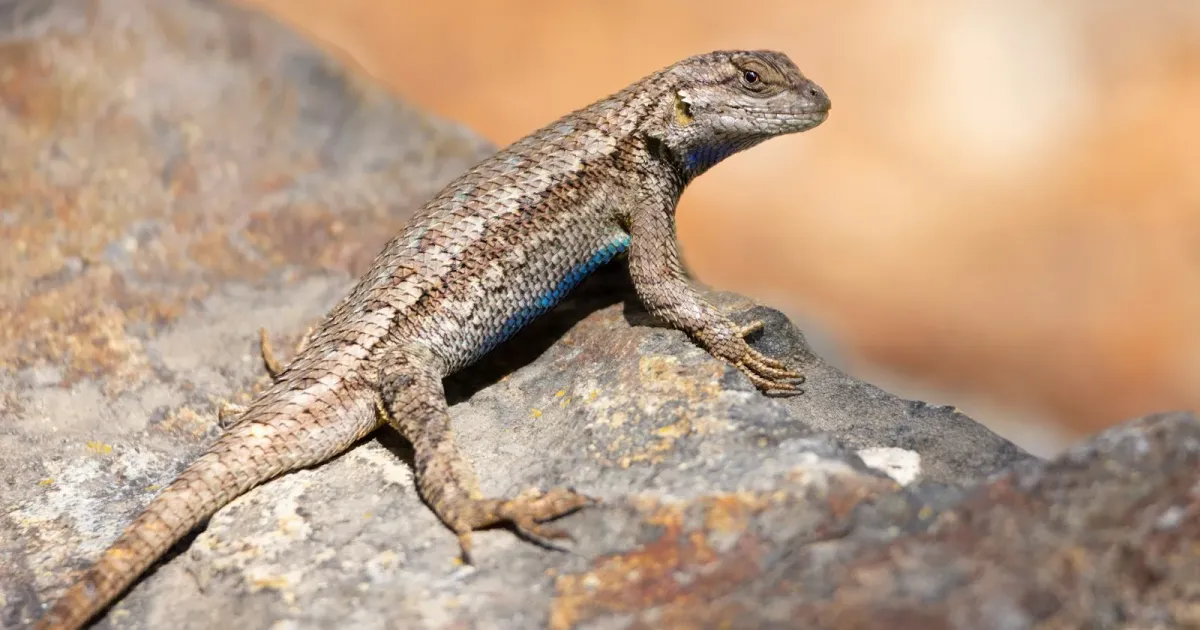
Western fence lizards are a good example. Males have bright blue patches on the belly and throat, says the Washington Department of Fish and Wildlife. Females have paler patches or none. That's where the nickname "blue belly" comes from. When a male rises up on a fence post, the blue flashes at anyone watching.
Anoles and the dewlap
Anoles add a second signal to their push-ups: the dewlap, a fan of colorful throat skin they can extend and fold away at will. Many anole species flash it when courting or facing off with a competitor.
Researchers who've filmed anoles in detail say their displays don't sort neatly into "threat" and "courtship." Tom Jenssen's work on the green anole, summarized on his Virginia Tech pages, describes three head-bob patterns, labeled A, B and C. All three show up in territorial encounters, in courtship and in dominance contests, just in different proportions. Both sexes perform them with the same precision. Whether the dewlap comes out depends on context.
Do different lizards do different push-ups?
Yes. Each species tends to have its own display rhythm, a bit like a signature. Anole Annals, a blog run by anole researchers, notes that classic work by Charles Carpenter and Tom Jenssen found head-bob patterns seemed specific to each species. In the 1990s, Joe Macedonia used video playback experiments to show that anoles can tell displays of their own species from those of others.
More recently, researcher Claire Nelson used a machine-learning method on displays from eight Puerto Rican anole species. It sorted most lizards into the right species from just a few displays. The clues varied, too: head-bob duration mattered for one species, dewlap timing for another.
The story isn't settled for every group. Jose Ramos and Richard Peters of La Trobe University studied a group of Australian dragon lizards in 2021. Their display differences tracked each species' habitat more than any need to tell species apart. So display style seems to depend on where a lizard lives, as well as on who's watching.
Why do lizards do push-ups at predators?
Some lizards do push-ups at predators to show they're too fit to be worth chasing. Biologists call this a pursuit-deterrent signal.
The best evidence comes from Puerto Rico. In a 1997 study in Animal Behavior, Manuel Leal and J. A. Rodríguez-Robles exposed crested anoles (Anolis cristatellus) to model snakes. The lizards did significantly more push-ups when the snake was there. They also flashed their dewlaps and faced the snake side-on, and the researchers concluded these displays work to deter predators.
Leal then tested whether the push-ups were honest. In a 1999 study, he showed 21 adult males a stuffed Puerto Rican racer, a local snake, and then measured how long each lizard could run on a circular track. Lizards that did more push-ups at the snake had more stamina. In other words, the display carried real information about how hard the lizard would be to catch.
This may explain why a lizard sometimes bobs at you. Nobody has studied lizards' displays to people the way they've studied snakes, but a large animal staring at a lizard may get treated as a possible threat.
Do lizards do push-ups to get attention?
Sometimes, yes. Some anoles use push-ups as an "alert" to make sure others are watching before the main display.
Terry Ord, then at Harvard's Museum of Comparative Zoology, and Judith Stamps studied 38 male yellow-chinned anoles in Puerto Rico's Luquillo Mountains. Their 2008 study in PNAS, reported by NBC News, found the lizards started with a quick four-legged push-up before their territorial display. They did this mostly when light was low, when wind-blown plants made the scene visually busy, or when the other lizard was far away. Ord compared it to tapping a glass at dinner before a speech.
Why do lizards do push-ups in the sun?
Lizards often do push-ups in the sun because that's where they spend their active time, and warmth gives a cold-blooded animal the energy to display. Most push-ups seen in the sun are still social signals.
There's a second idea, and it's worth treating carefully. The Arizona Game and Fish Department suggests a lizard doing push-ups may sometimes be lifting its body off a hot surface to cool down. Lizards are ectotherms, meaning their body temperature depends on their surroundings. Raising the belly away from scorching rock could help, but the research on push-ups points mostly to communication.
Why do bearded dragons bob their heads and wave?
Pet bearded dragons bob their heads and wave their arms to signal rank, and the meaning depends on speed and sex. The Australian Museum describes these displays in wild central bearded dragons:
A fast head bob with a puffed-out, blackened beard is a male showing dominance.
A slow bow is often an adult female signaling submission to a male.
Arm waving by a male signals submission to a more dominant male.
Arm waving by a female, usually with slow head bobs, shows she's receptive to a male.
In the wild, the Australian Museum notes, dragons form a pecking order when several gather at a good basking spot or food source. A pet dragon housed with others, or one that can see another dragon, may run through the same displays.
When to see a vet
Take a pet lizard to a reptile vet if its movements look weak or shaky rather than deliberate. VCA Animal Hospitals lists these warning signs in bearded dragons, many of which point to metabolic bone disease:
Trembling legs when it tries to walk
Muscle twitching or seizures
A swollen or soft lower jaw
Being too weak to push up into a normal standing posture
Loss of appetite or severe sluggishness
VCA advises that any change from normal behavior should be checked by a vet promptly.
Frequently asked questions
What does it mean when a lizard does push-ups at you?
A lizard doing push-ups at you is most likely displaying at a possible threat. Studies of Puerto Rican anoles show lizards do more push-ups when a predator appears, and a person can get similar treatment.
Why do lizards bob their heads?
Lizards bob their heads to communicate with other lizards, usually about territory, dominance or mating. Each species tends to have its own bob rhythm, and experiments with anoles suggest lizards can tell their own species' displays from others.
Do female lizards do push-ups?
Female lizards do push-ups too, though males display more often and more dramatically. In green anoles, females perform the same three head-bob patterns as males.
Why do lizards do push-ups in the sun?
Lizards do push-ups in the sun mostly because sunny spots are where they're active and warm enough to display. Arizona Game and Fish also suggests a lizard may lift its body off a hot surface to cool down.
Is a lizard doing push-ups being aggressive?
A lizard doing push-ups may be warning a rival, but the same display can also be courtship or a general "look at me." Researchers who study green anoles caution against labeling any single bob pattern as only a threat.
Why is my bearded dragon waving its arm?
A bearded dragon waving its arm is usually signaling submission or acknowledgment to another dragon. Females also wave, often with slow head bobs, to show they're receptive to a male.
Lizards aren't the only animals that announce their territory. See why roosters crow and why dogs howl, meet some much larger reptiles in alligator vs crocodile, or browse more reptile and amphibian articles.
Sources
Wild Kids: Lizard Aerobics, Arizona Game and Fish Department
Why lizards in Arizona do push-ups, Arizona Republic via Arizona Daily Star
Western fence lizard, Washington Department of Fish and Wildlife
Signalling displays during predator-prey interactions in a Puerto Rican anole, Anolis cristatellus, Leal and Rodríguez-Robles, Animal Behavior (1997)
Honest signalling during prey-predator interactions in the lizard Anolis cristatellus, Leal, Animal Behavior (1999)
Display Patterns of Male and Female Anolis carolinensis, Virginia Tech
Head-bob displays, Anole Annals
Territorial Displays of the Ctenophorus decresii Complex: A Story of Local Adaptations, Ramos and Peters, Frontiers in Ecology and Evolution (2021)
Central Bearded Dragon, Australian Museum
Bearded Dragons: Diseases, VCA Animal Hospitals


Comments