
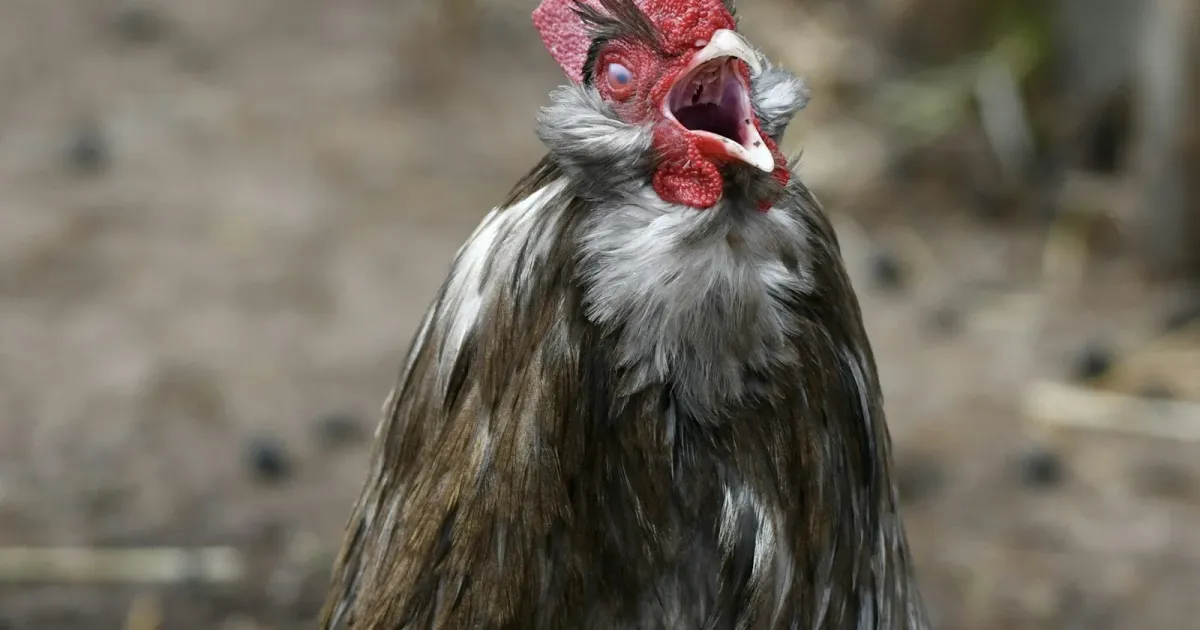
Why do roosters crow? Most people assume the sunrise sets them off. That turns out to be only part of the story, and anyone who has lived near a rooster knows they don't stop once the sun is up.
Researchers in Japan have spent years taking the "cock-a-doodle-doo" apart. Their experiments show that roosters keep time with an internal body clock, wait their turn according to the pecking order, and react to the world around them. Crowing is a loud way of telling other chickens "I'm here, and this is mine."
Quick facts
Roosters kept in constant dim light still crowed in the predawn hours, Nagoya University researchers Tsuyoshi Shimmura and Takashi Yoshimura reported in Current Biology in March 2013 (Phys.org).
On a 12-hour light, 12-hour dim cycle, the roosters began crowing about 2 hours before the lights came on (The Naked Scientists).
In a 2015 Scientific Reports study, the top-ranking rooster in groups of four almost always crowed first at dawn (Science News).
Crowing is driven by androgens, the male sex hormones (ABC Science).
University of Antwerp and Ghent researchers measured crows of more than 140 decibels at the entrance to a rooster's ear canal (Phys.org).
Why do roosters crow? The main reasons
Roosters crow to signal territory, dominance and safety to other chickens. The University of Maryland Extension says roosters crow to show dominance and to signal that the flock is safe (UMD Extension).
Crowing is one of several rooster calls. The same factsheet lists alarm calls when a predator is near, "tidbitting" calls that point hens to food, and soft purring sounds aimed at hens. The crow is the long-distance one, the call other roosters are meant to hear.
Crowing is driven by male hormones. The University of Minnesota Extension puts it plainly: mature roosters crow, while hens cluck.
Why do roosters crow in the morning?
Roosters crow in the morning because an internal circadian clock tells them dawn is coming. A circadian clock is the body's built-in timer that runs on a roughly 24-hour cycle, the same system that makes you sleepy at night.
Before 2013, nobody had tested whether roosters crow at dawn because of their own clock or because they see the first light. Shimmura and Yoshimura at Nagoya University set out to separate the two (Nagoya University ITbM).
First they kept roosters on 12 hours of light and 12 hours of dim light. The birds started crowing about 2 hours before the lights switched on. That alone suggested anticipation, since there was no light yet to react to.
Then the team kept the birds in constant dim light, with no day or night at all. The roosters still did most of their crowing in the period that matched predawn. Under those conditions their schedule drifted, and they crowed a little earlier each day (The Naked Scientists). That drift is a classic sign of an internal clock running on its own without a sunrise to reset it.
The study also tested outside triggers. The researchers played recorded crows and flashed lights at different times of day. These triggers set the roosters off mostly in the morning, far less later in the day, and not at night. So the clock controls both when roosters crow on their own and how ready they are to answer a trigger.
Which rooster crows first?
The highest-ranking rooster crows first. Shimmura, Yoshimura and colleagues showed this in a paper titled "The highest-ranking rooster has priority to announce the break of dawn," published in Scientific Reports on July 23, 2015.
The team let groups of four roosters sort out a pecking order, then recorded who crowed at dawn. The top bird almost always started the morning chorus, and the others followed in order of rank (EurekAlert). When the researchers removed the top rooster, the second-ranked bird took over the first crow.
Lower-ranked roosters can crow just fine. When the team stimulated them with light and sound, subordinates crowed as often as the boss (Asian Scientist). They hold back on their own. Shimmura told Science News that subordinate roosters compromise their circadian clock for social reasons.
Not everyone is sure the result carries over to farms. Bart Kempenaers of the Max Planck Institute pointed out that the birds were in cages, and subordinates in open spaces might crow more freely.
Why do roosters crow all day?
Roosters crow all day because crowing is a general signal, and lots of things can prompt it. Dawn is just the time they start.
The Old Farmer's Almanac notes that roosters crow in the morning, afternoon and evening. The Almanac lists several jobs for the crow: signaling that all is safe, showing dominance, warning of danger and marking territory. The Nagoya team listed car headlights and other roosters' calls among the triggers that can set a rooster off (CSMonitor).
Rooster crowing is also very loud. The 2018 study in Zoology by researchers from the University of Antwerp and Ghent University found that roosters protect their own hearing. When a rooster opens its beak to crow, its ear canal closes, and soft tissue covers about half of each eardrum (Phys.org). Hens don't have that full closure.
Why do roosters crow at night?
Roosters crow at night mostly when something startles them, such as a light, a noise or movement. Chickens normally make very few sounds at night, according to the University of Minnesota Extension.
Light is a common trigger, whether from a security light or passing car headlights. Movement outside the coop can do it too, and that movement may be a predator (Cackle Hatchery). If your rooster crows at odd hours, check what he can see and hear from his roost.
If you like farm animal questions, read why horses need shoes next.
Can you stop a rooster from crowing?
You can't stop a healthy rooster from crowing completely, but you can reduce how much and how early he crows. Cackle Hatchery, a poultry hatchery, says no method is 100 percent foolproof.
Chickens have no vocal cords like ours. They make sound with an organ called the syrinx, at the base of the windpipe. That is one reason surgical "de-crowing" is risky and rarely works. Practical steps that help:
Block coop windows so dawn light and passing headlights don't reach the roost.
Let the flock out after sunrise, when most of the morning crowing has passed.
Insulate the coop and plant shrubs around it to muffle sound.
Try a no-crow collar, which limits how far the neck can stretch, though not every rooster tolerates one.
Roosters aren't needed for hens to lay eggs, so many towns ban them because of the noise. Check your local rules before you buy a rooster.
Do hens crow?
Hens don't usually crow, but some do. The University of Minnesota Extension notes that hens with reproductive failures can take on male behaviors such as crowing.
A hen normally has only one working ovary, on the left. In rare cases where the left ovary is damaged, the right gonad can develop instead (Poultry Extension). Problems with that ovary are the kind of reproductive failure the Minnesota extension links to crowing hens.
For more animal behavior explained, see why dogs howl, why flamingos stand on one leg, and the rest of our farm animals category.
Frequently asked questions
Why do roosters crow?
Roosters crow to announce their territory and their place in the flock's pecking order. An internal circadian clock makes roosters start crowing before dawn. Roosters also crow during the day in response to lights, sounds, other roosters and threats.
Why do roosters crow in the morning?
Roosters crow in the morning because their circadian clock anticipates dawn. A 2013 Nagoya University study found that roosters kept in constant dim light still crowed in the predawn period. Roosters on a light schedule began crowing about 2 hours before the lights turned on.
Do roosters crow all day?
Yes, roosters crow all day, not only at sunrise. Rooster crowing peaks in the early morning, but other roosters, lights, sounds and threats can set a rooster off at any time. Dawn is when the crowing starts.
Why do roosters crow at night?
Roosters usually crow at night because a light, a noise or movement startled them. Chickens normally make very few sounds at night, so night crowing often points to security lights, headlights or a predator near the coop.
Do hens crow?
Hens don't normally crow, but a hen with a reproductive problem can start crowing and acting like a rooster. If a hen begins crowing and stops laying, a poultry vet should check her.
Can you stop a rooster from crowing?
No method stops a rooster from crowing completely. Blocking light from the coop, letting the flock out after sunrise and soundproofing the coop can reduce rooster crowing. No-crow collars limit neck stretching, but not every rooster tolerates one.
Sources
How a rooster knows to crow at dawn, Nagoya University ITbM
Putting the clock in "cock-a-doodle-doo", Phys.org
Clock-a-doodle-doo, The Naked Scientists
Roosters "cock-a-doodle-doo" by the clock, ABC Science
Rooster's crows driven by internal clock, say scientists, Christian Science Monitor
Bossy cock takes the lead vocal of cock-a-doodle-do, EurekAlert
Social pecking order gives roosters something to crow about, Science News
Pecking order determines which rooster crows first, Asian Scientist
Why roosters don't go deaf from their own loud crowing, Phys.org
Relationships between chicken vocalizations and health, behavior, and welfare, University of Maryland Extension
Common concerns with backyard or urban poultry keeping, University of Minnesota Extension
Avian reproductive system, Poultry Extension
Can you stop a rooster from crowing?, Cackle Hatchery
Why do roosters crow? 10 riveting facts about roosters, The Old Farmer's Almanac


Comments