
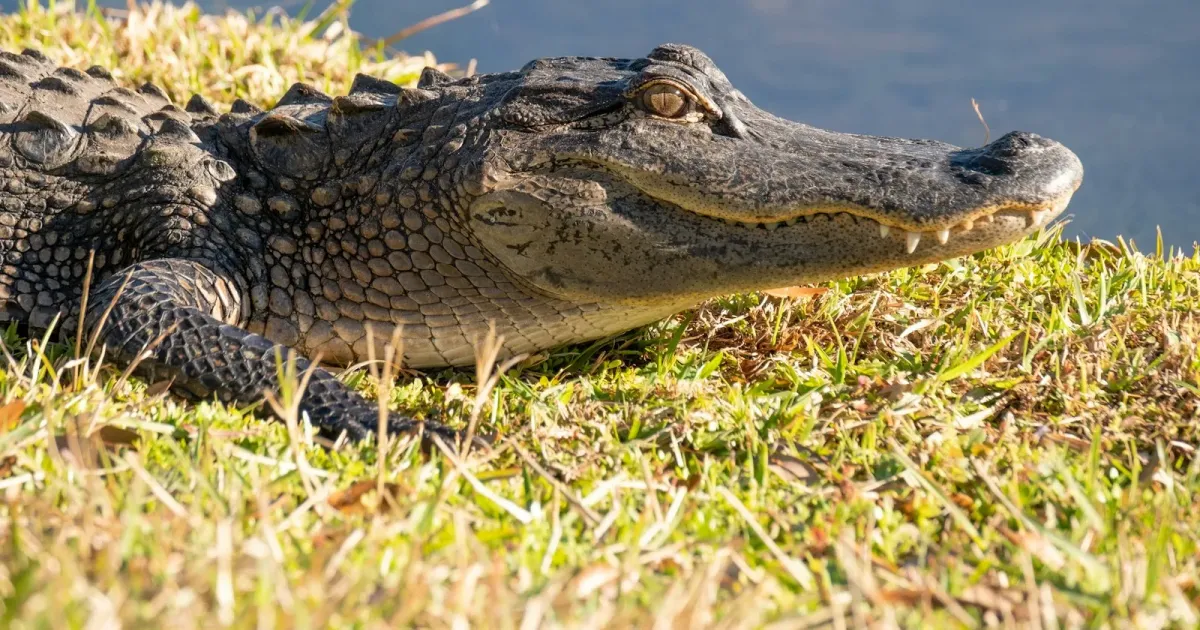
The alligator vs crocodile question trips people up because the two look so alike at a glance. Both are large, armored reptiles that lie in the water with only their eyes and nostrils showing. Once you know where to look, though, the difference between an alligator and a crocodile is easy to spot.
Below are the six clues that work, checked against wildlife agencies, zoos and national parks. We also cover size, temperament, and where caimans fit in.
Quick facts
There are 23 species of crocodilians in three families: alligators and caimans, crocodiles, and gharials (San Diego Zoo Wildlife Alliance).
Only two species are called alligators, the American and the Chinese, while there are 18 crocodile species (Discover Wildlife).
South Florida is the only place where American alligators and American crocodiles live side by side (National Park Service).
Florida's crocodiles have recovered from a few hundred animals to as many as 2,000 adults (Florida Fish and Wildlife Conservation Commission).
Florida's longest recorded alligator measured 14 feet 3.5 inches (FWC).
What's the difference between an alligator and a crocodile?
The main difference between an alligator and a crocodile is the head. Alligators have a wide, rounded snout and hide their lower teeth. Crocodiles have a pointed snout and an interlocking, toothy grin. Color, salt glands and tiny sense organs in the skin back this up. No single clue is perfect, so check two or three together.
Snout shape
This is the first thing to look at. According to the San Diego Zoo Wildlife Alliance, alligators have wide, rounded, U-shaped snouts, and crocodiles have longer, more pointed, V-shaped ones. The National Park Service (NPS) describes the American crocodile's snout as narrow and triangular.
The NPS alligator profile adds a caveat. Alligator snouts are broad, but the shape varies a little between populations and individuals.
Teeth you can see
In an alligator, the upper jaw is wider than the lower one. PBS Nature explains that the lower teeth fit into sockets in the upper jaw, so most of them disappear when the mouth closes. The Florida Fish and Wildlife Conservation Commission (FWC) puts it plainly: no lower teeth show when the jaw is closed.
A crocodile's upper and lower jaws are about the same width, so the teeth interlock and stay on display. The clearest marker is the fourth tooth on each side of the lower jaw. The NPS says it stays visible when the mouth is shut.
Color
Alligators are generally darker. FWC describes adults as mostly dark gray with a lighter underside. The NPS says alligators can be olive, brown, gray or nearly black. Algae in the water can make them look greener, and tannic acid from overhanging trees can darken them.
The American crocodile is lighter, with a grayish-green back and tail and a white to yellowish belly, per the NPS. Lighting and water change how both look, so treat color as a supporting clue.
Salt glands
You can't see this difference, but it explains a lot about where each animal lives. Crocodiles can get rid of extra salt through glands on the tongue, says Discover Wildlife. The NPS confirms that alligators lack these salt-secreting glands. Alligators can handle some salt for short periods, but they're built for fresh water.
Sensory pits
Look closely at the scales and you may spot small dark dots. These are pressure-sensitive organs that help crocodilians feel movement in the water. Discover Wildlife notes they cover a crocodile's whole body but are limited to the area around the mouth in alligators. Please don't get close enough to check.
Where do alligators and crocodiles live?
Alligators mostly live in fresh water in the southeastern US and China, while crocodiles live in coastal and salty water across the tropics. The American alligator ranges from southeast Oklahoma and east Texas to North Carolina and Florida, per FWC. It lives in lakes, slow rivers and wetlands, and sometimes turns up in brackish water.
Crocodiles live in Africa, Asia, Australia and parts of the Americas, depending on the species, as PBS Nature outlines. In Florida, American crocodiles live in brackish and saltwater coastal areas, usually mangrove swamps, according to FWC. They occasionally travel inland through the canal system.
South Florida is the only place where the two coexist, and Everglades National Park has both. The Florida crocodile population has grown enough that its status changed from endangered to threatened.
Crocodile vs alligator size: which is bigger?
The biggest crocodiles are larger than any alligator, though it depends which species you compare. Here's how the US species and the giant of the family stack up.
American alligator: Males occasionally reach 13 to 15 feet, and females top out around 10 feet, says the NPS. Florida's heaviest recorded alligator weighed 1,043 pounds, per FWC.
American crocodile: Males can reach about 20 feet but rarely exceed 14 feet in the wild, and breeding females measure about 8 to 12 feet, per the NPS.
Saltwater crocodile: This is the largest living crocodilian. National Geographic says average males reach 17 feet and 1,000 pounds, and animals 23 feet long and 2,200 pounds aren't uncommon.
So in a straight crocodile vs alligator size contest between the two American species, they overlap a lot. The saltwater crocodile of India, Southeast Asia and northern Australia is in a different league.
Which is more dangerous, an alligator or a crocodile?
Crocodiles have the worse reputation, but the risk depends heavily on the species. PBS Nature describes alligators as generally more reclusive, avoiding people when they can. Crocodiles are seen as more aggressive and territorial, especially the Nile and saltwater crocodiles.
National Geographic calls the saltwater crocodile the animal most likely to eat a human. The American crocodile is a different story. Both the NPS and FWC describe it as shy, and conflict with people is rare. If one splashes noisily into the water as you pass, FWC says that means it's frightened.
Alligator conflicts with people are also rare and generally not serious, according to the NPS. Most problems trace back to illegal feeding, which teaches alligators to lose their natural wariness of people.
Alligator vs crocodile vs caiman: where do caimans fit?
Caimans belong to the alligator family, so they're closer relatives of alligators than of crocodiles. The San Diego Zoo calls them a type of alligator. Discover Wildlife says all six caiman species live in Central and South America.
Caimans vary a lot in size. The San Diego Zoo gives a range of 5.6 to 16 feet. Cuvier's dwarf caiman is the smallest crocodilian of all, at 4 to 5.6 feet and 13 to 15 pounds. The black caiman of the Amazon River basin is the largest member of the alligator family.
The best-known species, the spectacled caiman, is named for a bony ridge between its eyes that looks like a pair of glasses, as the Smithsonian describes.
Spectacled caimans also live in South Florida, where they don't belong. The University of Florida's CrocDoc program says caiman imports for the pet trade rose after the US protected alligators from trade in the early 1950s. Escaped or released pets formed breeding groups in Miami-Dade and Broward counties. A 2026 UF review led by Sergio Balaguera-Reina found they're more widespread and adaptable than scientists had thought.
The third family, the gharials, is easier still. Gharials have very slender snouts lined with about 100 sharp teeth for catching fish, per the San Diego Zoo.
If you like animal look-alikes, try our guide to moth vs butterfly. For more reptile behavior, read why lizards do push-ups, or see why bees die after stinging. You'll find more side-by-sides in our animal comparisons.
Frequently asked questions
What's the difference between an alligator and a crocodile?
The main difference between an alligator and a crocodile is the snout and teeth. Alligators have a broad, U-shaped snout and hide their lower teeth when the mouth is closed. Crocodiles have a narrower, V-shaped snout, and the fourth lower tooth shows even with the mouth shut.
Which is bigger, a crocodile or an alligator?
The largest crocodiles are bigger than any alligator. Saltwater crocodiles can reach 23 feet, while American alligator males usually top out at 13 to 15 feet. American crocodiles and American alligators overlap in size in the wild.
Are there crocodiles in Florida?
Yes, American crocodiles live in coastal South Florida and the Keys. FWC says the population has recovered from a few hundred animals to as many as 2,000 adults, and the species is now listed as threatened instead of endangered.
Can alligators live in salt water?
Alligators can live in salt water only for short periods. They lack the salt-secreting glands crocodiles have, so they live mainly in fresh water, though FWC says they sometimes turn up in brackish water and, rarely, salt water.
Is a caiman an alligator or a crocodile?
A caiman is a member of the alligator family. The six caiman species live in Central and South America, and the nonnative spectacled caiman has also established breeding groups in South Florida.
Is a crocodile more dangerous than an alligator?
Crocodiles are generally seen as more aggressive than alligators, but it depends on the species. Saltwater and Nile crocodiles are very dangerous, while American crocodiles are shy. Alligator attacks are rare and often linked to illegal feeding.
Sources
American Crocodile, Everglades National Park, National Park Service
American Alligator, Everglades National Park, National Park Service
American Alligator, Florida Fish and Wildlife Conservation Commission
American Crocodile, Florida Fish and Wildlife Conservation Commission
Crocodilian, San Diego Zoo Wildlife Alliance
Alligator vs. Crocodile: What's the Difference?, PBS Nature
Crocodile vs alligator, Discover Wildlife
Saltwater Crocodile, National Geographic
Spectacled Caiman, Smithsonian Ocean
A Collaborative Program to Remove and Assess Populations of Nonnative Spectacled Caiman, University of Florida CrocDoc
Invasive caiman may pose new challenges for Everglades restoration, University of Florida News


Comments