
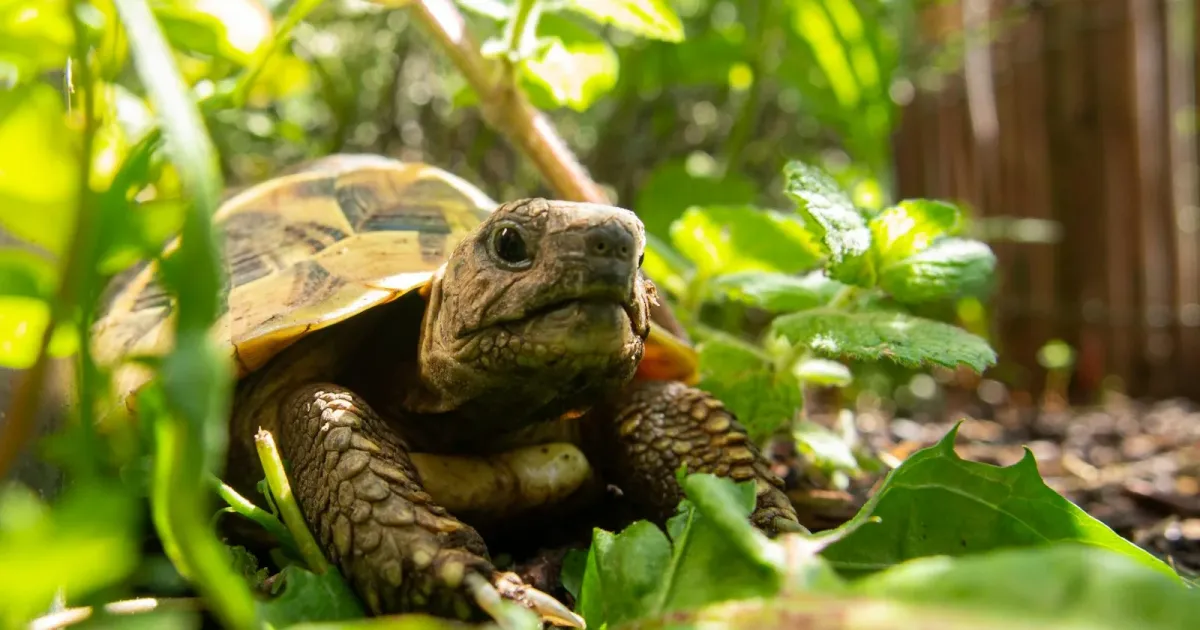
What do turtles eat? The honest answer is "it depends on the turtle." There are land turtles, pond turtles and sea turtles, and each group eats differently.
Age matters too. Many turtles start life as hungry little predators and slowly become salad eaters. A baby slider snaps up worms and bugs. A big adult slider spends more time munching greens.
Below we cover wild turtles, sea turtles and pet turtles, and explain why their menus look the way they do.
Quick facts
Most freshwater turtles are omnivores that eat both plants and animals (Royal Veterinary College).
Green sea turtles are the only mainly herbivorous sea turtles, eating seagrass and algae (NOAA Fisheries).
Plant material can make up as much as 36% of a snapping turtle's diet (Missouri Department of Conservation).
Three-toed box turtles can live 50 to 80 years, and some have lived past 100 (Missouri Department of Conservation).
Vets suggest feeding juvenile pet turtles daily and adults every two to three days (PetMD).
What do turtles eat in the wild?
Wild turtles eat whatever their habitat offers: insects, worms, snails, crayfish, fish, frogs, carrion, berries, mushrooms and water plants. The mix depends on the species and where it lives.
The common snapping turtle shows how broad a turtle's menu can be. The Missouri Department of Conservation lists insects, crayfish, fish, snails, earthworms, amphibians, snakes, small turtles, small mammals, birds and aquatic plants. Snappers also scavenge dead animals. They usually hide in mud or weeds and wait for prey to come close, or they walk along the bottom looking for food.
Snappers eat more greens than their reputation suggests. Plants can make up as much as 36% of their diet, and one large turtle in a study ate almost nothing but duckweed. Missouri also notes that snapping turtles help spread the seeds of plants such as mulberries.
How does the alligator snapping turtle catch fish?
The alligator snapping turtle fishes with its tongue. Animal Diversity Web, run by the University of Michigan, describes how it lies still on the bottom with its jaws open. Its tongue looks like a small pink worm. When a fish swims in to grab the "worm," the jaws close.
Fish are its main food. In one Louisiana study, other turtles turned up in the stomachs of nearly 80% of the alligator snappers examined. They also eat clams, snails, crayfish, frogs and snakes.
What do box turtles eat?
Box turtles eat earthworms, snails, insects, berries, mushrooms and young plant shoots. Like many turtles, they change their diet as they grow.
The Missouri Department of Conservation says young three-toed box turtles eat mostly earthworms and insects. Older ones eat a larger share of plants and fungi. Blackberries are a summer food, dogwood berries a fall one. When periodical cicadas emerge, box turtles feast on them.
So a box turtle's menu changes through the year with what's on the forest floor: worms and insects, then summer berries, then fall berries.
Why do turtles eat more plants as they get older?
Young turtles eat more animal food, and adults eat more plants. The Royal Veterinary College in London says this is the natural pattern for most freshwater turtles.
Why this happens is still an open question. One long-standing idea was that small turtles can't digest enough plant food to meet their energy needs. A 1999 study by Shannon McCauley and Karen Bjorndal in Physiological and Biochemical Zoology tested that idea on red-eared sliders. Both small and large turtles ate more of a diluted diet and kept their energy intake steady. That result suggests body size alone doesn't stop young sliders from eating plants, so the full explanation is still being worked out.
Not every species shifts the same amount. The Royal Veterinary College notes that red-eared sliders move toward vegetation as adults. Soft-shelled turtles stay mostly carnivorous their whole lives.
What do sea turtles eat?
Each sea turtle species has its own specialty, and its jaws match that food. NOAA Fisheries describes four clear examples:
Green sea turtles mostly eat seagrass and algae. They're the only sea turtles that are mainly herbivores.
Leatherbacks eat mostly jellyfish. Spiny structures lining their mouth and throat help them hold onto soft, slippery prey.
Hawksbills eat mainly sponges. Their sharp, pointed beak reaches into small holes and cracks in coral reefs.
Loggerheads are carnivores that eat bottom-dwelling animals such as whelks, horseshoe crabs and other crabs.
In each case the mouth fits the menu. A jellyfish eater gets grip, and a sponge eater gets a pointed beak for tight spaces.
What do pet turtles eat?
Pet water turtles do best on a mix of leafy greens, a measured amount of turtle pellets and some animal protein. PetMD's aquatic turtle care sheet, reviewed by veterinarian Melissa Witherell, DVM, gives these guidelines:
Juveniles under 1 year: feed every day. Protein foods such as earthworms, mealworms, krill and snails make up much of the diet. Greens and vegetables are about 25 to 30%.
Adults over 1 year: feed every two to three days. Greens and vegetables make up about 50 to 60% of the diet.
Pellets: no more than 25% of the diet at any age.
Fruit: an occasional treat, no more than 10% of the total diet.
An exotic animal care handout from Lafeber suggests dark leafy greens such as kale, romaine and chard. For protein it lists small fish, snails, insects and small frogs. The Royal Veterinary College advises offering only what a turtle can eat in 30 to 40 minutes.
A few cautions show up across these sources:
PetMD says feeder goldfish should only be an occasional treat because they are high in fat.
The Royal Veterinary College warns against frozen fish, since freezing can destroy important vitamins.
Both the Royal Veterinary College and Lafeber recommend a calcium supplement. PetMD suggests cuttlebone as an easy way to add calcium.
If you want to see how another reptile uses its body to communicate, read why lizards do push-ups.
When should you take a turtle to a vet?
See a reptile vet if your turtle stops eating or shows changes in its eyes, nose, breathing or shell.
PetMD lists these warning signs:
Swollen, sunken or closed eyes
Loss of appetite
Nasal discharge or bubbles from the nose
Difficulty breathing
Shell rot
Winter Park Veterinary Hospital notes that a lack of vitamin A can cause swollen eyelids in turtles, sometimes with ear abscesses. Lafeber lists metabolic bone disease, a weakening of bone and shell linked to poor care and diet, among common problems. PetMD recommends a vet checkup at least once a year.
Frequently asked questions
What do baby turtles eat?
Baby turtles eat mostly protein: insects, worms, snails and other small animals. The Missouri Department of Conservation says young box turtles eat mainly earthworms and insects. Pet hatchlings need food every day, according to PetMD.
Can turtles eat lettuce?
Turtles can eat dark leafy greens such as romaine, kale and chard. Lafeber's care handout lists these as good plant foods for pet water turtles. Adult sliders should get about half their diet from greens and vegetables.
Can turtles eat fruit?
Turtles can eat fruit as an occasional treat. PetMD advises keeping fruit under 10% of a pet turtle's diet. Wild box turtles eat berries such as blackberries and dogwood berries in season.
Do turtles eat fish?
Many turtles eat fish, especially snapping turtles and young pond turtles. Fish are the main food of the alligator snapping turtle. Pet turtles can have small fish, though PetMD says fatty feeder goldfish should be only an occasional treat.
How often should you feed a turtle?
A juvenile pet turtle should be fed every day, and an adult every two to three days. PetMD and the Royal Veterinary College both give this schedule. Offer only what the turtle can eat in 30 to 40 minutes.
How long can a turtle go without eating?
How long a turtle can go without food depends on species, age, size and temperature, and we didn't find a reliable single figure. A pet turtle that skips meals and also shows eye, nose or shell changes should see a vet. PetMD lists loss of appetite as a warning sign.
Turtles are one of the foods that wild foxes eat, as we explain in what do foxes eat. For a look at other big reptiles, see alligator vs crocodile. More reptile and amphibian guides live in our reptiles and amphibians section.
Sources
7 sea turtle facts for the ocean lover, NOAA Fisheries
10 tremendous turtle facts, NOAA Fisheries
North American snapping turtle, Missouri Department of Conservation
Three-toed box turtle, Missouri Department of Conservation
Macrochelys temminckii (alligator snapping turtle), Animal Diversity Web, University of Michigan
Aquatic turtle care sheet, PetMD (reviewed by Melissa Witherell, DVM)
Pet turtle feeding fact sheet, Royal Veterinary College
Care of aquatic and semi-aquatic turtles, Lafeber Company
Response to dietary dilution in an omnivorous freshwater turtle, Physiological and Biochemical Zoology (1999)
Hypovitaminosis A, Winter Park Veterinary Hospital


Comments