
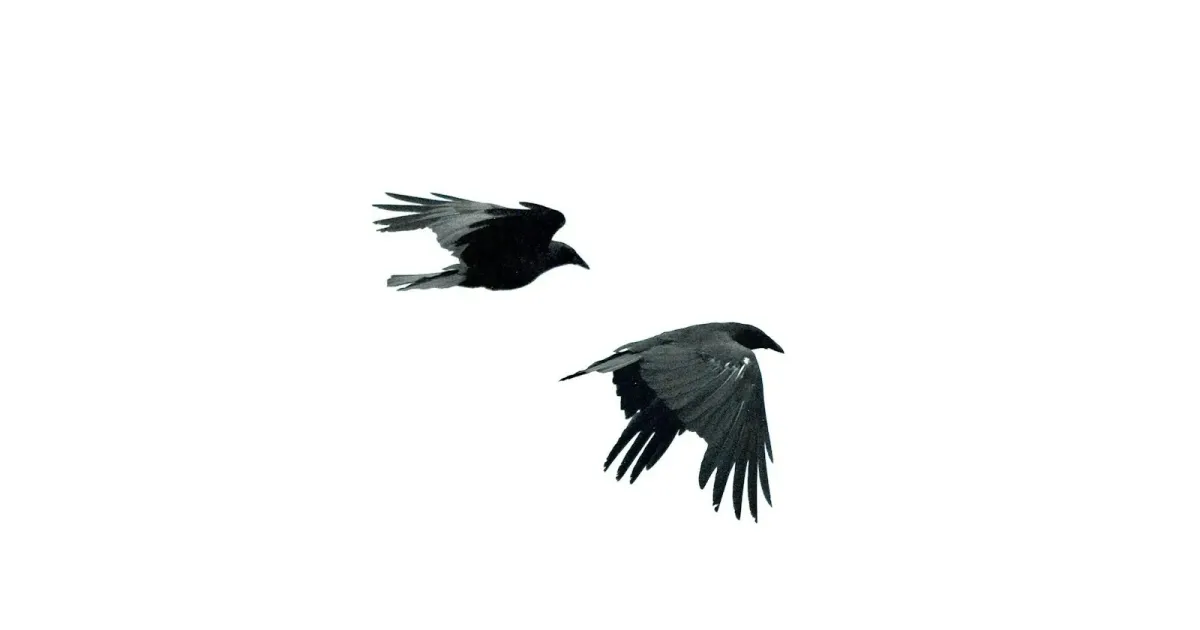
Raven vs crow is one of the most common bird identification questions in North America, and it's easy to see why. Both are big, glossy and black from beak to toe. Both are clever, noisy and happy to live near people.
The two are close relatives, but they aren't the same species, and once you know where to look the differences are clear. Below we cover size, tail shape, voice, behavior and range, plus why the two birds look so alike in the first place.
Quick facts
Common ravens weigh 689 to 1,625 grams; American crows weigh 316 to 620 grams (Cornell Lab of Ornithology).
A common raven's wingspan is about 46 inches, compared with 33.5 to 39.4 inches for an American crow (All About Birds: raven, crow).
Cornell calls the common raven the world's largest songbird (All About Birds).
Ravens and American crows split from a common ancestor about 7 million years ago (Kaeli Swift, Corvid Research).
North America has more than 30 million American crows (National Wildlife Federation).
Are ravens and crows the same bird?
No. Ravens and crows are different species, though both belong to the genus Corvus. In North America, "raven" usually means the common raven (Corvus corax) and "crow" usually means the American crow (Corvus brachyrhynchos).
The Cornell Lab of Ornithology also lists two more look-alikes in the US. Fish crows live along the East Coast and in the Southeast, while Chihuahuan ravens range across the southwestern US and Mexico.
The names don't map neatly onto family trees. Corvid researcher Kaeli Swift, who studied crows at the University of Washington, writes that American crows are more closely related to Europe's carrion crow than to the common raven. Ravens and American crows went their separate ways roughly 7 million years ago, she notes on her Corvid Research blog.
At a glance
Size: ravens weigh 689 to 1,625 grams, crows 316 to 620 grams.
Tail in flight: ravens have a wedge or diamond shape, crows a square or rounded edge.
Voice: ravens give a deep, throaty croak, crows a harsh caw.
Throat: ravens have shaggy feathers called hackles, crows have a smooth throat.
Bill: a raven's is very large and heavy, a crow's is moderate.
Flight: ravens glide and soar often, crows flap steadily.
Company: ravens are usually alone or in pairs, crows often in family groups or flocks.
Why do ravens and crows look so alike?
Ravens and crows look alike because they're close cousins in the same genus, built on the same basic body plan. Both are large, thick-necked birds with strong, straight bills. Cornell describes both as entirely black, right down to the legs, eyes and beak.
They also live similar lives. Both are omnivores that eat carrion, eggs, insects, plants and human garbage, according to Cornell's life history pages for the raven and the crow. Both are songbirds, too. That surprises people who know them by their rough calls, though Cornell says plainly that the raven is the world's largest songbird.
Their differences track their habits. Swift writes that the raven's larger, more powerful bill suits a diet heavy in carrion. The raven's longer, narrower wings fit a bird that spends a lot of time soaring over open country.
Raven vs crow: which is bigger?
A raven is much bigger than a crow. Cornell says the raven is "about half again larger" than an American crow, and Swift puts it at about twice a crow's mass.
The numbers show the gap clearly:
Common raven: 22.1 to 27.2 inches long, wingspan about 46 inches, 689 to 1,625 grams.
American crow: 15.8 to 20.9 inches long, wingspan 33.5 to 39.4 inches, 316 to 620 grams.
Size alone can fool you when a bird is on its own, with nothing nearby to compare it against. Cornell notes that western crows run slightly smaller than eastern ones. That's why birders lean on shape, sound and flight style as well.
How can you tell a raven from a crow?
Watch the tail, listen to the call and notice how the bird flies.
In flight
Look at the tail. A flying raven shows a long, wedge-shaped or diamond-shaped tail, while a crow's tail looks square or slightly rounded at the end.
Wing shape and flight style help too. According to Cornell, crows fly with a patient, steady flapping that's rarely broken by glides, a bit like rowing. Ravens have longer, narrower wings and glide or soar much more often.
Swift adds a detail for sharp-eyed watchers. In flight, a raven usually seems to show four long "finger" feathers at each wingtip, while a crow shows five. The raven's wingtip feathers are also more slender and pointed.
By sound
A crow says "caw." A raven gives a deep, throaty croak. Cornell describes the American crow's call as a strong, harsh caw, and the common raven's as a deep croak.
Sound is often the fastest way to tell them apart, especially when you can't see the bird well. Both species make plenty of other noises, though. Swift notes that ravens and crows both produce rattles, clicks and imitations, so go by the main call. The fish crow adds another twist with a weaker, more nasal caw, often in two notes.
Crows aren't the only birds known for their calls. Our piece on why roosters crow explains a very different kind of morning racket.
How do ravens and crows behave differently?
Crows are the more social of the two. Cornell says American crows live in year-round family groups made up of a breeding pair and their young from the past two years. Those older offspring help raise new chicks. In winter, crows gather in roosts that can reach hundreds of thousands of birds.
Ravens are less sociable. Cornell says they're usually seen alone or in pairs. Raven pairs bond for life and usually start breeding between ages 2 and 4.
The two species don't always get along. Where their ranges overlap, Swift writes, crows are usually the aggressors and will mob ravens. Ravens sometimes raid crow nests.
Their homes differ as well. Ravens live across the Northern Hemisphere in forests, deserts, mountains and tundra, according to Cornell. Crows prefer open places with scattered trees, like farmland, parks and towns, and avoid unbroken forest and desert.
Which is smarter, a raven or a crow?
Both are famously smart, and the best-known studies test different skills, so there's no simple ranking. Each species has its own famous experiment.
For ravens, a 2017 study in Science by Can Kabadayi and Mathias Osvath of Lund University tested planning. Ravens chose tools or tokens to use later, after delays of 15 minutes to 17 hours. They performed on par with great apes in the tool tasks and planned for bartering more accurately than apes.
For crows, University of Washington biologist John Marzluff ran a study on face recognition. His team trapped and banded seven crows on campus while wearing a caveman mask. For over a decade afterward, campus crows scolded and dive-bombed anyone wearing that mask, as the National Wildlife Federation reports. Most of those crows weren't born at the time of the trapping, so the birds appear to have passed the warning on.
Other animals have clever tricks of their own. For another side-by-side of two animals people mix up, see our alligator vs crocodile guide or moth vs butterfly.
Frequently asked questions
Is a raven just a big crow?
A raven is not just a big crow. The common raven and the American crow are separate species in the genus Corvus, and corvid researcher Kaeli Swift notes they split about 7 million years ago.
Are ravens bigger than crows?
Ravens are bigger than crows. A common raven weighs 689 to 1,625 grams, while an American crow weighs 316 to 620 grams, according to the Cornell Lab of Ornithology.
How do you tell a crow from a raven by sound?
A crow makes a harsh "caw," while a raven makes a deep, throaty croak. Both birds also make rattles, clicks and other sounds, so the main call is the best guide.
Do crows and ravens get along?
Crows and ravens often don't get along. Where the two species overlap, crows usually mob ravens, and ravens sometimes raid crow nests, according to corvid researcher Kaeli Swift.
Are ravens rare?
Ravens are not rare, though they usually travel alone or in pairs while crows gather in groups. Cornell rates both species as low conservation concern and says raven numbers have increased across North America since 1966.
Can ravens and crows live in the same area?
Ravens and crows can share an area, and many places in North America have both. Cornell maps American crows across most of the continent and common ravens in the West and Northeast, where the ranges overlap.
Find more side-by-side guides in our animal comparisons category.
Sources
How to Tell Crows and Ravens Apart by Sight and Sound, Cornell Lab of Ornithology
Common Raven Identification, All About Birds, Cornell Lab of Ornithology
American Crow Identification, All About Birds, Cornell Lab of Ornithology
Common Raven Life History, All About Birds, Cornell Lab of Ornithology
American Crow Life History, All About Birds, Cornell Lab of Ornithology
The definitive guide for distinguishing American crows and common ravens, Corvid Research (Kaeli Swift)
Ravens parallel great apes in their planning abilities, Lund University
Bird Brainy, National Wildlife Federation




Comments