
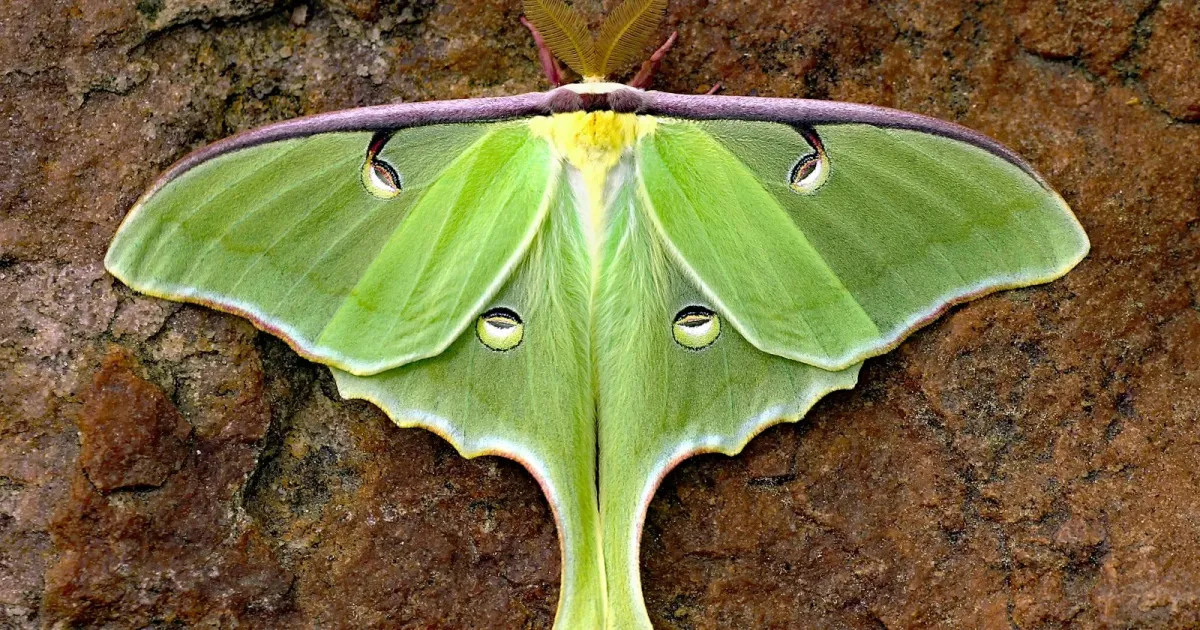
A small, pale insect lands on your porch light and you wonder whether it's a moth or a butterfly. Usually the answer takes about five seconds, once you know where to look.
Both belong to the insect order Lepidoptera. Their wings and bodies are covered in tiny scales, which the Library of Congress notes are modified hairs. But the moth vs butterfly split isn't an equal one. Moths vastly outnumber butterflies, and DNA studies now show that butterflies are a branch of the moth family tree.
Below are the six differences that work in the field, plus the exceptions that trip people up.
Quick facts
Scientists have described about 160,000 species of butterflies and moths, according to a 2019 PNAS study led by Akito Kawahara.
Only about 18,000 of roughly 165,000 Lepidoptera species are butterflies, says the UK charity Butterfly Conservation.
Britain has about 60 butterfly species but more than 2,500 recorded moth species (Butterfly Conservation).
The 2019 study, based on 2,098 genes from 186 species, found butterflies are day-flying moths that arose about 98 million years ago.
An estimated 75 to 85% of Lepidoptera species are active at night, per a 2017 Florida Museum study.
Moth vs butterfly: the key differences
The most reliable difference between moth and butterfly is the shape of the antennae, followed by resting posture and the wing-coupling frenulum. No single trait works for every species, so check two or three together.
Antennae: clubbed or feathery?
Butterfly antennae are long, thin shafts with a bulb at the end. The Library of Congress describes them as club-shaped, and moth antennae as feathery or saw-edged. The Australian Museum adds that many moths have simple thread-like antennae that taper to a point.
Feathery antennae have a lot of surface area. The Florida Museum's educator guide says that extra area helps moths pick up scents.
Skippers, a group of butterflies, often have a small hook at the tip of the club. One well-known exception runs the other way: sun moths (family Castniidae) have clubbed antennae.
Resting wing posture
Butterflies usually fold their wings straight up over their backs when they rest. Most moths hold their wings flat, or in a tent shape that hides the abdomen.
Watch for exceptions. Butterfly Conservation points out that geometrid moths such as the thorns hold their wings upright or at an angle. The Australian Museum notes that some blues and skippers (butterflies) rest with wings flat.
The frenulum
Most moths have a frenulum, a bristle or set of bristles on the hind wing that hooks onto the forewing so the two wings beat as one. Butterflies don't have one. This is the most technical difference, and you usually need a hand lens or a specimen to see it.
There's one famous exception. The Australian Museum says Australia's regent skipper is the only skipper in the world with a frenulum.
Day or night?
Most butterflies fly by day and most moths fly at night, but plenty of moths break the rule. The 2017 Florida Museum study found that 15 to 25% of Lepidoptera are active in daylight. Day-flying moths include some silk moths, tiger moths and borer moths, and some of them mimic bees or wasps.
Butterflies have their own night owls. The hedylids, a small family sometimes called moth-butterflies, fly at night. They were long filed as moths because of their dull colors and hearing organs. A 2014 Florida Museum study moved them into the butterflies (Florida Museum).
Butterfly Conservation also notes that the UK has more day-active moth species than butterfly species. So a bright insect in the sun can still be a moth.
Body shape and color
Moths tend to look stockier and fuzzier. The Florida Museum guide says moths have a thicker coat of scales than butterflies, which gives them a furry look. Butterflies tend to have slimmer bodies.
Color is a weaker clue. Butterflies are often brighter, which fits a life spent in daylight, while many moths wear browns and grays that hide them on bark by day. Still, the Library of Congress points to colorful day-flyers such as Urania leilus that look every bit like butterflies.
Size
Size overlaps almost completely. The Library of Congress lists the Queen Alexandra's birdwing butterfly at about 11 inches across and atlas moths at up to 12 inches. At the small end, the western pygmy blue butterfly is about half an inch, and pygmy moths can be as small as 3/32 of an inch.
Quick comparison
Antennae: butterflies have clubbed tips; most moths have feathery, saw-edged or thread-like antennae.
Resting wings: butterflies fold them upright; most moths hold them flat or tent-shaped.
Frenulum: most moths have this wing-coupling bristle; butterflies lack it.
Activity: butterflies mostly fly by day; about 75 to 85% of all Lepidoptera are nocturnal.
Body: butterflies are usually slender; moths are often stouter and furrier.
Pupa: butterflies form a chrysalis; many moths spin a silk cocoon.
Numbers: moths make up the vast majority of the roughly 160,000 described species.
Butterfly chrysalis vs moth cocoon
A butterfly chrysalis is the bare, hard-skinned pupa. A moth cocoon is a silk case the caterpillar spins around itself before it pupates. The Library of Congress describes the chrysalis as hard and smooth with no silk covering.
The pupa is the stage where the caterpillar rebuilds itself into an adult.
This rule has exceptions in both directions. The Australian Museum says many moths don't spin cocoons at all, and many butterflies make some kind of silk shelter for the pupa.
Moth caterpillar vs butterfly caterpillar
There's no general rule for telling a moth caterpillar from a butterfly caterpillar. The Butterfly House site in Australia explains that caterpillars differ by family. Butterflies make up only about half a dozen of Australia's roughly 100 Lepidoptera families, and their caterpillars vary from one another as much as moth caterpillars do.
In practice, people identify caterpillars by matching them to a species or family, often with a regional field guide. Hairiness, color and size won't sort them into moth or butterfly on their own.
White butterfly vs moth: how to tell
A small white insect fluttering over a vegetable garden in daytime is very often the cabbage white butterfly. Purdue University Extension describes it as a medium-sized white butterfly with black spots and a black band at the tip of the forewing. It flies during the day.
To be sure, use the same checks as for any other species:
Look for a club on the end of each antenna.
Watch how it lands. A cabbage white closes its wings upright over its back.
Note the time. A white insect drawn to a porch light after dark is far more likely to be a moth.
Are butterflies a type of moth?
Yes, in evolutionary terms butterflies are a specialized group of moths. The 2019 PNAS study by Kawahara and colleagues compared 2,098 genes across 186 species. It concluded that butterflies are diurnal (day-active) moths, nested inside the moth family tree.
The same study dates the Lepidoptera group to about 300 million years ago, in the Late Carboniferous period. Butterflies came much later, around 98 million years ago in the Late Cretaceous. A 2014 Florida Museum study had already found that butterflies are more closely related to small moths than to large ones.
In everyday use, "moth" covers every member of Lepidoptera outside the butterflies. That explains why so many exceptions turn up in the rules above.
Night-flying moths share the dark with hungry bats. Read why bats hang upside down to meet them, or compare more lookalikes in alligator vs crocodile. For more insects, see why bees die after stinging and why flies rub their hands, or browse our animal comparisons.
Frequently asked questions
What is the main difference between a moth and a butterfly?
The main difference between a moth and a butterfly is the antennae. Butterflies have thin antennae with a club at the tip, while most moths have feathery, saw-edged or thread-like antennae without a club.
Is a butterfly chrysalis the same as a moth cocoon?
A butterfly chrysalis is not the same as a moth cocoon. A chrysalis is the bare, hard pupa of a butterfly, while a cocoon is a silk case that many moth caterpillars spin around themselves before pupating.
Do moths fly during the day?
Yes, many moths fly during the day. A 2017 Florida Museum study estimated that 15 to 25% of butterflies and moths are active in daylight, including some silk moths, tiger moths and borer moths.
How can you tell a moth caterpillar from a butterfly caterpillar?
There is no general rule for telling a moth caterpillar from a butterfly caterpillar. Caterpillars differ by family, so identifying one means matching it to a species or family in a field guide.
Are butterflies moths?
In evolutionary terms, butterflies are a group of day-flying moths. A 2019 PNAS study of 2,098 genes found that butterflies sit inside the moth family tree and arose about 98 million years ago.
Are there more moths or butterflies?
There are far more moths than butterflies. Butterfly Conservation estimates about 18,000 butterfly species out of roughly 165,000 Lepidoptera, and Britain alone has about 60 butterflies but over 2,500 moths.
Sources
Phylogenomics reveals the evolutionary timing and pattern of butterflies and moths, PNAS (Kawahara et al., 2019)
How can you tell the difference between a butterfly and a moth?, Library of Congress
What is the difference between butterflies and moths?, Butterfly Conservation
What are the differences between butterflies and moths?, Australian Museum
Night-flyers or day-trippers? Study sheds light on when moths, butterflies are active, Florida Museum of Natural History
DNA tells story of butterfly evolution, Florida Museum of Natural History
Butterflies and Moths educator guide, Florida Museum of Natural History
Moth versus Butterfly Caterpillars, Butterfly House
Insect Spotlight: Cabbage White Butterfly, Purdue University Vegetable Crops Hotline

Comments