
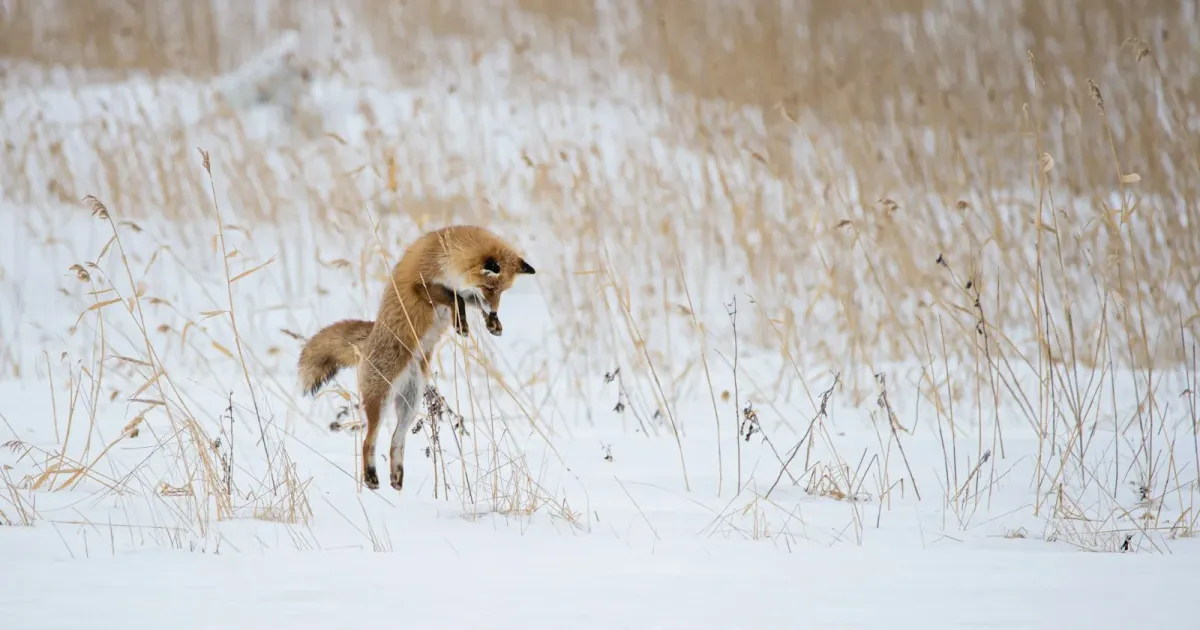
Fox vs coyote mix-ups happen all the time, especially at dusk or in a quick glimpse across a field. Both are wild members of the dog family, both have pointed ears and bushy tails, and both have learned to live alongside people.
Up close, they're easy to separate. Size, color and tail tips give each one away. Below we cover how to tell them apart, how their lives differ, and why foxes go out of their way to avoid coyotes.
Quick facts
The coyote is Canis latrans, a New World member of the dog family, and its name comes from the Aztec word coyotl (Britannica).
The red fox is Vulpes vulpes, and it has the largest natural range of any land mammal except humans (Britannica).
Red fox males in Yellowstone weigh 11 to 12 pounds, and females average 10 (National Park Service, Yellowstone).
Yellowstone coyotes weigh 25 to 35 pounds and stand 16 to 20 inches at the shoulder (NPS, Yellowstone).
Researchers have recorded 28 different kinds of red fox calls (Animal Diversity Web).
What's the difference between a fox and a coyote?
A coyote is a bigger, grayer, longer-legged wild dog, while a red fox is a small, red, solitary hunter. They belong to different genera in the dog family: coyotes are Canis and red foxes are Vulpes.
At a glance
Size: Coyotes weigh roughly two to three times as much as red foxes.
Color: Red foxes are reddish yellow. Coyotes are usually grizzled gray, though they range from creamy blond to nearly black.
Tail tip: Red foxes have a white tail tip. Coyote tails have a black tip.
Legs: Red foxes wear black "socks" on their lower legs. Coyotes don't.
Social life: Red foxes are solitary. Coyotes live in pairs or family groups.
Voice: Coyotes are known for group howls and yips. Red foxes make many different calls.
Speed: Coyotes can reach about 40 miles per hour, faster than a red fox's 30.
These points come from Yellowstone National Park, the Massachusetts Division of Fisheries and Wildlife, the National Wildlife Federation and Animal Diversity Web.
Fox vs coyote size: how much bigger is a coyote?
A coyote is usually two to three times heavier than a red fox. Exact numbers depend on the region.
Yellowstone coyotes weigh 25 to 35 pounds.
Eastern coyotes are larger. Massachusetts wildlife biologists give 33 to 40 pounds for females and 34 to 47 for males, with rare animals near 60.
Animal Diversity Web (ADW), a University of Michigan database, gives a full coyote range of 7 to 21 kilograms, or about 15 to 46 pounds.
Red foxes in Yellowstone weigh 10 to 12 pounds. ADW's range for the species runs from 3 to 14 kilograms, about 7 to 31 pounds.
A red fox can look bigger than it is because of its fluffy coat and long tail. The NWF describes it as about three feet long and two feet tall. Massachusetts describes the coyote as the size and shape of a medium dog.
How can you tell a fox from a coyote?
Check the tail tip and the legs first. A white tail tip and black legs mean red fox. A black tail tip on a grizzled gray body means coyote.
Tail
The National Wildlife Federation says red foxes have a fluffy, white-tipped tail. That detail also separates them from gray foxes, which have black tips. Coyotes carry a long, bushy tail with a black tip. ADW says a running coyote holds its tail below its back.
Color and coat
Yellowstone describes the red fox as reddish yellow, a bit darker on the back and shoulders, with black lower legs. Its throat, chin and belly are grayish white, per the NWF. Some red foxes come in darker "cross" or lighter colors, so color alone can mislead.
Coyotes vary even more. Massachusetts says they run from creamy blond to red to almost solid black, but grizzled gray is most common. Compared with dogs, they have longer, denser fur and pointed, upright ears.
Voice
If you hear a chorus of yips and howls at night, it's probably coyotes. Yellowstone calls them "song dogs" for their long-range calls. Massachusetts notes that a howling coyote family often sounds like more animals than it really is.
Red foxes are noisy in their own way. ADW counts 28 kinds of red fox calls and says individuals have voices that can be told apart. You can read more about why canines howl in our post on why dogs howl.
Do foxes and coyotes live the same way?
No, red foxes mostly live and hunt alone, while coyotes live in pairs and family groups. Their diets overlap a lot, though.
Social life
The NWF calls red foxes solitary, which helps them hide from people. Parents do raise pups together, and the family breaks up in fall.
Coyotes are more social. In Massachusetts, a mated pair defends a territory of 2 to 30 square miles and raises 4 to 8 pups in April or May. Before wolves returned to Yellowstone, coyotes there lived in packs of up to seven. After wolves came back, they shifted to pairs with pups. Our coyote vs wolf post covers how those two compare.
Diet
Both are flexible meat-eaters that take what's easy. Yellowstone lists voles, mice, rabbits, birds, amphibians, carrion and plants for red foxes. Coyotes there eat voles, mice, rabbits, other small animals, carrion and very young elk calves in spring. ADW says about 90% of a coyote's diet is mammals.
Coyotes can take bigger prey. Massachusetts lists deer among coyote foods, along with roadkill, fruit, birdseed and garbage. For the fox side of the menu, see our guide to what foxes eat.
Why do foxes avoid coyotes?
Foxes avoid coyotes because coyotes are bigger and sometimes attack them. ADW lists coyotes as predators of red foxes, though it notes these attacks are rarely about eating the fox. The two also hunt many of the same voles, mice and rabbits.
Yellowstone research shows how the two share space. Red foxes there strongly prefer forest, while coyotes use sagebrush and open meadows. In winter, their daily activity peaks fall at opposite times, so when coyotes are busy, foxes tend to rest. That split in time and place lets both live in the same park while seldom meeting.
Are coyotes dangerous to pets?
Coyotes can be a danger to cats and small dogs. Massachusetts wildlife officials say coyotes in suburbs may prey on unattended house cats and small dogs.
Red foxes prefer rodents and rabbits, per the NWF. They rely on hearing to find rodents, and the NWF says they can even hear mice digging underground. Mice and rats are a big part of the menu, as our rat vs mouse guide explains.
For more look-alike animals, browse our animal comparisons category.
Frequently asked questions
Is a coyote bigger than a fox?
Yes, a coyote is much bigger than a red fox. Yellowstone coyotes weigh 25 to 35 pounds, while red foxes there weigh about 10 to 12 pounds.
How do you tell a fox from a coyote at night?
At night, a fox and a coyote are easiest to tell apart by size and sound. A coyote is about the size of a medium dog and often yips and howls in a group. A red fox is smaller and usually alone.
Do coyotes kill foxes?
Coyotes do sometimes attack and kill red foxes. Animal Diversity Web lists coyotes as red fox predators but says the attacks are rarely to eat the fox.
Are foxes and coyotes related?
Foxes and coyotes are related, since both belong to the dog family, Canidae. The coyote is in the genus Canis, while the red fox is in the genus Vulpes.
Which is faster, a fox or a coyote?
A coyote is faster than a red fox. Animal Diversity Web gives a coyote top speed of about 65 km/h (40 mph) and a red fox top speed of about 48 km/h (30 mph).
What color is a coyote's tail tip compared to a fox's?
A coyote's tail tip is black, while a red fox's tail tip is white. Massachusetts wildlife officials describe the coyote tail as long, bushy and black-tipped.
Sources
Coyote, National Park Service, Yellowstone National Park
Red fox, National Park Service, Yellowstone National Park
Learn about coyotes, Massachusetts Division of Fisheries and Wildlife
Red fox, National Wildlife Federation
Canis latrans (coyote), Animal Diversity Web, University of Michigan
Vulpes vulpes (red fox), Animal Diversity Web, University of Michigan
Coyote, Britannica
Red fox, Britannica




Comments