
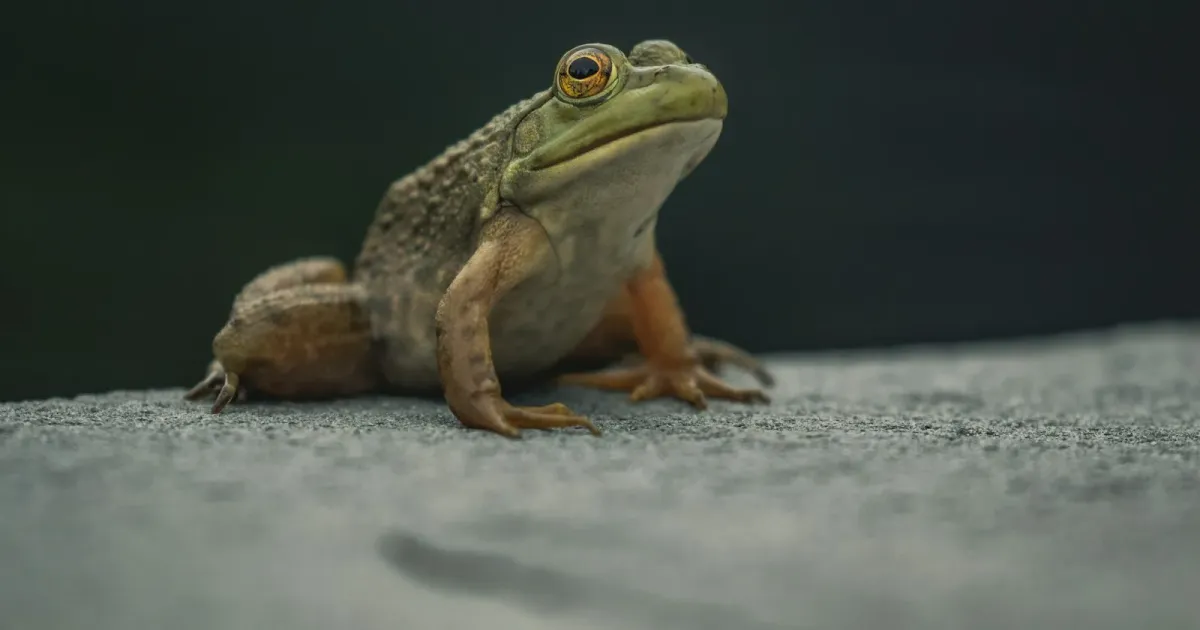
Frog vs toad is one of those comparisons that comes with a twist. Biologists put both in the same order, Anura, the tailless amphibians. Toads are a type of frog.
What makes some frogs "toads" is mostly body plan and lifestyle. True toads live mainly on land, with thick, dry skin, short legs and obvious poison glands.
Below we cover how to tell them apart, why toads look the way they do, and what to know if your dog grabs one.
Quick facts
There are 7,812 known frog species, a count that includes toads (AmphibiaWeb, February 2025).
True toads in the genus Bufo number more than 300 species (Britannica).
Toads range from about 2 to 25 cm long and have thick, dry, often warty skin (Britannica).
A single toad species can lay from 600 to more than 30,000 eggs, in two long jelly strings (Britannica).
The cane toad is established in Florida, Hawaii and Texas, and its toxin can kill dogs (Merck Veterinary Manual).
Frog vs toad: are toads frogs?
Yes, toads are frogs. "Toad" is a common name for certain kinds of frog.
Britannica defines a toad as any squat, rough-skinned, tailless amphibian of the order Anura, the same order that holds all frogs. The name applies most of all to the true toads, family Bufonidae. Britannica counts more than 300 true toad species in the genus Bufo, found worldwide except Australia, Madagascar, the polar regions and Polynesia. Some have been introduced to those places since.
Because Britannica's definition covers any squat, rough-skinned frog, the word "toad" stretches beyond Bufonidae. Treat the features below as general patterns.
At a glance
The Merck Veterinary Manual, in a page reviewed by Natalie Antinoff, DVM, lists these typical differences:
Skin: frogs have moist, smooth skin; toads have dry, lumpy skin.
Movement: frogs jump; toads walk.
Eyes: frogs have bulging eyes; toad eyes don't bulge.
Teeth: frogs have teeth in the upper jaw; toads have none.
Eggs: frogs lay eggs in clusters; toads lay eggs in chains.
Glands: true toads have two raised poison glands behind the eyes, according to Britannica.
Why do toads have dry, bumpy skin?
Toads have thick, dry skin because they live mostly on land. Typical frogs keep moist, slimy skin and stay closer to water.
Merck explains that most amphibians are coated in a mucus film called a slime layer. Their skin has to stay moist for oxygen exchange, since adult amphibians breathe through their lungs and their skin. Damp places help keep that skin wet.
Britannica describes true toads as mainly terrestrial and nocturnal. Their skin is thick, dry, often warty and usually mottled brown. They still return to water to breed, and some travel about 1.5 km to reach a breeding site.
Do toads give you warts?
No. Britannica states plainly that toads don't cause warts. Merck notes that toads have small poison glands spread through the skin, along with the big pair behind the eyes.
Why do toads walk instead of jump?
Toads walk or take short hops because their legs are short. Frogs that live in and near water tend to have long back legs built for big leaps.
Britannica describes true toads as stout-bodied with short legs that limit them to walking or hopping. Merck's comparison is short: frogs jump, toads walk.
A long-legged frog can launch itself into a pond in one bound to escape a predator. A toad on dry ground has a different defense, which is the next section.
Why are toads poisonous?
Toads are poisonous because their skin glands make toxins that protect them from predators. The biggest glands, called parotoid glands, sit in two raised lumps behind the eyes.
Britannica says these secretions irritate a predator's eyes and the lining of its mouth. In some species the toxin can cause temporary paralysis or even death in large animals. All frogs have poison glands in their skin, Britannica notes in its frog and toad overview, but true toads have this obvious pair behind the eyes.
The Merck Veterinary Manual names two toads as the most dangerous to pets. The cane toad (Rhinella marina), also called the marine toad, is established in Florida, Hawaii and Texas. The Colorado River toad (Incilius alvarius) lives in the southwestern US and northern Mexico. Their secretions affect the heart and nerves.
Do frogs and toads lay eggs differently?
Yes. Frogs usually lay eggs in clumps, while toads lay them in long strings.
Merck's comparison lists frog eggs in clusters and toad eggs in chains. Britannica adds that true toads lay their eggs in two long jelly tubes. Depending on the species, a clutch holds from 600 to more than 30,000 eggs. The tadpoles hatch within days and turn into small toads within one to three months.
So if you find a jelly rope wound around pond weeds in spring, it's probably toad spawn. A floating mass of jelly balls is more likely frog spawn.
Do frogs and toads eat the same food?
Mostly, yes. Both are carnivores as adults and catch insects and other small animals with sticky tongues.
Britannica says toads hunt with sticky tongues and stay within a fairly small area. The great majority of frogs eat insects, other small arthropods or worms, and some larger species eat vertebrates. As tadpoles, most of both groups graze on algae and plants. Size changes the menu more than the frog or toad label does. National Geographic says the American bullfrog, a big water-loving frog, eats insects, mice, fish, birds and snakes. For the full menu, see our guide to what frogs eat. For another pair of lookalikes people mix up, try alligator vs crocodile.
Frequently asked questions
Is a toad a frog?
A toad is a frog. Toads belong to the same order as all other frogs, Anura, and "toad" is a common name for the drier, warty kinds. The true toads form the family Bufonidae.
How can you tell a frog from a toad?
You can tell a frog from a toad mainly by skin and legs. Frogs usually have smooth, moist skin and long jumping legs, while toads have dry, bumpy skin and short legs. True toads also have raised poison glands behind the eyes.
Are toads poisonous to touch?
Toads make toxins in their skin glands, and these mainly harm animals that bite or mouth them. Britannica says the secretions irritate the eyes and mouth lining of predators. Keep toad secretions away from your own eyes and mouth for the same reason.
Are toads poisonous to dogs?
Toads can be poisonous to dogs, and some can kill them. The Merck Veterinary Manual names the cane toad and the Colorado River toad as the most dangerous species in the US. Rinse the dog's mouth with plenty of water and call a vet right away.
Do toads have teeth?
Toads have no teeth, while most frogs have teeth in the upper jaw. The Merck Veterinary Manual lists this as one of the typical differences. Both frogs and toads catch prey with sticky tongues.
Do toads live in water?
Toads live mainly on land and come out mostly at night, according to Britannica. They return to water to breed, and some travel about 1.5 km to reach a breeding site. Toad tadpoles grow up in the water before moving onto land.
For two more lookalikes where one name hides a family tree, read turtle vs tortoise and hare vs rabbit. Find more side-by-side guides in our animal comparisons section.
Sources
Toad, Britannica
Anura: Natural history, Britannica
Anura: Form and function, Britannica
Introduction to amphibians, Merck Veterinary Manual
Toad poisoning in dogs and cats, Merck Veterinary Manual (Andrew Padula, BVSc, PhD)
AmphibiaWeb species counts, University of California, Berkeley
Tadpole, Britannica
American bullfrog, National Geographic



Comments