
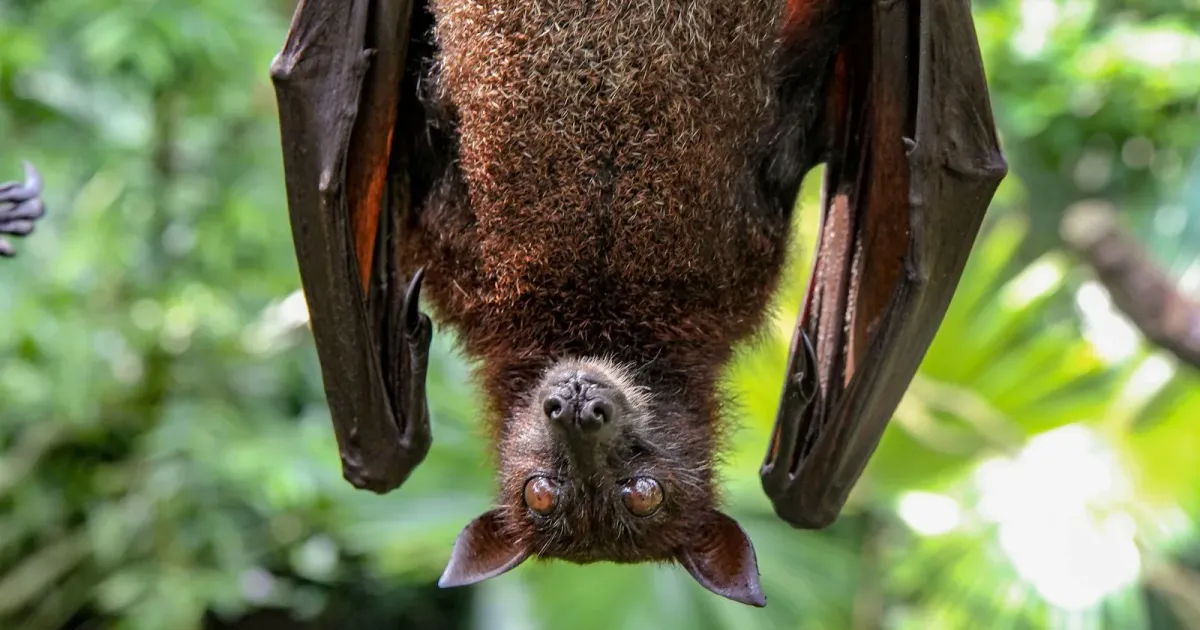
Picture a cave ceiling covered in sleeping bats, every one of them head down. It looks uncomfortable to us. For a bat, it's the easiest way to rest.
So why do bats hang upside down? The short answer is that a bat's body is built for flying, not standing. Its legs are light and its wings can't lift it off flat ground very well. Hanging solves both problems at once, and it gives bats access to roosts few predators can reach.
Below we cover the four main reasons, how bats grip without tiring, why the blood doesn't rush to their heads, and the few bats that sleep the right way up.
Quick facts
There are more than 1,400 bat species worldwide, and Bat Conservation International says almost all of them hang upside down.
Bats are the only mammals capable of true powered flight, according to Bat Conservation International (2023).
A 1977 study by D.J. Howell and Joe Pylka in the Journal of Theoretical Biology found that most bat leg bones can't handle compression stress well (BCI).
Most bats have a ratchet-like tendon lock in their feet that lets them hang with reduced muscle activity, per a 1994 paper by Nancy Simmons and Thomas Quinn (Journal of Mammalian Evolution).
Bats weigh roughly 0.07 to 2.5 pounds, too little for gravity to pool their blood, as bat expert Rob Mies told National Geographic in 2015.
Why do bats hang upside down to take off?
Bats hang upside down mainly because it's the easiest way for them to get airborne. A bird can jump and flap its way up from the ground. Most bats can't launch themselves high enough to start flying from a standing start, so Bat Conservation International explains that hanging lets gravity do the work.
When a roosting bat wants to leave, it lets go. It falls a short distance, opens its wings and gains enough speed to fly. BCI's FAQ puts it plainly: their feet clench when relaxed, and dropping gives them the momentum they need.
Landing is the trickier part. A 2015 Brown University study published in PLOS Biology filmed bats flipping over to land on a ceiling. The researchers, led by Attila Bergou with Sharon Swartz and Kenny Breuer, found bats tuck one wing in slightly while flapping the other. The heavy wings create inertial forces that rotate the bat head down and feet up (Brown University).
Are bat legs too weak to stand on?
Bat legs are light and built for hanging, so standing upright would be awkward and costly. BCI notes that a bat's legs are rotated 180 degrees compared with other mammals, with knees that bend backward. Their bones are lighter and more delicate than other mammals' bones, though they aren't hollow like a bird's.
That light build matters. Howell and Pylka's 1977 work showed that most bat leg bones don't cope well with compression (BCI). Compression is the squashing force of weight pressing down from above, and the long thigh bones (femurs) are especially light. Hanging puts the bones under tension instead, which suits them.
Australia's Bat Rescue Inc frames it as a weight trade-off. Legs strong enough to hold a bat upright would be extra weight to carry on every flight.
How do bats hang without getting tired?
Bats hang without tiring because a tendon lock in their toes holds the grip for them. When a bat lands and curls its toes around a branch or into a crack, muscles called the flexor digitorum contract. The sheath around the tendons has tiny ribs that catch like a ratchet, so the toes stay closed without the muscles working (BCI).
Simmons and Quinn's 1994 paper describes this tendon locking mechanism (TLM) in detail. Bumpy cartilage on the tendon meshes with folds in the tendon sheath, a bit like the teeth of a zip tie. Most bat families have it. Leaf-nosed bats (family Phyllostomidae) are an exception: they use a smoother "friction lock" instead (Journal of Mammalian Evolution).
The lock works so well that a bat that dies while roosting can stay hanging, as National Geographic reported. Rob Mies, then director of the Organization for Bat Conservation, said hanging takes less effort than sitting upright would.
Where do bats sleep during the day?
Bats sleep during the day in sheltered spots like caves, trees, rock crevices, mines, bridges and buildings. The National Park Service says these roosts keep bats safe from predators through the day. Hanging high on a ceiling or deep in a crack puts a bat where most predators can't follow.
So yes, most bats do sleep during the day. They're nocturnal, which means they're active at night and rest in daylight. Roosts change with the seasons too:
Day roosts where bats rest between night flights.
Maternity colonies in spring and summer, where females gather to raise young.
Hibernacula, the winter shelters where some species hibernate.
Not every bat picks a cave. The NPS hoary bat profile says hoary bats spend summer days hidden in tree foliage. Females even give birth while hanging upside down in that leafy shelter.
Does blood rush to a bat's head?
Blood doesn't rush to a bat's head in any harmful way, because bats are small and light. Rob Mies told National Geographic that bats don't weigh enough for gravity to affect their blood flow much. The same small size helps them avoid the dizziness people feel when upside down.
BCI adds that bats may also have small valves in their blood vessels, similar to the ones in human veins that help push blood back against gravity. BCI presents this as likely, so treat it as a reasonable idea and not a settled finding.
For a person, hanging upside down for long is dangerous. Our bodies are heavy enough for blood to pool in the head. A bat weighing a few ounces doesn't have that problem.
How do bats poop if they're upside down?
Bats turn themselves the right way up to go to the bathroom, at least in some species. Bat Rescue Inc says flying foxes, the large fruit bats of Australia and Asia, are very clean animals. To relieve themselves, they flip around and hang right side up so they don't soil their fur.
Droppings (called guano) build up under busy roosts. BCI warns that bat droppings can carry the fungus that causes histoplasmosis, so avoid breathing dust where droppings collect.
Do all bats hang upside down?
No, a few bats roost head up. The best-known is Spix's disk-winged bat of Central and South America. Bat Conservation International describes small groups of five or six that sleep head up inside young, rolled-up Heliconia leaves. They cling with suction cups at the bases of their thumbs and ankles, and they move to a new leaf every day.
Madagascar's sucker-footed bat also roosts head up, on the broad leaves of traveler's palms. A 2009 study by Daniel Riskin and Paul Racey found these bats grip with wet adhesion, a thin layer of fluid on pads at their wrists and ankles. Scientists had long assumed they used suction (Brown University).
There are exceptions to the takeoff rule as well. BCI notes that the common vampire bat can get into the air from the ground, which most bats can't.
Frequently asked questions
Why do bats sleep upside down?
Bats sleep upside down because it lets them drop straight into flight when they wake. A tendon lock in their toes keeps their grip closed without effort, so sleeping head down costs bats very little energy.
Do bats sleep during the day?
Yes, most bats sleep during the day because they're nocturnal. Bats rest in caves, trees, crevices and buildings by day and come out to feed after dark.
Where do bats sleep?
Bats sleep in roosts such as caves, mines, hollow trees, tree foliage, rock crevices, bridges and buildings. The National Park Service says these sheltered spots keep bats safe from predators while they rest.
Why don't bats fall when they sleep?
Bats don't fall because their toes lock shut with a ratchet-like tendon mechanism. The lock holds even when the bat's muscles relax, and a bat that dies on its roost can stay hanging.
Do bats poop upside down?
Some bats turn the right way up to poop. Flying foxes flip and hang right side up so they don't soil their fur, according to Bat Rescue Inc in Australia.
Do any bats sleep right side up?
Yes, a few bats roost head up. Spix's disk-winged bat sleeps inside rolled leaves using suction cups, and Madagascar's sucker-footed bat sticks to palm leaves with wet adhesive pads.
Bats aren't the only animals with a strange resting pose. See why flamingos stand on one leg, why cats sleep so much, and the difference between moths and butterflies, another night shift favorite of hungry bats. More animal mysteries are in our wildlife section.
Sources
Why Do Bats Hang Upside Down?, Bat Conservation International
Where the Upside Is Down, Bat Conservation International
Bat FAQ, Bat Conservation International
Species Spotlight: Spix's Disk-winged Bat, Bat Conservation International
Evolution of the digital tendon locking mechanism in bats and dermopterans, Journal of Mammalian Evolution
Bats and Sloths Don't Get Dizzy Hanging Upside Down, National Geographic
Bats use weighty wings to land upside down, Brown University
Sucker-footed bats don't use suction after all, Brown University
Where Bats Live, National Park Service
Hoary Bats, National Park Service
Batty Facts, Bat Rescue Inc



Comments