
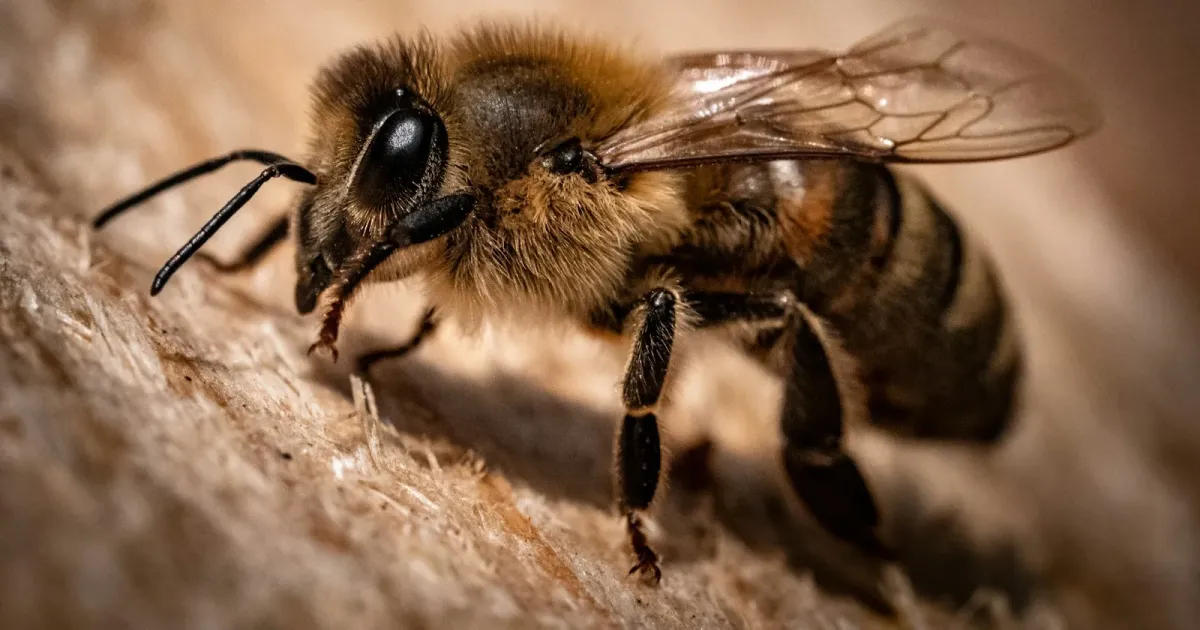
Why do bees die after stinging? The short answer most of us learned is "because they lose their stinger." That's true, but only for a small group of bees, and the way it happens is stranger than the short version suggests.
The barbed sting, the venom pump it leaves behind and the alarm scent it releases all serve the colony. For the person who gets stung, speed of removal matters, and so do the signs of an allergic emergency.
Quick facts
Only about 8 of the nearly 21,000 bee species in the world die when they sting, and all 8 are honey bees (The Conversation).
A bee's sting is a modified egg-laying tube, so only females can sting (University of Missouri Extension).
UC Davis apiculturist Eric Mussen advised getting a honey bee sting out within 45 to 60 seconds (UC ANR, 2008).
A 1996 Lancet study found that scraping or pinching out a sting made no real difference to the welt, but delay did (UC Riverside).
Severe allergic reactions to stings can start within minutes, and stings cause an average of 72 deaths a year in the US (ACAAI).
Do bees die when they sting?
Most bees don't die when they sting. The Conversation points out that only about eight of the almost 21,000 known bee species die after stinging, and they're all honey bees in the genus Apis. That includes the familiar European honey bee, Apis mellifera.
Even inside a honey bee hive, it's only the workers. The University of Arizona Extension notes that drones, the males, have no sting at all. Queens have one and can use it again and again.
Some bees can't sting anyone. The same Conversation article counts 537 species of stingless bees, about 2.6% of all bee species.
Why do bees die when they sting? The barbs
Worker honey bees die because their sting is barbed and gets stuck in skin. The barbs are jagged and point backward, like the barbs on a fishhook.
A bee's sting began as an ovipositor, the tube a female insect uses to lay eggs. Over evolutionary time it became a weapon, which is why only females sting, as Missouri Extension explains.
The University of Illinois BeeSpotter program describes the honey bee's barbs as an anchor in the wound that rules out a second sting. Once the sting is in, it won't slide back out.
When the bee tries to fly away, she can't pull free. Arizona Extension says the barbs catch, and the whole sting structure is pulled out of her body as she moves off. Losing the sting, venom gland and muscles tears open the tip of her abdomen. UC Davis apiculturist Eric Mussen, speaking to UC Agriculture and Natural Resources in 2008, confirmed that workers die after stinging. She dies soon after.
Do bees die when they sting you, or only other animals?
Do honey bees die after stinging you? Yes. A worker dies after stinging you or any other mammal, because mammal skin is what traps the barbs.
The part left in your skin keeps working. Michigan State University's bee anatomy guide explains that the sting, venom gland and the muscles that run them keep pumping venom into you after the bee is gone.
Entomologists at UC Riverside describe how that works. A valve and piston at the base of the moving lancets pump venom from the venom sac, a bit like an old hand pump. Muscle contractions move the lancets so the one-way barbs drive the sting deeper, pumping more venom with each stroke. Squeezing the venom sac has little to do with it.
The torn-off sting also gives off an alarm pheromone, a chemical scent signal. MSU says it marks you, so other bees from the colony come to sting you again. In a hive, a worker's death doesn't end her defense of the colony.
Do bumble bees die when they sting?
No, bumble bees don't die when they sting. BeeSpotter says the bumble bee's sting is smooth, so it slides back out and the bee can sting more than once.
The rule "a bee stings once and dies" fits only honey bee workers. Other stinging insects are built differently:
Honey bee queens have an unbarbed sting and can sting repeatedly, says BBC Science Focus. A newly emerged virgin queen hunts down rival virgin queens and tries to sting them to death.
Bumble bees have smooth stings, live in small colonies, and tend to be gentler than honey bees, according to BeeSpotter.
Wasps, yellowjackets and hornets have smooth stings too, and Missouri Extension says they can sting repeatedly.
Male bees and wasps can't sting at all, since they have no ovipositor.
If one insect stung you several times, it wasn't a honey bee worker. If you find a sting stuck in your skin, it almost certainly was. Flies have their own odd habits, covered in why flies rub their hands.
How do you remove a bee stinger?
Get it out as fast as you can, by any method. Because a honey bee's sting keeps pumping venom, speed matters most.
Many guides say to scrape the sting out with a card edge and never pinch it. The American College of Allergy, Asthma and Immunology (ACAAI) gives that advice, warning that pinching could release more venom. But a 1996 study in The Lancet by P. Kirk Visscher and Richard Vetter of UC Riverside and Scott Camazine of Penn State tested it. UC Riverside reports that welts were about the same size either way. Welts grew larger the longer the sting stayed in.
Walk away from the area, since the alarm scent can draw more bees.
Remove the sting right away with a fingernail, a card edge or your fingers.
Wash the spot gently with soap and water.
Hold a cold, damp cloth or ice pack on it for 10 to 20 minutes, as the Mayo Clinic suggests.
How quickly can a bee sting be dangerous?
For most people a bee sting isn't dangerous, but for someone with a venom allergy, ACAAI says a severe reaction can start within minutes. That reaction is anaphylaxis, a whole-body allergic response that can be fatal without fast treatment.
A normal sting causes pain, redness and swelling at the spot. Some people get a large local reaction, where swelling spreads well beyond the sting. ACAAI says that swelling usually peaks two to three days later and can last a week or more. It's uncomfortable but usually not dangerous.
Severe allergy is less common. ACAAI estimates that 0.4 to 0.8 percent of children and 3 percent of adults have potentially life-threatening reactions to insect stings. Mussen put the share at about one or two people in 1,000 when speaking to UC ANR. ACAAI counts an average of 72 deaths a year from stings in the US.
Call 911 or your local emergency number right away if someone who was stung has any of these signs, listed by the Mayo Clinic:
Trouble breathing
Swelling of the lips, face, eyelids or throat
Dizziness, fainting or unconsciousness
A weak, rapid pulse
Hives
Nausea, vomiting or diarrhea
Anyone who has had a serious reaction should see an allergist. ACAAI says venom immunotherapy, a course of allergy shots that builds tolerance over time, can give up to 98% protection against future reactions.
For more on insects and how they live, read moth vs butterfly or why horses need shoes, or browse our insects and bugs articles.
Frequently asked questions
Do bees die when they sting?
Most bees don't die when they sting. Only worker honey bees die, because their barbed sting gets stuck in mammal skin and tears out of their body. Bumble bees, honey bee queens and most other bees can sting more than once.
Do honey bees die after stinging?
Worker honey bees die after stinging a person or other mammal. The barbs anchor the sting in the skin, and the sting, venom gland and muscles rip out of the bee's abdomen as she flies off. Honey bee queens have smooth stings and survive.
Do bumble bees die when they sting?
Bumble bees don't die when they sting. A bumble bee's sting is smooth, so it pulls back out of the skin and the bee can sting again. If an insect stung you more than once, it was not a honey bee worker.
Do wasps die after stinging?
Wasps don't die after stinging. Wasps, yellowjackets and hornets have smooth stings, so a single wasp can sting repeatedly.
How quickly can you die from a bee sting?
A bee sting is not dangerous for most people, but in someone with a venom allergy, a severe reaction called anaphylaxis can start within minutes, according to ACAAI. Signs include trouble breathing, swelling of the face or throat, dizziness and hives. Call 911 at once and use an epinephrine auto-injector if the person has one.
How long does a bee stinger keep pumping venom?
A honey bee stinger keeps pumping venom after it detaches from the bee, so the sooner it's out, the less venom gets in. UC Davis apiculturist Eric Mussen advised removing it within 45 to 60 seconds. A 1996 Lancet study found welts grew larger the longer removal was delayed.
Sources
Most bees don't die after stinging, and other surprising bee facts, The Conversation
Bee Stings, BeeSpotter, University of Illinois
Bees and Wasps, University of Missouri Extension
Honeybee Series: Honeybee Basic Biology, University of Arizona Extension
Honey bee anatomy, Michigan State University
Bee Sting Removal, UC Riverside
The Sting, UC Agriculture and Natural Resources
11 things people believe about bees that aren't true, Noble Research Institute
Does a queen bee ever sting?, BBC Science Focus
Insect Sting Allergies, American College of Allergy, Asthma and Immunology
Insect bites and stings: First aid, Mayo Clinic



Comments