
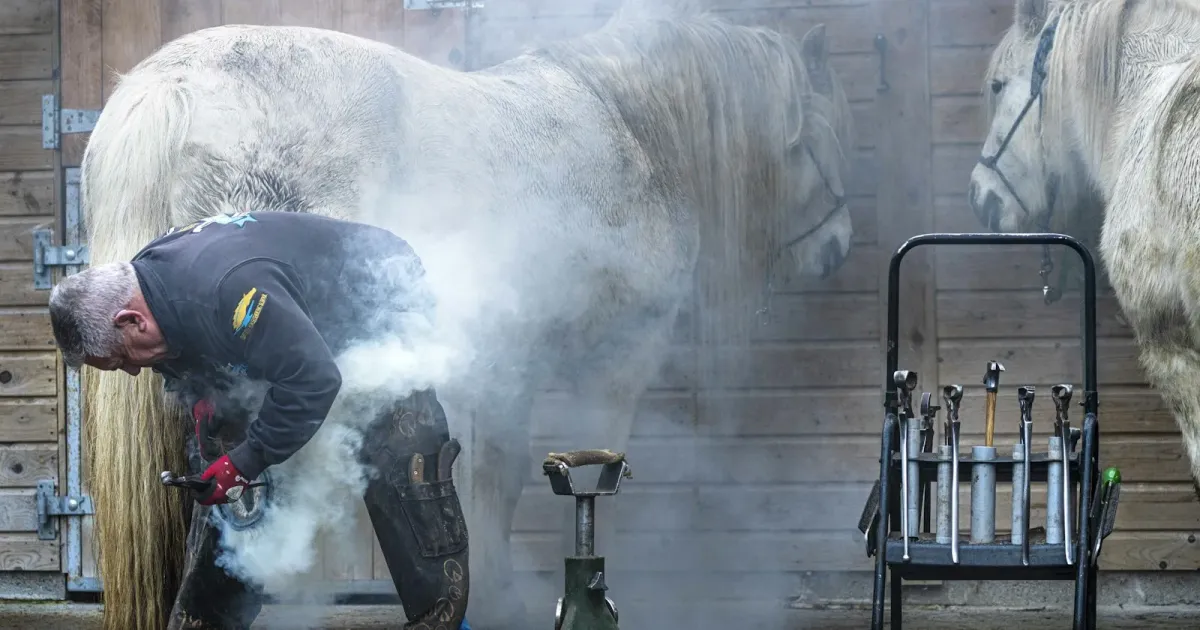
Why do horses need shoes when wild horses get by without them? Not all of them do. A horseshoe is a tool, and whether a horse needs one depends on how fast its hooves grow, how fast they wear away, and what work the horse does.
A farrier (a specialist who trims hooves and fits shoes) looks at all three before reaching for a shoe. To follow that reasoning, it helps to know what a hoof is made of.
Quick facts
A horse's hoof grows about 1/4 to 3/8 inch a month, so a horse grows a whole new hoof in roughly a year (eXtension Horses).
The outer hoof is keratin, the same protein in human fingernails and rhino horn (ASPCA).
Most horses need a farrier visit every six to eight weeks (ASPCA).
Horseshoes are usually steel, with aluminum and plastic glue-on shoes also popular (ASPCA).
Oregon State University kept 18 school horses barefoot, according to a 2005 report in The Horse.
What is a horse's hoof made of?
A hoof is a hard keratin shell wrapped around living bone and tissue. The ASPCA compares the outer layer to your fingernails, and like your nails, it never stops growing.
The University of Missouri Extension describes the main parts you'd see if you picked up a horse's foot:
The hoof wall is the hard outer shell, made of parallel horn fibers.
The sole is the horny underside that shields the sensitive structures inside.
The frog is the spongy, flexible V-shaped pad toward the heel, and it bears weight too.
The white line is the seam where the wall meets the inner foot, the outward sign of the layered bond between wall and coffin bone.
Inside sits the coffin bone, held to the wall by sensitive tissue called laminae. The wall and sole act like armor. Everything they cover is alive and full of nerves and blood vessels.
How fast do horse hooves grow?
A hoof grows about 1/4 to 3/8 inch a month, according to eXtension's horse specialists. Growth starts at the coronary band (the hairline at the top of the hoof) and moves down toward the toe. A hoof wall is about 3 to 4 inches long, so it replaces itself in about a year.
That rate shifts with age and season. eXtension puts young foals at about 0.6 inch a month and horses over 12 at about 0.25 inch. Hooves grow fastest in spring and slow down in winter.
Missouri Extension adds that hind feet may grow faster than front feet, and unshod feet may grow faster than shod ones. Good nutrition supports growth, though eXtension notes that biotin supplements give mixed results from horse to horse.
Do wild horses need shoes?
No, wild horses don't need shoes, because their daily travel wears the hoof down at about the same rate it grows. Indiana Public Media's A Moment of Science explains that this keeps the wall and sole in balance, with no trimming needed.
The same program points out what changes for domestic horses. Hard surfaces such as roads and dirt paths wear hooves faster than they can grow back. When that happens, the sole and frog can be damaged.
Domestic life can tip the balance the other way too. A horse that spends its days in a soft pasture may not wear its hooves enough. Its feet get long and need trimming, even if it never needs a shoe.
Why do horses need shoes? Wear vs growth
Horses need shoes mainly when their hooves wear away faster than they grow. Farrier and author Doug Butler, PhD, gave that simple test in The Horse in 2005: if the foot wears down faster than it grows, protect it with a shoe. If the two stay even, a trim is enough.
Several things push a horse toward horse shoes:
Terrain. Butler said a horse on crushed granite can't stay barefoot for long.
Workload. Frequent hard work on gravel or pavement speeds up wear.
Breeding. Butler argued that many modern horses were bred with small, weak feet, which makes barefoot work harder for them.
Traction. Reining horses wear sliding plates on their hind feet for long stops. For winter, eXtension mentions snow pads plus cogs, borium or nails at the heels for grip on ice.
Balance and protection. The ASPCA says specialized shoes help keep a foot balanced and stop the wall from chipping.
What are therapeutic horse hoof shoes?
Therapeutic shoes are horse hoof shoes, often paired with pads, that a farrier fits on a vet's advice to treat a foot problem. The best-known example is laminitis.
Laminitis happens when blood flow to the laminae is disrupted, explains the American Association of Equine Practitioners (AAEP). The laminae weaken. In severe cases the coffin bone can rotate or sink inside the hoof and may push through the sole.
The AAEP lists corrective trimming, frog supports, and therapeutic shoes or pads among the treatments. X-rays show how far the coffin bone has rotated, and the vet and farrier plan the work together.
University of Minnesota Extension gives other examples. For navicular disease (a painful condition at the back of the foot), it lists a short toe, raised heels, a good breakover and pads. For laminitis, it lists short toes and support for the frog and sole.
Do horseshoes hurt horses?
No, horseshoes don't hurt horses when they're fitted correctly. The nails go into the outer hoof wall, which has no nerve endings, much like the white tip of your fingernail.
The landmark is the white line. A 2001 article in The Horse explains that nails should enter the outer wall at the white line, next to the sensitive laminae without touching them. That keeps them in dead horn.
So do horse shoes hurt horses when something goes wrong? They can. A nail that pierces the laminae, or sits close enough to press on them, has "quicked" the horse. Some horses tense, quiver or jerk the foot away right away. Others look fine at first. The Horse says a "hot nail" can make a horse tender four or five days later as infection sets in. A "close nail" can bring on lameness over five to seven days.
Can horses go barefoot instead?
Yes, many horses can go barefoot. The ASPCA says every horse needs regular hoof care, but not every horse needs horseshoes. For plenty of horses, trims are enough.
The same 2005 article in The Horse covers the upside. Butler said a bare hoof keeps its natural movement and traction, which a shoe limits to some extent. Oregon State exercise physiologist Christian Rammerstorfer, PhD, described running a string of 18 school horses barefoot. The only exception was the reiners, which wore sliding plates behind.
Rammerstorfer also described how he switched horses over. He let about six weeks of growth come in after the last shoeing, then pulled the shoes. He said it took about two to three months for the old nail holes to grow out.
How often does a horse need the farrier?
Most horses need the farrier every six to eight weeks, whether they wear shoes or not. Hooves keep growing either way.
eXtension breaks that down by season:
In summer, trim or shoe every 6 to 8 weeks, and more often for performance horses.
In winter, every 6 to 12 weeks, because hooves grow more slowly.
eXtension also says a horse that's normally barefoot can stay barefoot through winter. Waiting too long between visits throws a hoof out of balance. Missouri Extension notes that a shod hoof at a 50-degree angle can drop to 46 or 47 degrees in four to six weeks as the toe grows out.
Farm animals have plenty of other habits worth a closer look. Read why roosters crow, why bees die after stinging or why dogs eat grass, or browse more farm animal explainers.
Frequently asked questions
Do wild horses need shoes?
Wild horses don't need shoes because their daily travel wears their hooves down at about the rate the hooves grow. That keeps their feet in balance without a farrier. Domestic horses often work on hard surfaces or live on soft pasture, which throws that balance off.
Do horseshoes hurt horses?
Horseshoes don't hurt horses when a farrier fits them correctly, because the nails go into the outer hoof wall, which has no nerve endings. A nail that strays into the sensitive laminae can hurt and cause lameness. Lameness after shoeing should be checked by a farrier or vet.
Do all horses need horse shoes?
Not all horses need horse shoes, but every horse needs regular hoof care. Many horses only need trims. Shoes are mainly for horses whose hooves wear faster than they grow, need extra grip, or need therapeutic support.
How often do horseshoes need to be changed?
Horseshoes are usually reset every six to eight weeks. In winter, when hooves grow more slowly, the interval can stretch to 12 weeks. The farrier pulls the shoe, trims the new growth and refits or replaces the shoe.
What are horseshoes made of?
Horseshoes are most often made of steel, according to the ASPCA. Aluminum shoes and plastic glue-on shoes are also popular.
How fast does a horse's hoof grow?
A horse's hoof grows about 1/4 to 3/8 inch a month, according to eXtension. Since a hoof wall is 3 to 4 inches long, a horse grows a new hoof in about a year. Foals grow hoof faster than older horses.
Sources
It Behooves You to Know These Six Fun Facts About Horse Hooves, ASPCA
How a Horse's Hoof Grows, eXtension Horses
Basic Horse Hoof Care, eXtension Horses
Horse Foot Care: Selected Topics, University of Missouri Extension
Caring for your horse's hooves, University of Minnesota Extension
Hoofing, Indiana Public Media, A Moment of Science
To Shoe or Not to Shoe?, The Horse
Nail-Quicked, The Horse
Laminitis: Prevention and Treatment, American Association of Equine Practitioners


Comments