
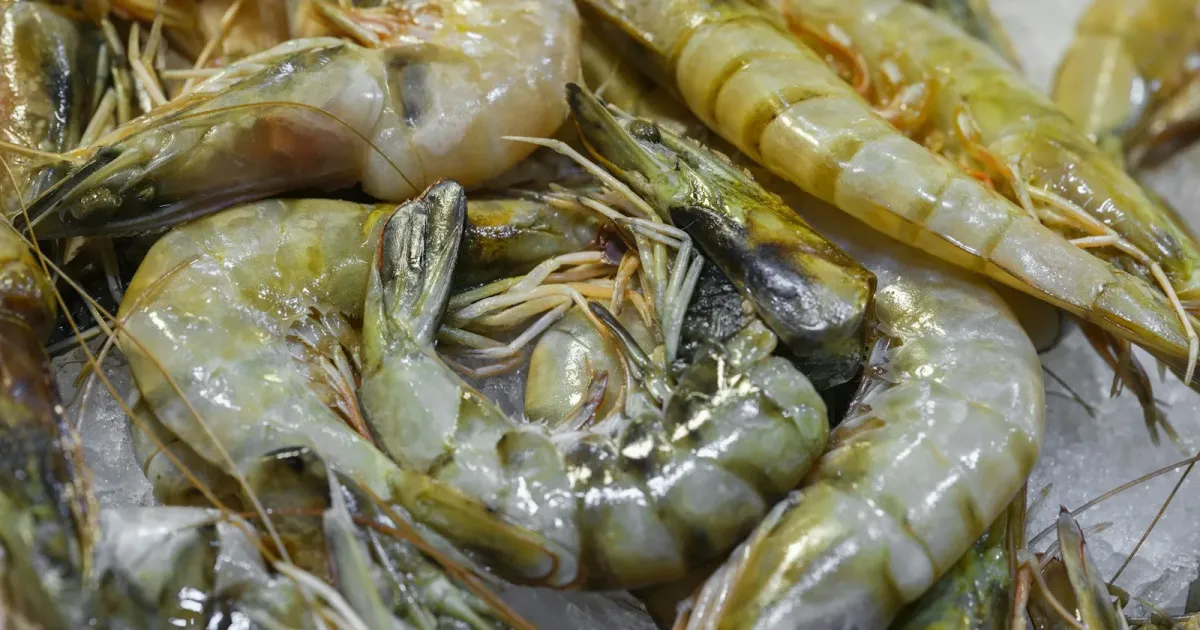
Order a plate of prawns in London and a plate of shrimp in Chicago and you might get the exact same animal. So what's the real story with prawn vs shrimp? There is a biological difference, and it has nothing to do with size or price.
Both are decapods, the group of ten-legged crustaceans that also includes crabs and lobsters. But true prawns and true shrimp sit on separate branches of that family tree. The trouble is that everyday English ignores those branches, which is why the words get swapped so often.
Quick facts
Britannica counts about 2,000 shrimp species, from a few millimeters to more than 20 cm (about 8 inches) long (Britannica).
In the US, America's Test Kitchen says "prawn" is often used in the South, while northerners tend to say "shrimp" (America's Test Kitchen).
The giant tiger prawn, Penaeus monodon, reaches about 13 inches and 10 ounces, and females are generally larger than males (Louisiana Sea Grant, LSU).
The UK's common prawn, Palaemon serratus, grows up to 11 cm, and females carry up to 4,000 eggs on their legs (The Wildlife Trusts).
A female pink shrimp, a dendrobranchiate, releases roughly 500,000 to 1 million eggs near the sea floor (NOAA Fisheries).
What is the difference between prawn vs shrimp?
The difference is anatomy, and the clearest sign is the gills. Prawns belong to the suborder Dendrobranchiata, a name that, as Wikipedia's overview explains, comes from the Greek for "tree" and "gills." Their gills branch like little trees.
True shrimp belong to the infraorder Caridea. Healthline places them in the broader suborder Pleocyemata. Their gills are lamellar, which means they're made of flat, stacked plates.
You can't see gills on a cleaned, cooked shrimp, of course. America's Test Kitchen points out that this key feature is hard for shoppers to spot and usually gets lost in processing. Luckily, a few other traits help.
At a glance
Gills: prawns have branching gills; true shrimp have flat, plate-like gills.
Body plates: on a true shrimp, the second abdominal segment overlaps both the first and the third. On a prawn, each segment overlaps the next like roof shingles.
Claws: prawns have claws on three pairs of legs; true shrimp have fewer.
Legs: Healthline notes that prawns tend to have longer legs.
Eggs: prawns release their eggs into the water, while true shrimp females carry them under the abdomen.
Size: prawns are often bigger, but size overlaps and isn't a reliable test.
How can you tell a shrimp from a prawn by looking?
The easiest visual clue is the side of the tail section. On a true shrimp, the second segment's shell flares out and covers both the segment in front and the one behind it.
On a prawn, the plates line up in order, each one lapping over the next. America's Test Kitchen describes the prawn's head overlapping the thorax, which overlaps the abdomen, "like the shingles on a roof." In a shrimp, the thorax wraps over both the head and abdomen like a band.
Claws are the second clue. Prawns have small pincers on three pairs of legs, and Healthline says shrimp have only one pair. So a crustacean with pincers on its third pair of legs is a prawn.
If you're curious how other look-alike animals compare, our guide to alligator vs crocodile uses the same kind of clues: snout shape, teeth and where they live.
Why do prawns and shrimp look so alike?
Prawns and shrimp look alike because they live similar lives. Both swim, and both need a light, flexible body to do it. Britannica describes shrimp as having a semi-transparent body flattened from side to side, a bendy abdomen that ends in a fan-shaped tail and long whip-like antennae.
Britannica also notes that their legs are adapted for swimming, and that shrimp swim backward by quickly flexing the abdomen and tail. A body built for that kind of life looks much the same whichever branch of the decapod tree it sits on. The differences that remain, like gill shape and egg care, are mostly the parts you can't see from outside.
Do prawns and shrimp reproduce differently?
Yes, and egg care is one of the biggest biological differences between them. Dendrobranchiate prawns don't brood their eggs. They shed them straight into the water and swim away.
NOAA Fisheries gives a good example. Female pink shrimp (which, despite the name, are dendrobranchiates) release about 500,000 to 1 million eggs near the ocean floor. The eggs are fertilized as they're released. The young drift into marshy estuaries to grow, then head back out to deeper, saltier water.
True shrimp do the opposite. Females hold their eggs on their swimming legs until they hatch. The spot prawn of the North Pacific shows this well. According to the Alaska Department of Fish and Game, spot prawn females carry eggs on hair-like bristles under the abdomen from October through March.
Holding eggs means a caridean mother lays far fewer of them. Britannica puts shrimp clutches at 1,500 to 14,000 eggs, far below a pink shrimp's spawn. For another sea creature with an unusual way of making babies, see how eels reproduce.
Why do people use the words prawn and shrimp differently?
The names come from habit and geography, not from biology. Britannica notes that larger individuals are often called prawns, whatever group they belong to.
Healthline says Commonwealth countries use "prawn" as the general word. In North America, "shrimp" covers the smaller kinds, and "prawn" mostly gets used for large or freshwater ones. America's Test Kitchen adds two wrinkles. Southerners in the US often say "prawn" where northerners say "shrimp," and in Britain and many Asian countries the choice of word usually comes down to size.
That's why common names often contradict the science. A few examples:
The spot prawn, Pandalus platyceros, is a true shrimp. It's a caridean and the females carry their eggs.
The UK's common prawn, Palaemon serratus, carries its eggs too. The Wildlife Trusts say a female can hold up to 4,000 fertilized eggs on her legs, the typical caridean habit.
The giant river prawn, Macrobrachium rosenbergii, is also a caridean. Adults live in fresh water. Egg-carrying females migrate downstream to brackish water, where the eggs hatch, and fresh orange eggs take about three weeks to hatch, according to SEAFDEC, the Southeast Asian Fisheries Development Center.
Pink shrimp, Farfantepenaeus duorarum, are dendrobranchiates, so biologically they're prawns.
The giant tiger prawn, Penaeus monodon, really is a dendrobranchiate prawn.
So a "prawn" on a menu may be a true shrimp, and a "shrimp" may be a true prawn.
Is there a difference in taste between prawn and shrimp?
No consistent taste difference separates them. Healthline says no flavor reliably tells a shrimp from a prawn, and that the two are very close in taste and texture. America's Test Kitchen found that sweetness varies by species rather than by whether the animal is a prawn or a shrimp.
The test kitchen also had no trouble swapping one for the other in recipes. What matters for cooking is size. Seafood is sold by count per pound, and Healthline notes that "large" generally means 40 or fewer per pound. Match the count and the cooking time stays the same.
Nutrition is close too. Healthline lists about 85 calories, 18 grams of protein and 166 mg of cholesterol in 3 ounces (85 g), and treats shrimp and prawns as nutritionally alike.
Which is bigger, a prawn or a shrimp?
Prawns are often bigger, but not always, so size can't settle the prawn vs shrimp question. The giant tiger prawn can reach about 13 inches, says Louisiana Sea Grant. Yet some true shrimp are giants as well. The Alaska Department of Fish and Game lists spot prawns at over 12 inches, and the Smithsonian Environmental Research Center's NEMESIS database puts male giant river prawns at up to 320 mm (about 12.6 inches).
Meanwhile, many small dendrobranchiates stay modest. NOAA says pink shrimp can top 8 inches but mature at around 3.3 inches. Britannica gives a typical shrimp length of about 4 to 8 cm (1.5 to 3 inches).
Lifespans vary a lot too. NOAA says pink shrimp usually live less than 2 years. Spot prawns can reach 11 years, based on tagging studies in Prince William Sound, Alaska. Spot prawns also change sex. They start life as males and later become females.
Want more side-by-side animal puzzles? Browse our animal comparisons, or try seal vs sea lion, another pair people mix up all the time.
Frequently asked questions
Are prawns and shrimp the same thing?
Prawns and shrimp are not the same in biology. True prawns belong to the suborder Dendrobranchiata and true shrimp to the infraorder Caridea, and they differ in gills, claws, body plates and egg care. In shops and restaurants, though, the two names are often used for the same animal.
Is a prawn just a big shrimp?
A prawn is not simply a big shrimp, even though many people use the word that way. Some true shrimp, like the spot prawn, grow over 12 inches long, while some dendrobranchiate prawns stay small.
What is the main difference between a prawn and a shrimp?
The main biological difference between a prawn and a shrimp is gill shape. Prawns have branching, tree-like gills, while true shrimp have flat, plate-like gills.
Do shrimp and prawns taste different?
Shrimp and prawns don't have a consistent taste difference. America's Test Kitchen found that sweetness depends on the species, and that one can stand in for the other in recipes if the size matches.
Why do Americans say shrimp and the British say prawns?
Americans say shrimp and British speakers say prawns mainly out of regional habit. In the US, shrimp is the general word and prawn usually means a large or freshwater kind, while in the UK and other Commonwealth countries prawn is the everyday word.
Can you substitute prawns for shrimp in a recipe?
You can substitute prawns for shrimp in a recipe. America's Test Kitchen recommends matching the count per pound so the cooking time stays the same.
Sources
Shrimp, Encyclopaedia Britannica
Prawns vs Shrimp: What's the Difference?, Healthline
Shrimp vs. Prawn, America's Test Kitchen
Pink Shrimp, NOAA Fisheries
Spot Shrimp Species Profile, Alaska Department of Fish and Game
Dendrobranchiata, Wikipedia
Common prawn, The Wildlife Trusts
Giant Tiger Prawn, Louisiana Fisheries, Louisiana Sea Grant, Louisiana State University
Giant freshwater prawn, Southeast Asian Fisheries Development Center Aquaculture Department
Macrobrachium rosenbergii species summary, NEMESIS, Smithsonian Environmental Research Center

Comments