
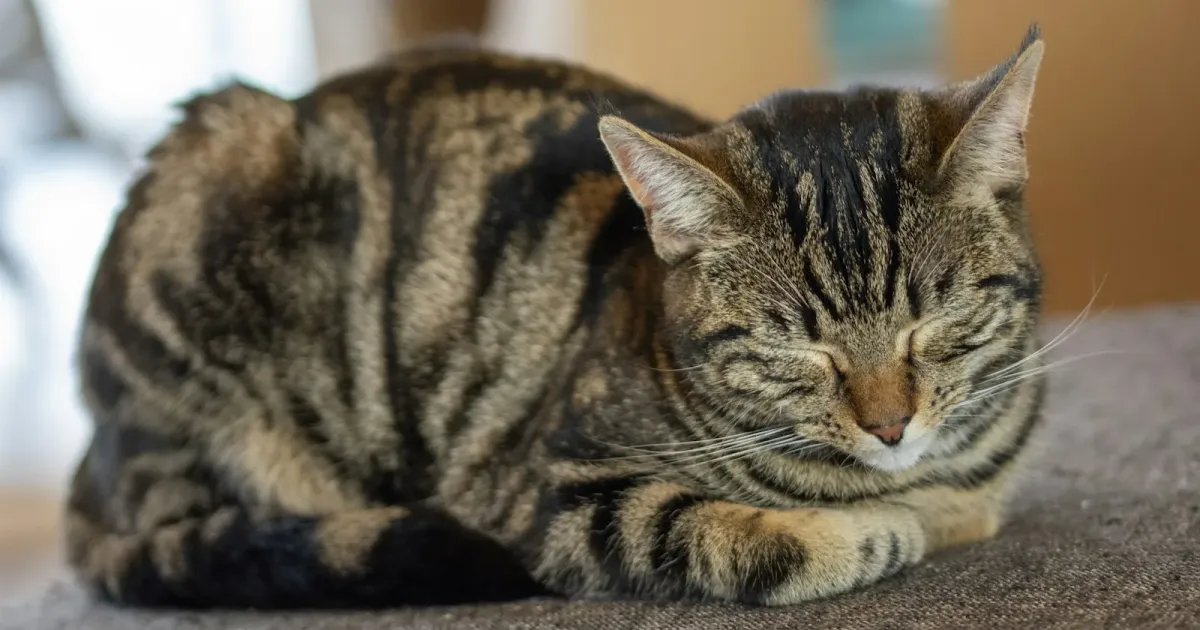
If you've ever wondered why do cats sleep so much, the short answer is that a sleepy cat is usually doing exactly what its body was built to do. A cat that spends the whole afternoon asleep on the sofa is normal.
What matters more than the total is change. Below we cover where the habit comes from and why cats twitch or nap on your lap. We also look at how sleep shifts with age and when extra sleep could mean a health problem.
Why do cats sleep so much? Quick facts
Hill's Pet Nutrition puts adult cat sleep at 12 to 16 hours a day (Hill's).
Oakland Veterinary Referral Services gives a higher average of 16 to 20 hours (OVRS).
In a 2025 French study, 12 shelter cats wearing motion-sensing collars were inactive about 85% of the time (Applied Animal Behaviour Science).
Rapid eye movement (REM) sleep makes up about a quarter of a cat's total sleep (Purina).
Cats run warm, with a body temperature around 101°F, which helps explain why they seek out human body heat (Purina).
The Cornell Feline Health Center now considers cats older at about 12 to 14 years (Cornell).
How long do cats sleep?
Most adult cats sleep somewhere between 12 and 20 hours a day, depending on which source you read. Hill's says 12 to 16 hours. OVRS, a veterinary referral hospital, gives an average of 16 to 20.
Part of that gap probably comes from what counts as sleep, because quiet resting and light dozing are easy to lump together. The 2025 study by Alia Chebly and colleagues tracked 12 cats at a shelter in France for about three weeks. The cats spent roughly 85% of their time inactive.
How much a cat sleeps also depends on the cat and the day. The Catwatch newsletter reports that indoor cats sleep more than outdoor cats, and heavier cats more than slim ones. OVRS adds that cats tend to sleep longer and deeper on cold, rainy days.
Why do cats sleep so much during the day?
Cats sleep through the day mainly because they are crepuscular and built to save energy between hunts. Their busiest hours are at dawn and dusk.
Hunting takes a lot of energy
Stalking and catching prey is hard work. Cat behavior expert Pam Johnson-Bennett, quoted by Hill's, says cats are both predator and prey, which adds stress on top of the effort. Sleep lets them recharge for the next hunt.
OVRS lists a few more reasons cats sleep: to conserve energy, to help regulate body temperature, and because it's comfortable. Your house cat may never hunt anything bigger than a toy mouse, but it keeps the same rhythm of long rests between short bursts.
They're crepuscular
Cats are often called nocturnal, but crepuscular fits better. It means most active at twilight, around dawn and dusk. Catwatch notes that cats see well in dim light, which suits hunting at those hours. Hill's says cats tend to sleep through the late morning and afternoon.
So a cat that naps through lunch and races down the hallway at 5 a.m. is following its natural clock.
Cats bend their schedule around people
Pet cats adjust their sleep to their household. WikiVet, an online veterinary reference, says cats that are closely involved with their owners are more active in daylight. OVRS notes that cats shift their naps around mealtimes and the people they like.
The French shelter study showed the same thing. The cats' activity peaked at their caretakers' morning and afternoon feeding times, and 65.8% of their activity happened during the day.
How much of a cat's sleep is deep sleep?
Only a small part. Most cat sleep is light dozing, broken up by short spells of deep sleep.
Hill's describes cats dozing for 5 to 30 minutes at a time while staying alert. Catwatch says light sleep lasts up to 30 minutes, and a cat in light sleep looks ready to spring into action. Deep sleep comes in much shorter stretches. OVRS puts them at about 5 minutes, while Catwatch says about 10.
Katherine Houpt, a veterinary behaviorist at Cornell University quoted by Catwatch, says cats usually have two major sleep periods during the night as well as their daytime naps.
Why do cats twitch in their sleep?
Cats twitch in their sleep because they're in REM sleep, the deep stage linked with dreaming. Purina says REM makes up about a quarter of a cat's total sleep.
During REM you might see whiskers flicker, ears twitch, paws paddle or the tail swish. Catwatch says cats probably dream, though nobody knows what about.
Normal sleep twitching stops as soon as the cat wakes up. Purina contrasts it with tremors, which are shaking that can happen awake or asleep, and with seizures, which can involve full-body convulsions and loss of bladder or bowel control.
Why do cats sleep on you?
Cats sleep on people mostly for warmth, comfort and a sense of safety. Purina gives a cat's normal body temperature as about 101°F, and says cats are drawn to the heat of a human body. Cats Protection compares your body to a big hot water bottle.
Sleeping on you is also a sign of trust. Veterinary behaviorist Dr. Wailani Sung told PetMD that cats are most vulnerable while asleep, so choosing to nap on you suggests your cat feels safe. Cats Protection notes that bonded cats sleep touching each other in the same way.
Scent and sound play a part as well. Purina says cats use scent glands on their bodies to mark territory. Your heartbeat and breathing may also remind a cat of snuggling with its mother and littermates. A purring lap cat is a familiar sight for a reason, and why cats purr has its own explanation.
Why do cats sleep at your feet?
Your feet let a cat stay close without feeling trapped. Purina says sleeping at your feet gives a cat a sense of connection and an easy exit if it needs one. Cats Protection adds that legs and feet are a handy spot for getting strokes and chin rubs.
Head sleepers have their own logic. Sung says your head is often uncovered, gives off warmth, and carries your scent from sweat and oil glands.
How much do cats sleep at different ages?
Kittens and senior cats sleep the most, while healthy adults settle in between.
Kittens: OVRS says newborn kittens sleep almost 24 hours a day, and older kittens average about 16 hours. Catwatch notes kittens sleep most of the time until about three months old.
Adults: about 12 to 16 hours a day, with busy spells at dawn and dusk or around your routine. Learn what normal looks like for your own cat.
Seniors: the Cornell Feline Health Center says older cats tend to be less active and playful and may sleep more.
Cornell also warns against putting every change down to age. Gradual changes in health or behavior can be signs of common diseases or dental problems that a vet should check.
When is too much sleep a sign of illness?
Extra sleep is worth a vet visit when it's new. A cat that has always slept a lot is fine. Nicholas Dodman, director of the animal behavior clinic at Tufts University's Cummings School of Veterinary Medicine, told Hill's that changes in sleep patterns may signal illness.
Catwatch links sleeping more with problems such as kidney disease, cognitive decline and cancer. Sleeping less, with more activity, can point to an overactive thyroid (hyperthyroidism) or FIV, the feline immunodeficiency virus. A change in sleeping position may mean the cat is uncomfortable.
International Cat Care says a change in a cat's normal behavior is the most significant sign of pain, because cats hide discomfort. PetMD adds that cats in pain often become less active and sleep more than they used to.
When to see a vet
Call your vet if your cat's sleep has changed and you notice any of these:
sleeping much more than usual, or resting in unusual places
resting hunched up instead of curled and relaxed
reluctance to jump or climb stairs
grooming less, leaving a scruffy coat
eating less, or becoming fussier about food
urinating or defecating outside the litter box
hiding, or less interest in people and other pets
PetMD says a cat panting at rest needs a vet immediately, since it can mean pain or trouble breathing. Never give a cat pain medicine meant for people. Cornell says six-month checkups are great for geriatric cats, which helps catch slow changes early.
Cats choose their nap spots with care, from sunny sills to cardboard boxes and freshly kneaded blankets. You'll find more in our cat behavior articles.
Frequently asked questions
How long do cats sleep?
Most adult cats sleep about 12 to 16 hours a day, and some veterinary sources put the average at 16 to 20 hours. Kittens and senior cats sleep more than healthy adults.
How many hours a day do cats sleep?
A healthy adult cat sleeps roughly 12 to 16 hours a day, mostly in light naps of up to 30 minutes. Cats sleep longer on cold, rainy days and tend to be most active around dawn and dusk.
Is it normal for a cat to sleep 20 hours a day?
Sleeping 20 hours a day can be normal for a cat, since one veterinary hospital gives 16 to 20 hours as the adult average. A sudden increase in a cat's sleep, especially with other changes, is a reason to see a vet.
Why do cats twitch in their sleep?
Cats twitch in their sleep during REM sleep, the stage linked with dreaming, which makes up about a quarter of a cat's sleep. Twitching that stops when the cat wakes is normal, but full-body convulsions need a vet right away.
Why do cats sleep on you?
Cats sleep on people for warmth, comfort and security, and because they trust them. A person's heartbeat and breathing may also remind a cat of sleeping beside its mother and littermates.
Why do cats sleep at your feet?
A cat sleeping at your feet stays close to you while keeping an easy escape route. The spot also puts the cat within reach for strokes and chin rubs.
Sources
Why Do Cats Sleep So Much?, Hill's Pet Nutrition
Why do Cats Sleep so Much?, Oakland Veterinary Referral Services
Feline Sleep Behavior: What's Normal?, Catwatch Newsletter
Assessing the circadian rhythm of cats living in a group using accelerometers, Applied Animal Behaviour Science
Timing of Feline Activity, WikiVet
Why Does My Cat Sleep On Me?, Purina
Why does my cat sleep on me?, Cats Protection
Loving Care for Older Cats, Cornell Feline Health Center
Recognising and managing acute pain in cats, International Cat Care



Comments