
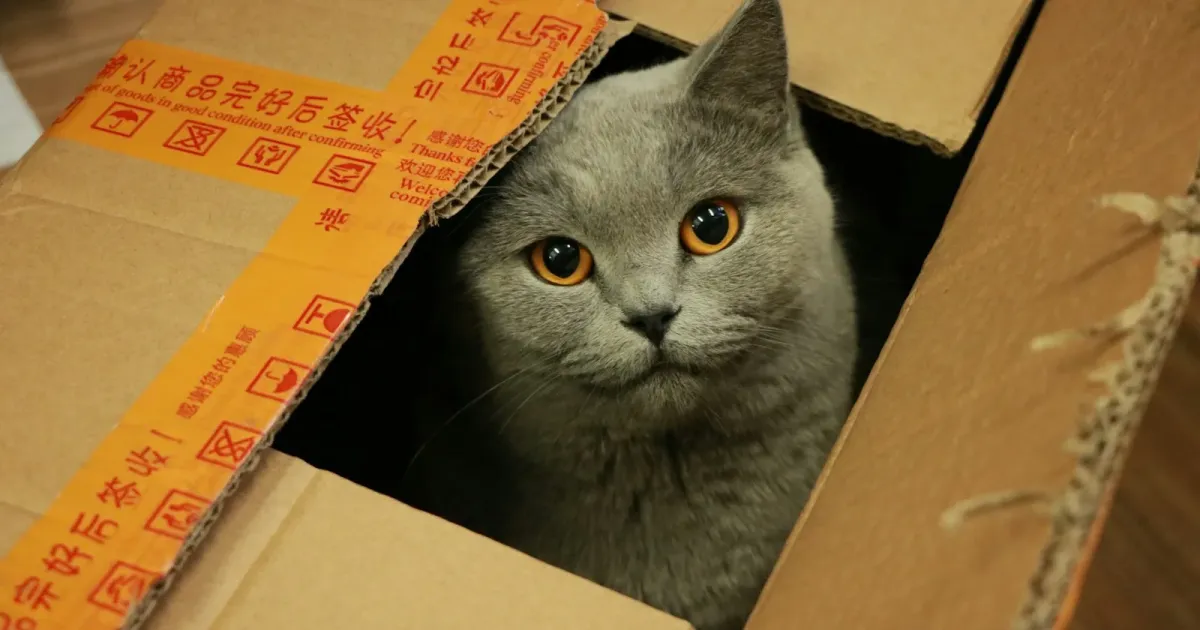
Why do cats like boxes so much that a new cat bed gets ignored while the cardboard it came in becomes a throne? Unlike most cat quirks, this one has been studied. Researchers have scored the stress levels of shelter cats with and without boxes, and even tested whether cats will sit in a square taped on the floor.
The short answer is safety. Below is what the studies found, which explanations are still guesses, and how to use a cat's love of boxes to make home less stressful.
Quick facts about cats and boxes
In a 2014 study of 19 shelter cats, cats with a hiding box recovered from arrival stress by about day 3. Cats without one took until day 14 (Utrecht University).
Given a choice of hiding place, toy, perch or empty space, 26 shelter cats spent a median 55% of their time in the hiding compartment (Behavioral Processes, 2017).
The #CatSquare trend on Twitter in 2017 showed cats sitting in squares of tape on the floor (BPS Research Digest).
In a 2021 citizen science study, cats sat in a real square 8 times, an illusory square 7 times and a control shape once (BPS Research Digest).
The US National Research Council puts a cat's thermoneutral zone at 30 to 38°C, about 86 to 100°F (Veterinary Ireland Journal).
Why do cats love boxes?
Cats love boxes because walls on most sides mean nothing can sneak up on them. Cats are predators, but they are also small enough to be prey for animals like coyotes. Companion Animal Psychology explains that enclosed spaces cover both roles: a place to stalk from unseen and a shelter from bigger animals.
Hiding is also how cats deal with things they don't like. Many cats retreat and wait for a problem to pass instead of facing it. International Cat Care says cats need secret hideaways to take a break from social contact, such as spots under the bed, inside cupboards or behind the sofa. A cardboard box does the same job in the middle of the living room.
Companion Animal Psychology also notes that safe, cat-sized spaces are one of the "five pillars" of a healthy feline environment, a framework used in feline welfare guidance.
Do boxes reduce stress in cats?
Yes, at least in shelters, where two studies have measured it.
The Utrecht hiding box study
The best-known evidence comes from the Netherlands. Vinke and colleagues at Utrecht University studied 19 cats newly arrived at a Dutch shelter and published the results in Applied Animal Behaviour Science in 2014.
Ten cats got a hiding box in their pen and nine didn't. The team scored each cat's stress for 14 days using the Kessler and Turner Cat-Stress-Score, a scale based on body posture and behavior. Here's what they found:
On days 3 and 4, cats with a hiding box had significantly lower stress scores.
Cats with boxes had recovered around day 3. Cats without boxes didn't catch up until day 14.
Scores in the box group were similar from cat to cat, while the no-box group varied widely.
The authors concluded that a hiding box seems to be an important enrichment for helping cats cope with a new shelter in the first weeks. Nineteen cats is a small sample.
Shelter cats pick hiding over toys
A 2017 study in Behavioral Processes by J.J. Ellis and colleagues gave 26 shelter cats a choice of four compartments for 10 days. One was empty, one had a prey-like toy, one had a perch and one had a place to hide.
According to the published abstract, the cats spent a median of 55% of their time in the hiding compartment. They spent just 2% with the toy and 4% in the empty space. The researchers suggested that shelters short on space or money should put hiding places first.
Why do cats sit in squares? The "if I fits, I sits" study
Cats sit in squares on the floor because even the outline of an enclosed space seems to appeal to them. In 2017, cats sitting inside squares of tape became a Twitter trend under #CatSquare, as the British Psychological Society's Research Digest notes.
Gabriella Smith of the City University of New York decided to test it. Her team's citizen science study, "If I fits I sits", was published in Applied Animal Behaviour Science in 2021. Owners printed three shapes and placed them on the floor at home:
A real square outline
A Kanizsa square, an optical illusion where four Pac-Man shapes make you see a square that isn't drawn
A control made of the same Pac-Man shapes turned so no square appears
Owners wore sunglasses during the trials so they couldn't cue their cats. Cats sat in the real square 8 times, the illusory square 7 times and the control once. Statistically, cats chose both squares over the control, with no real difference between the two squares.
That suggests cats see the illusory outline much as people do. The mere suggestion of a box seems to be enough.
Why do cats like boxes? Other possible reasons
Safety and stress relief have the strongest evidence. A few other explanations make sense but haven't been tested directly.
A hunter's hide
Cats stalk, wait and pounce. Companion Animal Psychology notes that cats like to stay invisible while they stalk prey, and a box gives them a hidden spot to watch from. Cats Protection lists lying in wait to pounce on a toy as one ordinary reason cats hide.
Warmth
Cats are comfortable at warmer temperatures than people. A Veterinary Ireland Journal article cites the US National Research Council's thermoneutral zone for cats of 30 to 38°C (86 to 100°F). That's the range where a cat doesn't have to spend energy keeping warm or cool, and most homes are cooler.
A snug box that holds body heat may help, though we found no study that tests warmth as a reason cats pick boxes. International Cat Care does say that cats prefer warm places to sleep. That matters for an animal that spends much of the day asleep, as we explain in why cats sleep so much.
Novelty and scent
A new box is something to explore and sniff. International Cat Care suggests putting out cardboard boxes or paper bags to challenge a cat's sense of smell and urge to explore. Cats also have scent glands in their paws, the same glands involved when your cat makes biscuits on a favorite blanket. A box your cat uses often may come to smell like home, though that idea is untested.
Are boxes good for cats?
Yes. A plain cardboard box is one of the cheapest bits of enrichment you can give a cat, and the shelter research suggests hiding spots help cats cope with stress. Some ways to use them:
Keep one out all the time. A box or an open carrier gives your cat a reliable retreat, and a carrier that's always out may seem less scary on vet days.
Offer hiding spots up high. International Cat Care says cats feel safe resting where they can watch from above, so try a box on a shelf or cat tree.
Help a new cat settle. Based on the Utrecht results, add a hiding box to the room where a newly adopted cat first stays.
Line it with a towel for a softer, warmer bed.
Leave your cat alone in there. International Cat Care says a cat in a private spot shouldn't be disturbed unless you think they're unwell.
When is hiding in a box a problem?
A cat in a box is normal, but hiding more than usual can mean stress or illness. Cats Protection says a cat who hides more than usual may be stressed, anxious or unwell, and recommends a vet visit to rule out medical causes.
Contact your vet if your cat:
Suddenly hides much more than normal
Hides and won't come out for food
Hides and also seems lethargic or in pain
Is hiding and also eating, drinking or using the litter box differently
Don't drag a hiding cat out. Cats Protection advises leaving them until they feel safe enough to come out, because coaxing can make them more anxious and keep them hidden longer. If your vet rules out a medical cause, a qualified cat behaviorist can help.
Frequently asked questions
Why do cats love boxes?
Cats love boxes because enclosed spaces make them feel safe and hidden. A box lets a cat rest without being disturbed and watch its surroundings unseen, and a 2014 Utrecht University study found hiding boxes helped shelter cats recover from stress faster.
What does "if it fits, I sits" mean?
"If it fits, I sits" describes a cat's habit of squeezing into boxes and other small spaces, and researchers borrowed it for the title of a 2021 study. That study, "If I fits I sits," found that cats will even sit inside square outlines on the floor, including squares that are only an optical illusion.
Why do cats sit in squares?
Cats sit in squares because the outline of an enclosed space seems to attract them even without walls. In a 2021 citizen science study, cats chose real squares and illusory Kanizsa squares over a control shape, though only nine cats sat on a shape at all.
Are boxes good for cats?
Cardboard boxes are good for cats once you remove staples, tape, plastic and handles. Boxes give cats a cheap hiding place, and research on shelter cats shows hiding spots help cats settle and cope with stress.
Do boxes reduce stress in cats?
Boxes do reduce stress in shelter cats. In a 2014 Utrecht University study, cats with a hiding box recovered from arrival stress around day 3, while cats without one took about two weeks.
Why does my cat hide in a box when guests visit?
A cat hides in a box when guests visit because hiding is a normal way for cats to cope with new or overwhelming situations. Let the cat come out in its own time. If the cat starts hiding much more than usual when nothing has changed, check in with your vet.
Want more cat explainers? See why cats hate water or browse all our cat behavior articles.
Sources
Will a hiding box provide stress reduction for shelter cats?, Utrecht University / Applied Animal Behaviour Science
If I fits I sits: A citizen science investigation into illusory contour susceptibility in domestic cats, Applied Animal Behaviour Science
Environmental enrichment choices of shelter cats, Behavioral Processes
If the cat fits, it tells us what they see, Companion Animal Psychology
Making your home cat friendly, International Cat Care
Cats hiding, Cats Protection
Cats like to sit in squares, British Psychological Society Research Digest
The heat is on: the feline TNZ, Veterinary Ireland Journal


Comments