
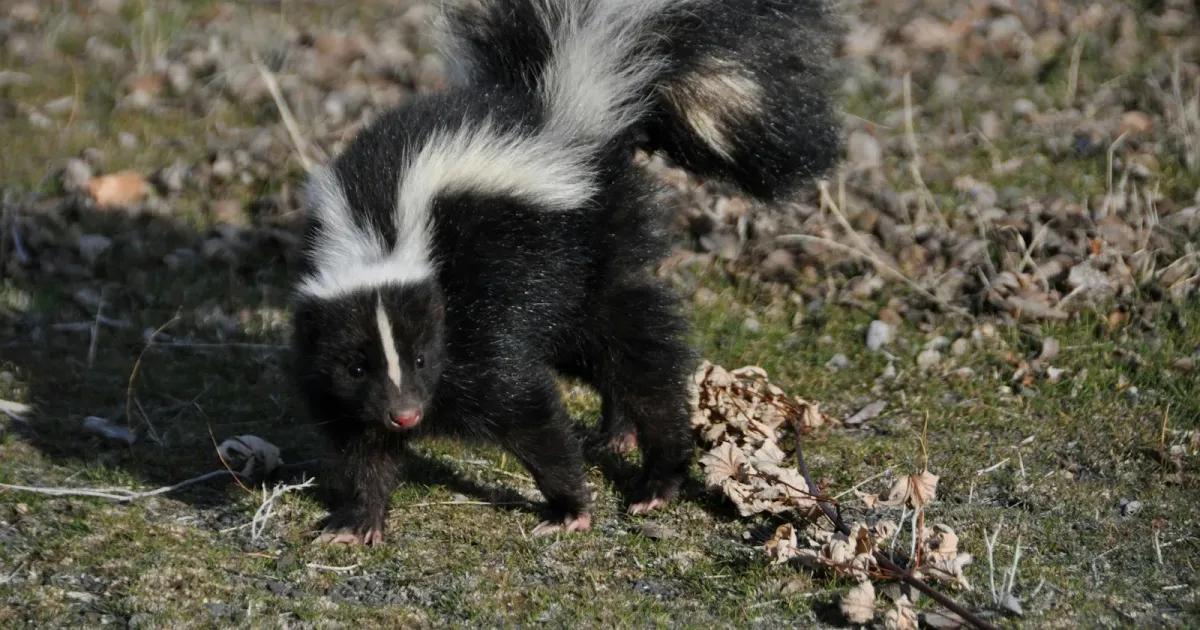
What do skunks eat? A bit of everything, but bugs come first. A striped skunk spends its nights nosing through grass and leaf litter for insects and their larvae.
That habit explains a lot. It's why skunks dig small holes in lawns, why they show up near garbage cans, and why Humane World for Animals counts them as useful pest control.
Below we look at the skunk menu, how it shifts with the seasons, and what draws skunks into backyards.
Quick facts
Up to 80 to 90 percent of a striped skunk's diet is animal food (Animal Diversity Web).
In warm months, striped skunks are mainly insect eaters (Animal Diversity Web).
Skunks can lose up to 50 percent of their body weight over winter as they live off fat (Chesapeake Bay Program).
Strong forefeet and long nails make skunks excellent diggers (Mass.gov).
Skunks are one of four wild animals considered primary carriers of rabies (Humane World for Animals).
What do skunks eat in the wild?
In the wild, skunks eat mainly insects and other small animals, plus some fruit and plants. Animal Diversity Web (ADW), run by the University of Michigan, says up to 80 to 90 percent of a striped skunk's diet comes from animals.
Here's what wild striped skunks eat, according to ADW and the Chesapeake Bay Program:
Insects: grasshoppers, crickets, beetles and bees
Larvae, such as beetle grubs
Worms and crayfish
Small mammals, especially voles
Eggs and young of ground-nesting birds
Amphibians, reptiles and fish
Carrion (animals that were already dead)
Seeds, nuts and fruit, including black cherries and ground cherries
Corn and nightshade
ADW calls the striped skunk an opportunistic feeder that changes its diet as needed. Mass.gov, the Massachusetts state wildlife site, sums it up as mostly insects, other invertebrates and fruit.
Why do skunks eat so many insects?
Skunks eat so many insects because their bodies are built for digging small prey out of the ground. Mass.gov says skunks have strong forefeet and long nails that make them excellent diggers. They're poor climbers, though, and their short legs give them a waddling walk.
That body suits a slow forager that scratches through soil and leaves for beetles, grubs and worms.
Skunks do this work in the dark. ADW says striped skunks are mostly nocturnal, active from twilight until daybreak. The Virginia Department of Wildlife Resources says they're most active at dawn and dusk.
Their spray lets them take their time. Most mammals avoid skunks because of it, ADW notes. A skunk can spray its musk up to about 10 feet, says Mass.gov, and some sources give longer distances.
How does a skunk's diet change with the seasons?
A skunk's diet swings from insects in summer to small mammals and eggs in winter. ADW describes the striped skunk as mainly insectivorous, meaning insect eating, during the warmer months.
When it gets cold, the insects disappear. ADW says the diet then shifts to small mammals like voles, along with the eggs and young of ground-nesting birds. The Chesapeake Bay Program adds worms and crayfish to the warm-season list and voles, young birds and eggs to the cold-season list.
Winter is lean. Skunks don't hibernate, but ADW says they become inactive and rely on stored fat. The Chesapeake Bay Program says skunks in cold places can lose up to half their body weight over winter. ADW gives figures of up to 47.7 percent for males and 50.1 percent for females.
Several females sometimes share a den over winter, the Chesapeake Bay Program notes. Skunks usually move into burrows dug by other animals or into hollow logs.
Why do skunks dig holes in my lawn?
Skunks dig holes in lawns to find grubs and other insects in the soil. Humane World for Animals, formerly the Humane Society of the United States, says skunks leave small, shallow holes while foraging for grubs.
These holes look a lot like squirrel digging. Mass.gov describes skunk foraging as a single small hole in a lawn, leaf litter or sand. Squirrels dig too, for different reasons. Our post on what squirrels eat covers their side of it.
Humane World points out that skunks also knock over plants and can damage crops like corn.
What do baby skunks eat?
Baby skunks learn to find food by following their mother. ADW and the Virginia Department of Wildlife Resources both describe young skunks trailing their mother in a single-file line on her nightly outings. ADW says this is how the young learn to hunt.
What do skunks eat around homes?
Around homes, skunks eat garbage, pet food, compost and bird seed on top of their wild foods. Mass.gov lists all four. Humane World says garbage and pet food left out at night are common skunk attractions.
Skunks also look for shelter near people. Humane World notes that they den under decks, sheds and porches and sometimes wander into garages.
To keep skunks from moving in, Humane World and Mass.gov suggest:
Secure trash cans with tight lids.
Feed pets indoors, or pick up bowls right after outdoor meals.
Keep bird feeders clean and pick up spilled seed.
Block gaps under porches, decks and sheds with welded wire.
Cover window wells.
Check the yard before letting pets out at night.
Raccoons and opossums go after the same trash and pet food. See what raccoons eat and what possums eat for how their diets compare.
Are skunks good to have around?
Skunks can be helpful neighbors, because they eat insects and rodents that people consider pests. Humane World makes this point directly.
Mass.gov describes skunks as typically docile animals that tolerate people nearby. They also warn before they spray. Humane World lists the signs: foot stamping, a raised tail, hissing and short charges.
Skunks have fairly short lives. ADW says striped skunks live up to about 7 years in the wild. The Virginia Department of Wildlife Resources gives average longevity of 2 to 3.5 years.
Frequently asked questions
Are skunks omnivores?
Yes, skunks are omnivores. Striped skunks eat insects, small mammals, eggs, fish and carrion, plus fruit, seeds, nuts and corn. Animal Diversity Web says up to 80 to 90 percent of their diet is animal food.
Do skunks eat cat food?
Skunks do eat cat food and dog food if it is left outside. Humane World for Animals lists pet food left out at night as a common skunk attraction. Feeding pets indoors is the simplest fix.
Do skunks eat eggs?
Skunks eat eggs, especially the eggs of ground-nesting birds. Animal Diversity Web says eggs and young birds become a bigger part of the skunk diet in winter. Skunks also eat voles and other small mammals at that time of year.
Do skunks eat mice?
Skunks eat mice, voles and other small rodents. Humane World for Animals says skunks eat insects and rodents that many people regard as pests. Voles are a key winter food, according to Animal Diversity Web.
Do skunks eat bees?
Skunks do eat bees. Animal Diversity Web lists bees alongside grasshoppers, crickets, beetles and larvae as summer foods for striped skunks. Insects make up most of a skunk's diet in warm months.
Do skunks hibernate in winter?
Skunks don't hibernate, but they become inactive in cold weather and live off stored fat. The Chesapeake Bay Program says they can lose up to 50 percent of their body weight over winter. Several females may share a den.
For more backyard wildlife diets, see what foxes eat and what deer eat. For a predator at the other end of the scale, read what lions eat. Find more in our wildlife section.
Sources
Mephitis mephitis (striped skunk), Animal Diversity Web, University of Michigan
Striped skunk, Chesapeake Bay Program
Learn about skunks, Massachusetts Division of Fisheries and Wildlife (Mass.gov)
What to do about skunks, Humane World for Animals
Striped skunk, Virginia Department of Wildlife Resources



Comments