
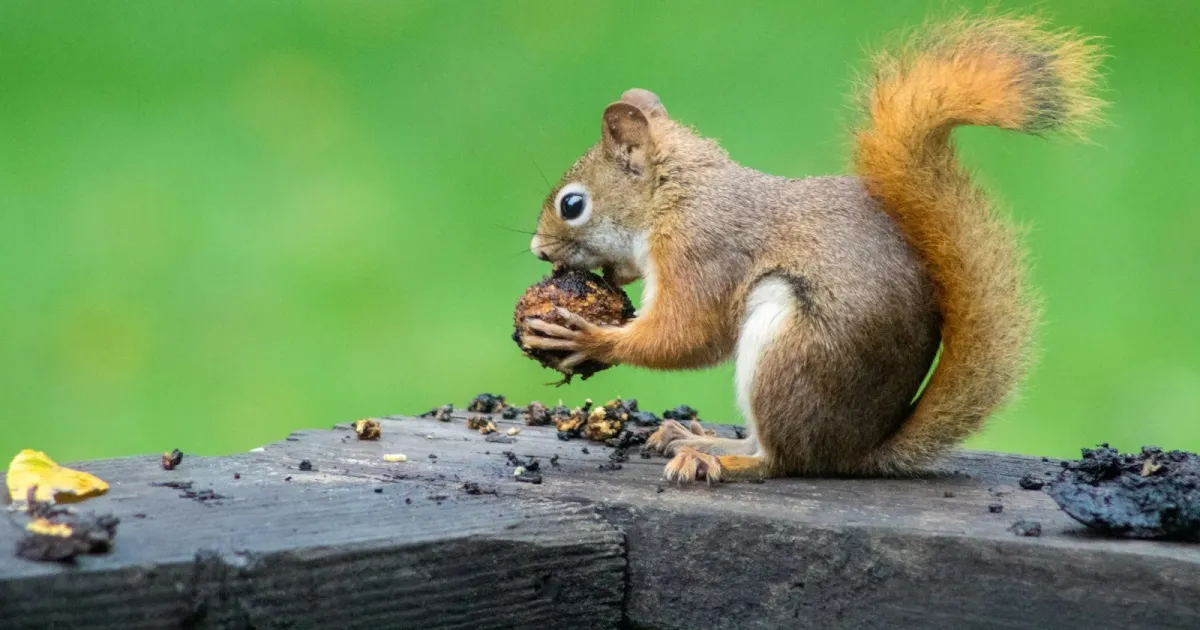
What do squirrels eat? If you've watched one in a park, the answer looks like "acorns, all day." Nuts are the backbone of the diet, but squirrels eat a much wider menu than that.
They eat buds in spring, fungi and fruit in summer, and buried nuts in winter. They'll also eat insects, raid bird feeders and, now and then, take an egg or a baby bird.
Below we focus on the eastern gray squirrel, the common backyard squirrel across much of North America. We also look at red squirrels and western species, and at why squirrels treat some acorns differently from others.
Quick facts
Eastern gray squirrels eat nuts, flowers and buds from more than 24 oak species and 10 hickory species (Animal Diversity Web).
A single gray squirrel may cache about 3,000 nuts in a season (Wildlife Online).
Gray squirrels usually bury nuts within about 150 feet of where they found them (National Wildlife Federation).
Truffle spores turned up in 272 of 275 squirrel droppings in a 2019 Washington state study (WDFW).
Central Park's 2018 Squirrel Census counted an estimated 2,373 squirrels (Central Park Conservancy).
What do squirrels eat in the wild?
Wild squirrels eat mostly plant foods: nuts, seeds, buds, flowers, fruit and fungi. Animal Diversity Web, run by the University of Michigan, gives a long list for the eastern gray squirrel.
It includes nuts, flowers and buds from oaks, hickories, pecan, walnut and beech. Squirrels also eat seeds, fruits, bulbs or flowers from maple, mulberry, hackberry, elm and horse chestnut. Cedar, hemlock, pine and spruce seeds are on the menu too.
The Central Park Conservancy adds corn, wheat, tree bark, carrion and berries. In short, a gray squirrel eats almost any plant part with energy in it.
Do squirrels eat meat?
Yes, squirrels eat some meat, though it's a small part of the diet. Animal Diversity Web says gray squirrels eat insects in summer, which are probably especially important for young squirrels. They may also eat bones, bird eggs, nestlings and frogs.
NC State Extension also lists bird nestlings and insects in the summer diet. Animal Diversity Web lists bones without explaining why squirrels eat them, and we didn't find a source that settles it.
So a squirrel at your bird feeder is mostly after seed. In summer, though, it may check a nest too.
How does a squirrel's diet change with the seasons?
A squirrel's diet tracks what's ripe. NC State Extension says squirrels eat fruits, fungi, nestlings and insects in summer. In winter, when food is scarce, they eat nuts, twigs, buds and the bark of trees.
Flowers and buds show up throughout Animal Diversity Web's list, and buds stay on the menu into winter.
Fall is harvest season. Acorns and hickory nuts drop, and squirrels spend their days eating some and burying the rest.
Why do squirrels bury nuts?
Squirrels bury nuts to save food for winter, when little else is available. Gray squirrels are scatter hoarders. They bury food in many small caches, often one nut at a time, instead of one big pile.
The National Wildlife Federation says fox and gray squirrels scatter-hoard thousands of acorns, usually within about 150 feet of the tree. Wildlife Online puts a single squirrel's total at around 3,000 nuts in a season.
Finding them again takes memory and smell. Animal Diversity Web says gray squirrels use both. A 1991 study by Jacobs and Liman found that gray squirrels dug up more of their own caches than other squirrels' caches nearby, even 12 days later. That points to real spatial memory. Squirrels may also dig fake caches when other squirrels are watching, which Wildlife Online describes as a way to fool thieves.
They don't recover everything. Wildlife Online says recovery ranges from 26% to 95% depending on the size of the nut crop. The National Wildlife Federation notes that after a big acorn year, as much as 75% of the stored acorns can be left behind. Those forgotten nuts can sprout, which is why the Central Park Conservancy calls squirrels inadvertent foresters.
Why do squirrels eat some acorns and bury others?
Squirrels tend to eat white oak acorns right away and bury red oak acorns for later. It comes down to timing and chemistry.
The National Wildlife Federation explains the difference. White oak acorns are sweet and sprout soon after they fall. Red oak acorns are bitter with tannin but contain three times more fat, and they stay dormant until spring. So a buried red oak acorn keeps until spring, while a buried white oak acorn would soon sprout.
A review published by the U.S. Forest Service, led by Michael Steele of Wilkes University, adds two clever tricks:
Gray squirrels sometimes cut the embryo out of white oak acorns. Without the embryo, the acorn can't sprout, and these acorns stayed intact in caches for up to six months.
Tree squirrels cache sound acorns and eat the ones infested with insect larvae.
Season matters too. In the same review, a 1986 study by Smallwood and Peters found squirrels chose low-tannin acorns in autumn but higher-fat acorns in winter.
What do red squirrels and western squirrels eat?
Red squirrels eat mostly conifer seeds, while western squirrels rely heavily on underground fungi. Diets shift a lot by species and forest type.
The SUNY College of Environmental Science and Forestry says conifer cone seeds are the mainstay of the American red squirrel's diet. Red squirrels cut green cones from fir, larch, cedar, pine and spruce, then store them in one or more spots in their territory. The piles of cone scraps they leave are called middens. In summer they also eat fungi and fleshy fruits, and hang them in branches to dry.
Out West, truffles are a big deal. A 2019 Washington Department of Fish and Wildlife study by Johnston and colleagues looked at droppings from eastern gray, western gray and Douglas' squirrels. Truffle spores showed up in 272 of 275 samples, in every month. Eastern gray squirrels there favored maple seeds and acorns. Western gray squirrels ate a lot of green Douglas-fir cones.
Should you feed squirrels?
It's best not to feed squirrels human food. The Central Park Conservancy asks visitors never to feed squirrels any human food. It plants native species so squirrels can find natural food instead.
If squirrels raid your bird feeders, you're not alone. NC State Extension says it's a common complaint, and squirrels often chew feeder openings and perches. Feeders draw other animals too. If you see foxes visiting, our guide on what foxes eat explains why spilled seed attracts them. If you feed birds at a pond as well, our guide to what ducks eat covers what's safe.
Frequently asked questions
What is a squirrel's favorite food?
A squirrel's favorite foods are nuts such as acorns, hickory nuts, walnuts and pecans. Animal Diversity Web lists nuts from more than 24 oak species and 10 hickory species in the eastern gray squirrel's diet. Squirrels also love seeds, buds and fruit.
Do squirrels eat bird eggs?
Yes, squirrels sometimes eat bird eggs and nestlings. Animal Diversity Web and NC State Extension both list them in the gray squirrel diet. Eggs and baby birds are an occasional food, mostly in summer.
Do squirrels eat fruit?
Yes, squirrels eat fruit and berries, especially in summer. The Central Park Conservancy lists fruits and berries in the gray squirrel diet, and NC State Extension names fruit as a summer food. Red squirrels even hang fleshy fruits in branches to dry.
What do squirrels eat in winter?
In winter, squirrels eat the nuts they buried in fall, plus twigs, buds and tree bark. NC State Extension lists these as winter foods when food is scarce. Squirrels find their buried nuts using memory and smell.
Do squirrels remember where they bury nuts?
Squirrels do remember many of their cache sites. A 1991 study by Jacobs and Liman found gray squirrels recovered more of their own nuts than nuts buried by other squirrels nearby. Smell helps them too.
Do squirrels eat mushrooms?
Yes, squirrels eat mushrooms and other fungi, including underground truffles. A 2019 Washington study found truffle spores in 272 of 275 squirrel droppings. Red squirrels eat fungi in summer too, according to SUNY ESF.
For another rodent comparison, see rat vs mouse. For more backyard animals, browse our wildlife section.
Sources
Sciurus carolinensis (eastern gray squirrel), Animal Diversity Web, University of Michigan
Eastern gray squirrel, NC State Extension
When nature goes nuts, National Wildlife magazine (1999)
Oak dispersal syndromes: do red and white oaks exhibit different dispersal strategies?, USDA Forest Service (Steele and colleagues)
What controls the caching behaviour of squirrels and how do they find their buried nuts?, Wildlife Online
Red squirrel, SUNY College of Environmental Science and Forestry
Diets of native and introduced tree squirrels in Washington, Washington Department of Fish and Wildlife (2019)
Getting to know Central Park's squirrels, Central Park Conservancy



Comments