
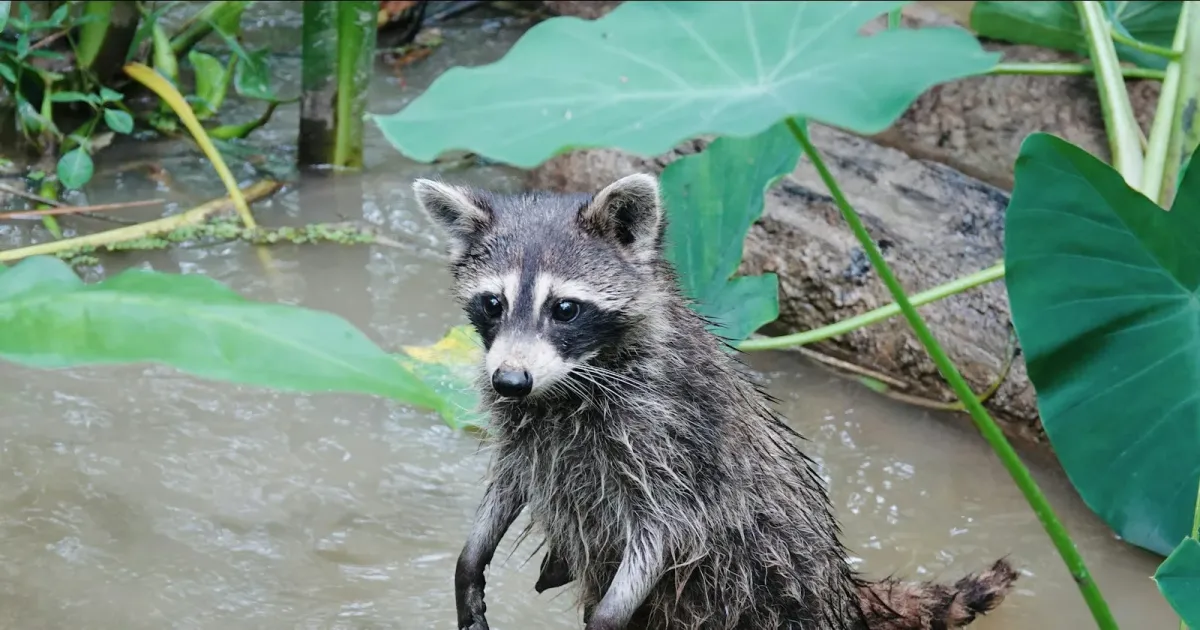
What do raccoons eat? The honest answer is "whatever they can find and pry open." A raccoon will feel around a creek bed for crayfish one night and tip over a trash can the next.
That flexibility is the reason raccoons do so well near people. National Geographic notes that raccoons have adapted so well to cities that they're now more common in cities than in the countryside.
Below we cover the wild diet, how raccoons find food with their hands, the famous "washing" habit, and what draws them into yards.
Quick facts
Raccoons usually weigh 6 to 7 kg (about 13 to 15 pounds), though the range runs from 1.8 to 10.4 kg (Animal Diversity Web).
The species name lotor means "the washer" (Animal Diversity Web).
Raccoons eat more invertebrates (animals without backbones, like crayfish and insects) than vertebrates (Animal Diversity Web).
City raccoons that eat human food grow heavier than wild raccoons living on natural foods (Washington Department of Fish and Wildlife).
Raccoons spread the seeds of the many fruits they eat (Missouri Department of Conservation).
What do raccoons eat in the wild?
In the wild, raccoons eat a mix of small water animals, insects, eggs, small mammals, fruit and nuts. They're opportunistic omnivores, which means they eat both plants and animals and take whatever is easiest at the time.
The Missouri Department of Conservation gives a long list. On the plant side: persimmons, grapes, blackberries, corn, acorns and pecans. On the animal side: crayfish, clams, fish, insects, frogs, bird eggs, mice, squirrels and rabbits.
Animal Diversity Web (ADW), run by the University of Michigan, adds wild cherries, apples and berries. ADW also makes a point that surprises many people. In some habitats, plants make up a bigger share of a raccoon's diet than animals.
Here's the wild menu in one list:
Water animals: crayfish, clams, snails, fish and frogs
Insects, slugs and earthworms
Bird eggs
Small mammals such as mice, young squirrels and rabbits
Carrion (animals that were already dead)
Fruit and berries: grapes, cherries, persimmons, blackberries, apples
Nuts and grain: acorns, pecans and corn
Why do raccoons eat so many different foods?
Raccoons eat a wide range of foods because they're generalists built to grab and handle food, not to chase it. ADW describes their forepaws as especially sensitive and able to pry open prey. Hands like that work best on food that's small, slow or stays put.
That fits the diet. ADW says raccoons eat more invertebrates than vertebrates, and crayfish, insects and snails are easy to catch by hand. Fruit and nuts are easier still, since they don't run away at all. Missouri's list shows how the menu follows what's ripe or available.
The same opportunist streak shows up in what foxes eat. Both animals do well where people live.
What do raccoons eat near water?
Near water, raccoons hunt crayfish, frogs, fish, clams and snails. The Washington Department of Fish and Wildlife (WDFW) says raccoons are especially fond of creatures found in water.
ADW notes that raccoons need ready access to water and prefer moist woodland. In wet lowlands like marshes and flood plains, ADW reports densities averaging 50 raccoons per square kilometer.
Raccoons find much of this food by feel. A Britannica video caption describes a raccoon sifting for prey using its keen sense of touch.
Do raccoons really wash their food?
Raccoons often dip or handle food in water, and the habit looks more like touching than cleaning. People have called it washing for a long time. ADW notes that the species name lotor means "the washer."
The key is the raccoon's hands. ADW says raccoons have a highly developed sense of touch, and their front paws are especially sensitive. Those paws let them handle and pry open prey, and raccoons usually pick food up with their paws before putting it in their mouth.
National Geographic also points to their dexterous front paws and long fingers. Given how much raccoons rely on their paws, the "washing" probably makes the most sense as a way to explore food by touch. Scientists haven't settled every detail, so it remains the leading idea.
What do raccoons eat in cities and backyards?
In cities and suburbs, raccoons eat garbage, pet food, bird seed and garden produce on top of their wild foods. ADW says raccoons have added trash and other suburban and urban food to their diet.
The Humane World for Animals (formerly the Humane Society of the United States) lists the common yard foods:
Garbage in open or loose-lidded cans
Pet food left outside
Seed from bird feeders
Vegetables and fruit in gardens
Earthworms and grubs dug from lawns
Fish and frogs in garden ponds
This easy food has effects. WDFW reports that urban raccoons eating human-supplied food become heavier than wild ones. It also lists human food, few predators and limits on hunting and trapping as reasons city raccoon numbers grow. In cities, a raccoon's home range can be as small as 1 mile across.
Should you feed raccoons?
No, you shouldn't feed raccoons. WDFW warns that fed raccoons lose their natural wariness and may become aggressive when they don't get fed as expected.
Feeding also packs animals together. WDFW notes that crowded raccoons pass parasites and diseases more easily. Your neighbors may not welcome the raccoons you attract either.
There's a health angle for people and pets too. The CDC says raccoons carry a roundworm called Baylisascaris. Its eggs pass in raccoon feces, and people can be infected by swallowing them. The CDC notes that human cases are not often reported but can be severe, and it advises people not to keep, feed or adopt wild raccoons.
Raccoons often use the same spots, called latrines, as toilets. If you find one in your yard, check the CDC's guidance before cleaning it up. WDFW also suggests feeding pets indoors, or at midday, with all food and spills removed before dark.
What do baby raccoons eat?
Baby raccoons live on their mother's milk until they're weaned, then shift to solid food. The Missouri Department of Conservation says young raccoons are weaned by August but stay with their mother until the following spring.
National Geographic notes that females have one to seven young in early summer. The young spend about their first two months in a tree den.
If you find a baby raccoon that seems alone, don't try to feed it. Contact a licensed wildlife rehabilitator or your state wildlife agency for advice.
Frequently asked questions
Are raccoons omnivores?
Yes, raccoons are omnivores. Animal Diversity Web describes raccoons as opportunistic omnivores that eat fruit, nuts, crayfish, insects, frogs, rodents and bird eggs.
What is a raccoon's favorite food?
Raccoons don't have one single favorite food. The Washington Department of Fish and Wildlife says raccoons are especially fond of water animals like clams, crayfish, frogs, fish and snails. In towns, raccoons also go after pet food and garbage.
Do raccoons eat bird seed?
Yes, raccoons eat bird seed from feeders. Humane World for Animals suggests taking feeders in at night or hanging them on thin poles raccoons can't climb.
Do raccoons eat mice and rats?
Raccoons do eat mice. The Missouri Department of Conservation lists mice, squirrels and rabbits among raccoon foods. To tell small rodents apart, see our guide to rats vs mice.
Do raccoons eat squirrels?
Raccoons sometimes eat squirrels, according to the Missouri Department of Conservation. Raccoons and squirrels also compete for the same acorns and fruit, which you can read about in our guide to what squirrels eat.
What do raccoons eat in winter?
Raccoons spend much of winter dormant or inactive, according to the Missouri Department of Conservation, so they forage far less than in summer. When raccoons do come out, they eat whatever wild or human food is still around. For how other animals cope with winter food, see what deer eat or browse our wildlife category.
Sources
Raccoon (Procyon lotor), Animal Diversity Web, University of Michigan
Raccoon field guide, Missouri Department of Conservation
Raccoon, Washington Department of Fish and Wildlife
Raccoon, National Geographic
Raccoon, Britannica
What to do about raccoons, Humane World for Animals
About Baylisascaris, Centers for Disease Control and Prevention




Comments