
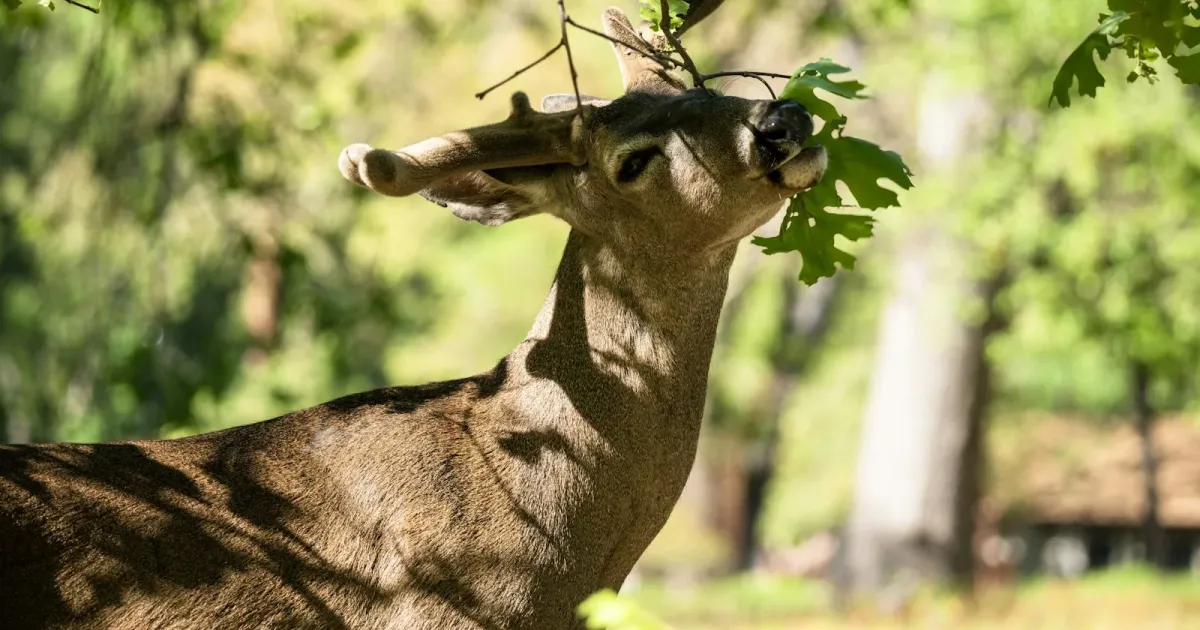
What do deer eat? Almost any plant that's tender, nutritious and within reach. The Missouri Department of Conservation describes deer as herbivores that eat the leaves, twigs, fruits and nuts of trees and shrubs, plus non-woody plants, grasses and crops.
That list explains a lot about where you see deer. They love the edges between woods and open ground, where shrubs, grasses and fields meet. It also explains why a leafy suburban garden can look like a buffet to them.
Below we cover the main foods, how a deer's stomach handles them, how the menu changes through the year, and what that means for your yard.
Quick facts
White-tailed deer are crepuscular, feeding mostly around dawn and again from late afternoon to dusk (Animal Diversity Web).
Deer are ruminants with four-chambered stomachs, and they chew cud brought back up from the rumen (National Park Service).
White-tailed fawns become fully ruminant at about two months old (Animal Diversity Web).
Mule deer eat roughly 22 grams of food per kilogram of body weight each day (Animal Diversity Web).
Britannica counts 43 deer species, native to every continent except Australia and Antarctica (Britannica).
What do deer eat in the wild?
In the wild, deer eat mostly leaves, twigs and buds of woody plants, plus grasses, wildflowers, fruits and nuts. Exactly which plants depends on where they live.
Animal Diversity Web (ADW), a University of Michigan database, gives a good sense of the range for white-tailed deer. In forests they eat buds and twigs of maple, sassafras, poplar, aspen and birch. In the deserts of the Southwest they eat yucca, prickly pear cactus and tough shrubs.
The Missouri Department of Conservation adds succulent grasses, farm crops, and now and then fungi, mosses and lichens. National Geographic lists corn and alfalfa among the foods white-tailed deer graze on.
The wild deer menu, in short:
Leaves, buds and twigs of trees and shrubs
Forbs, which are soft flowering plants like wildflowers and clover
Grasses, especially young, green ones
Acorns and other nuts
Berries and other fruit
Farm crops such as corn and alfalfa
Mushrooms, mosses and lichens
How does a deer's stomach digest plants?
A deer digests tough plants with a four-chambered stomach and a second round of chewing called "chewing the cud." Animals built this way are called ruminants.
The National Park Service explains it for mule deer. Food goes first into the rumen, the first chamber. Later the deer brings the softened food (the cud) back up and chews it again.
This setup suits a prey animal. Wikipedia's summary of white-tailed deer biology notes that the four-part stomach lets a deer eat a range of foods and digest them later in a safer spot. Rechewing also grinds plant matter smaller, which helps the deer absorb more of it.
The system takes time to develop. ADW notes that white-tailed fawns become fully ruminant at about two months old.
Are deer browsers or grazers?
Deer lean toward browsing, which means eating leaves and twigs from shrubs and trees, though they graze on grass too. A grazer, by contrast, feeds mostly on grass.
ADW describes mule deer as intermediate feeders. They eat woody and soft, leafy plants in roughly equal amounts. But they don't do well on twigs alone. ADW says a diet made mostly of woody twigs can't meet a mule deer's basic needs.
The National Park Service gives the reason. For an animal their size, mule deer have small stomachs. So they have to be picky and choose higher quality, more nutritious plants. That's why deer move from plant to plant, taking the tenderest bits, instead of mowing down a whole patch like a cow.
How does a deer's diet change with the seasons?
A deer's diet follows what's available, so it eats soft green plants in spring and summer, nuts and fruit in fall, and woody twigs in winter. ADW notes that white-tailed deer often turn to conifers in winter, when other foods run short.
Here's how the year tends to look:
Spring brings new buds, young grasses and fresh leaves, which are easy to digest.
Summer adds wildflowers, clover, garden plants and crops.
Fall is mast season. Mast means the nuts and fruit trees drop, like acorns, berries and other fruit.
Winter leaves mostly twigs, buds and evergreen browse.
Deer also change how much they eat. ADW describes a yearly cycle in mule deer. They eat more in summer and store fat, then slow their metabolism in winter so they can get by on poorer food. ADW adds that adult males eat much less once the fall rut, or breeding season, starts.
The acorn and berry season matters because it comes right before winter. Animals as different as deer, squirrels and foxes all take advantage of that fall supply.
What do mule deer eat compared to white-tailed deer?
Mule deer and white-tailed deer eat many of the same kinds of plants, but they live in different places, so the actual species differ. ADW says white-tailed deer live across southern Canada and all of the mainland US except two or three western states, and south through Central America to Bolivia. Mule deer live in western North America.
The National Park Service says mule deer feed mainly on forbs, leaves and twigs of woody plants, and mast like berries and fruit. In the grasslands of western Nebraska and the Dakotas, they browse heavily on skunkbush sumac and Rocky Mountain juniper. They may even eat the pads of prickly pear cactus.
ADW lists acorns, legume seeds and fleshy fruits for mule deer too. The main difference is local. Each deer eats what grows best in its own patch of country.
What do deer eat in your yard?
In yards, deer eat many of the same leafy plants they eat in the wild, which often means flowers and shrubs. Your garden is basically an edge habitat with extra-tender food.
Rutgers University's New Jersey Agricultural Experiment Station rates hundreds of yard plants by how often deer damage them. Its scale runs from A (rarely damaged) to D (frequently severely damaged). Rutgers recommends sticking with A and B plants where deer are a problem.
Examples on Rutgers' "rarely damaged" list include:
Ageratum
Barberry
Bleeding heart
Blue fescue
Bayberry
American holly
Rutgers is clear that no plant is deer proof. How much damage you see depends on local deer numbers and the weather. A plant deer skip in a mild year may get eaten in a hard winter.
When do deer eat?
Deer eat mostly around dawn and dusk. ADW describes white-tailed deer as crepuscular, meaning most active in twilight. They feed from before dawn until a few hours after, then again from late afternoon until dusk.
National Geographic adds that white-tailed deer are mainly nocturnal or crepuscular, though they sometimes come out in daylight.
Frequently asked questions
What do deer eat in the winter?
In winter, deer eat mostly twigs, buds and evergreen plants because soft greens are gone. Animal Diversity Web notes that white-tailed deer often turn to conifers when other food is scarce.
Do deer eat meat?
Deer are classified as herbivores by Animal Diversity Web and the Missouri Department of Conservation. Their diet is built around leaves, twigs, grasses, nuts and fruit, and their four-chambered stomach is designed for digesting plants.
What do baby deer eat?
Baby deer, called fawns, need time before they can digest plants the way adults do. Animal Diversity Web says white-tailed fawns become fully ruminant at about two months old.
Do deer eat acorns?
Yes, deer eat acorns. Animal Diversity Web lists acorns among mule deer foods, and nuts are a main part of the white-tailed deer diet in fall, according to the Missouri Department of Conservation.
What plants will deer not eat?
No plant is fully deer proof, according to Rutgers University. Rutgers rates plants like barberry, bleeding heart, blue fescue and American holly as rarely damaged by deer.
What do deer eat besides plants?
Besides green plants, deer eat fungi, mosses and lichens now and then, says the Missouri Department of Conservation. For other plant-eating wildlife, see our guide to what rabbits eat or browse the wildlife category.
Sources
White-tailed deer (Odocoileus virginianus), Animal Diversity Web, University of Michigan
Mule deer (Odocoileus hemionus), Animal Diversity Web, University of Michigan
White-tailed Deer field guide, Missouri Department of Conservation
Mule Deer, National Park Service
White-tailed deer, National Geographic
Deer, Britannica
White-tailed deer, Wikipedia
Landscape Plants Rated by Deer Resistance, Rutgers New Jersey Agricultural Experiment Station
White-tailed Deer, New York State Department of Environmental Conservation



Comments