
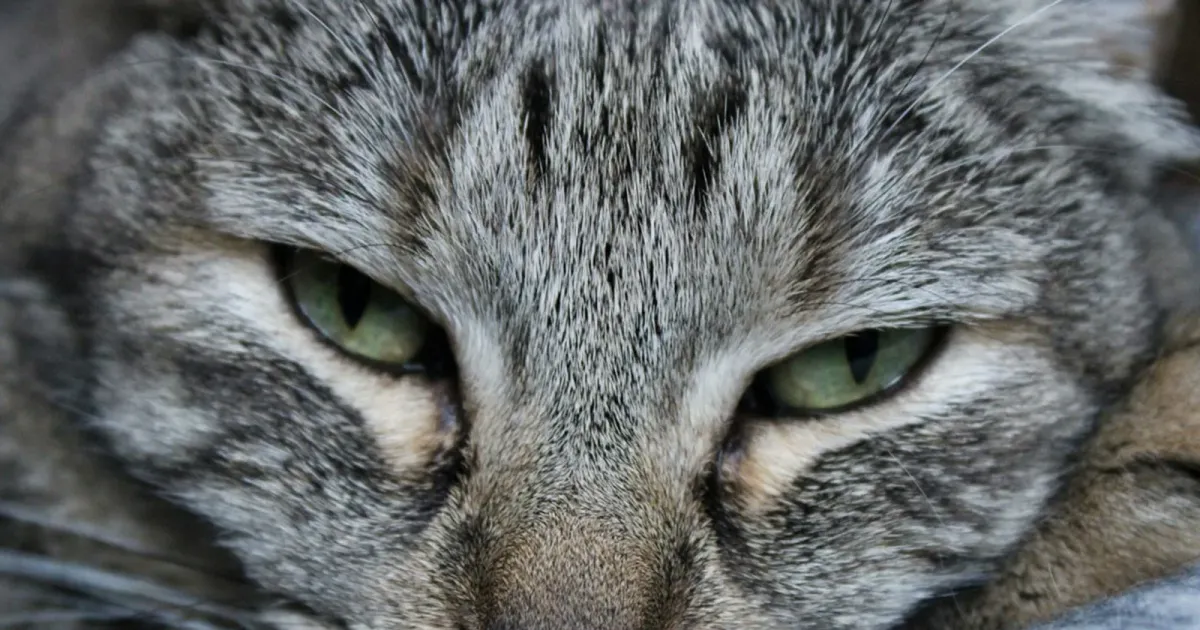
For a long time people said cats were completely color blind. That turned out to be wrong. So what colors can cats see? Mostly blues and yellows, while reds and oranges look dull or grayish. A cat's view of your living room is probably a bit like a faded photo with the reds washed out.
The reason comes down to how cat eyes are built. They gave up some color and sharpness in exchange for excellent vision at dawn, dusk and night. Here's what the research shows.
Quick facts
Cats are dichromatic, with two types of cones peaking near 460 nm (blue) and 560 nm (yellow-green), a 2016 study in Experimental Eye Research concluded.
Cats have 6 to 8 times more rod cells than humans, while humans have about 10 times more cones, according to veterinarian Kerry Ketring in NBC News.
The Merck Veterinary Manual says cats see about 6 times better than people in dim light.
A cat's field of view is about 200 degrees, compared with about 180 for people (Popular Science, 2013).
Something a person sees sharply from 100 to 200 feet away needs to be within about 20 feet for a cat to see it clearly, Ketring told NBC News.
What colors can cats see?
Cats see blues and yellows best, and reds, oranges and browns look muted or gray. VCA Animal Hospitals says cats are not completely color blind and can see blue, yellow and shades of gray.
The best test of this comes from a 2016 study by Daria Clark and Robert Clark in Experimental Eye Research. They trained two cats to pick out colored lights from plain white ones. To stop the cats from cheating on brightness, the researchers kept changing how bright the white light was.
Both cats easily told apart wavelengths from 456 to 497 nanometers (blues) and 510 to 524 nanometers (greens). Both failed at about 505 nm, a blue-green the cats couldn't tell apart from white. Scientists call that a neutral point. Having one is a sign of two-cone, or dichromatic, vision.
The Clarks wrote that cat color vision is comparable to red-green color blindness in people. Earlier studies had suggested cats might have three-color vision, so their result went against older work. The Merck Veterinary Manual is more cautious and says it's uncertain how well cats see color. Most of the evidence now points to two-color vision.
How do cats see color compared to humans?
Cats see fewer colors than people because they have two working cone types where we have three. Human cones are most sensitive to red, green and blue light, NBC News explains.
Cones are the cells in the retina (the light-sensing layer at the back of the eye) that detect color and work best in bright light. Rods handle dim light and movement, VCA says. Cats have far more rods than cones.
That trade-off shapes everything about a cat's view. In bright daylight, VCA notes, people often see better than cats. Cats also see colors less vividly. Popular Science, working with ophthalmologists at the University of Pennsylvania's veterinary school, described cat vision as missing red, orange and brown tones.
Dogs have a similar setup. Our guide to what colors dogs can see explains how canine vision compares.
Can cats see red?
Cats probably can't see red as a distinct color. To a cat, red objects likely look dark or grayish, and they may blend with greens.
That follows from the 2016 study. A cat's longer-wavelength cone peaks near 560 nm, which is yellow-green light. Light much redder than that barely stimulates it. So a red ball may look about as interesting to a cat as a gray one, unless it moves.
This is also why laser pointers still work. A cat may not see the red dot the way you do, but it sees a bright, moving spot. Cats are wired to notice motion, and VCA says the tapetum lucidum (a mirror-like layer behind the retina) helps them detect movement and see in the dark.
Why do cats see fewer colors?
Cats likely traded color for night vision because they hunt in low light. VCA notes that cats are built to hunt in the evening, at night and in the early morning.
Several features help:
Lots of rod cells, which pick up faint light
Pupils that open very wide in the dark
The tapetum lucidum, which bounces light back through the retina for a second chance at being detected
The Merck manual says the tapetum gives cat eyes their blue or greenish glint at night. It also says cats see about 6 times better than people in dim light. Popular Science put the figure at six to eight times better.
Neither source says cats see in total darkness. Merck calls that a myth. Cats need at least a little light.
There's a cost in sharpness too. Ketring told NBC News that cats need to be about 20 feet from an object to see it as sharply as a person standing 100 to 200 feet away. VCA adds that nearsightedness is common in cats. Their wide field of view, about 200 degrees, makes up for it by catching movement at the edges.
What colors do cats like?
No study has shown that cats prefer one color, but blues and yellows are the colors they see best. If you pick toys with that in mind, a blue or yellow toy will likely stand out more for a cat than a red one.
Movement probably matters more than color. A dull toy that darts and twitches will grab a cat's attention faster than a bright one that sits still. Our posts on why cats like boxes and why cats make biscuits look at other things that matter to cats.
How can you tell if your cat's vision is changing?
Cats with failing eyesight often bump into things, avoid dark rooms or have pupils that stay wide in bright light. Because cats rely so heavily on rods, problems with those cells often show up first as trouble seeing at night.
VCA's guide to progressive retinal atrophy (PRA, an inherited disease that slowly destroys the retina) says night blindness is usually the first sign. PRA isn't painful, so indoor cats can lose a lot of sight before anyone notices. Abyssinian and Persian cats are the breeds with confirmed inherited forms.
When to see a vet
See a vet promptly if your cat shows any of these signs:
Sudden blindness, or suddenly bumping into furniture
Pupils that stay very large even in bright light
Pupils of two different sizes
Nervousness at night or reluctance to enter dark rooms
Unusually shiny or reflective eyes
Sudden blindness is urgent. VCA says retinal detachment is often caused by high blood pressure linked to kidney disease or hyperthyroidism. Caught early, many cats regain normal vision. Left for even a few days, the loss can be permanent. Regular checkups also help keep older cats healthy, which matters for how long cats live.
Browse more of our cat articles for other questions about feline senses and behavior.
Frequently asked questions
What colors can cats see?
Cats can see blues and yellows best, along with many shades of gray. Reds, oranges and browns look muted to cats, and cats likely confuse reds with greens.
Are cats color blind?
Cats are not completely color blind. A 2016 study in Experimental Eye Research found cats are dichromatic, with color vision similar to red-green color blindness in people.
Can cats see red?
Cats probably don't see red as a separate color. A cat's color cones respond best to blue and yellow-green light, so red objects likely look dark or grayish to a cat.
Can cats see in the dark?
Cats can't see in complete darkness, but cats see far better than people in dim light. The Merck Veterinary Manual puts cat vision at about 6 times better than human vision in low light.
What color is easiest for cats to see?
Blue is likely the easiest color for cats to see, with yellow close behind. Cat cones are most sensitive near 460 nm, which is blue light, and near 560 nm, which is yellow-green.
Do cats see the same colors as dogs?
Cats and dogs see a fairly similar range of colors, according to veterinarian Kerry Ketring in NBC News, though cat color vision may be less rich. Both animals see fewer colors than people with three working cone types.
Sources
Neutral point testing of color vision in the domestic cat, Experimental Eye Research (Clark and Clark, 2016)
Do Cats See Color?, VCA Animal Hospitals
How your kitten's senses differ from yours, VCA Animal Hospitals
Eye Structure and Function in Cats, Merck Veterinary Manual
See the world through the eyes of a cat, Popular Science
Progressive Retinal Atrophy in Cats, VCA Animal Hospitals
Retinal Detachment in Cats, VCA Animal Hospitals



Comments