
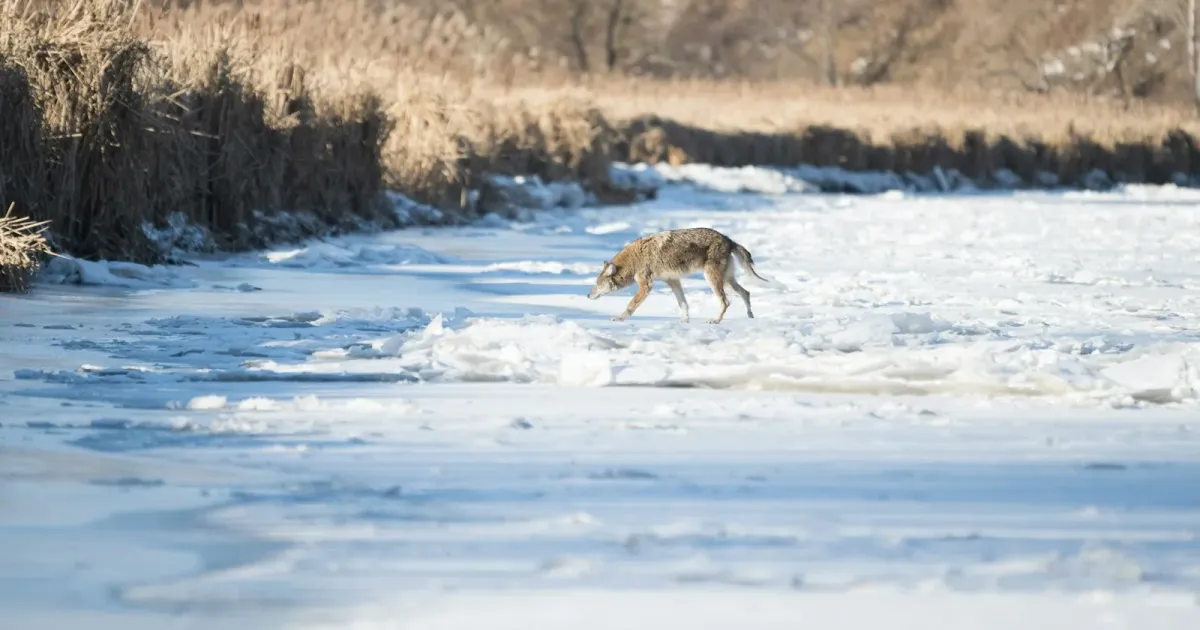
From a distance, a coyote and a wolf can look a lot alike. Both are wild members of the dog family, both come in grays and browns, and both howl. Coyotes even go by the nickname "prairie wolf," according to Britannica.
Up close, the two animals live very different lives. A Yellowstone wolf lives mostly on elk. A Yellowstone coyote lives mostly on voles, mice and rabbits. Those jobs shape everything from their skulls to their family size, and they explain why wolves treat coyotes as rivals.
Quick facts
Yellowstone's male wolves average 100 to 130 pounds and females 80 to 110 pounds (National Park Service).
Yellowstone's coyotes weigh 25 to 35 pounds and stand 16 to 20 inches at the shoulder (National Park Service).
Wolf tracks are about 5 inches long by 4 inches wide, and coyote tracks are about half that size (Washington Department of Fish and Wildlife).
After wolves returned to Yellowstone, coyote numbers on the park's northern range dropped by as much as 50% (National Park Service).
Coyotes can run up to 40 miles per hour (National Geographic).
Coyote vs wolf: how big is each one?
A wolf is much bigger than a coyote, roughly two to three times the size. Exact figures vary by region, so it helps to look at one place with both animals.
In Yellowstone National Park, the National Park Service (NPS) gives these numbers:
Wolves stand 26 to 36 inches at the shoulder and are 4 to 6 feet long from nose to tail tip.
Male wolves average 100 to 130 pounds, and females 80 to 110.
Coyotes stand 16 to 20 inches at the shoulder and weigh 25 to 35 pounds.
The NPS describes a coyote as about one-third a wolf's size, with a slighter build. Washington's Department of Fish and Wildlife (WDFW) puts it a little differently, calling wolves about twice the size of coyotes.
Across their whole range, both species vary a lot. The U.S. Fish and Wildlife Service says adult gray wolves weigh 40 to 175 pounds, depending on sex and location. National Geographic lists coyotes at 20 to 50 pounds.
At a glance
Size: wolves are about two to three times bigger, per the NPS and WDFW.
Muzzle: a wolf's is larger and blockier than a coyote's.
Ears: wolf ears are shorter and more rounded.
Tail: a wolf's tail is shorter and bushier, says WDFW.
Tracks: wolf prints run about 5 by 4 inches; coyote prints are roughly half that.
Prey: wolves hunt elk, deer and moose; coyotes mostly catch voles, mice and rabbits.
Family groups: wolves live in packs of about six to ten; coyotes often live as a pair with pups.
How can you tell a coyote from a wolf?
Look at the head, ears, tail and tracks along with overall size. Body size alone can mislead you, since both species vary from place to place.
WDFW lists the clearest features. Wolves have larger, blockier muzzles than coyotes. Their ears are shorter and more rounded. Their tails are shorter and bushier.
Color is less helpful. The U.S. Fish and Wildlife Service says wolf coats vary more than almost any other species, from white to gray to brown to coal black. The NPS says gray is most common in wolves, while coyotes run tan to buff, sometimes gray, with orange on the ears and tail.
What do wolf and coyote tracks look like?
Wolf tracks are big, about 5 inches long and 4 inches wide, according to WDFW. They show four even toes, visible claw marks and a single lobe on the front of the main pad. Coyote tracks are about half that size.
WDFW notes that even a large domestic dog usually leaves smaller prints than a wolf. A wolf's trail also tends to run in a direct, purposeful line, while a dog's trail wanders.
What do coyotes and wolves eat?
Wolves mainly hunt large hoofed animals, while coyotes eat mostly small animals and almost anything else they find.
The U.S. Fish and Wildlife Service says North American wolves mainly prey on moose, elk, deer, caribou, muskox and bison. In Yellowstone, elk make up about 90% of a wolf's winter diet, the NPS says. National Geographic notes a single wolf can eat up to 20 pounds of meat in one sitting.
Yellowstone's coyotes eat voles, mice, rabbits, other small animals and carrion, according to the NPS. They take only very young elk calves in spring. National Geographic calls coyotes opportunists that will eat almost anything, from frogs and insects to fruit and grass.
Diet can shift by region. New York's Adirondacks are one example. There, the State University of New York College of Environmental Science and Forestry (SUNY ESF) found white-tailed deer were the eastern coyote's main food in every season. Snowshoe hare came next.
Foxes fill a similar small-prey niche. Our post on what foxes eat compares them.
Do coyotes and wolves live in packs?
Wolves live in packs, while coyotes usually live in smaller family groups. National Geographic says wolves live and hunt in groups of about six to ten.
Coyotes are more flexible. National Geographic says they form strong family groups and may team up in fall and winter to hunt. In Yellowstone, the NPS reports that coyotes once lived in packs of up to seven before wolves came back. Afterward, they returned to pairs with pups, which the NPS calls more typical.
National Geographic links the coyote's seasonal teamwork to hunting more effectively. For wolves, the pack is the hunting unit year-round.
Do wolves kill coyotes?
Yes, wolves kill coyotes, and they can drive coyote numbers down. Yellowstone gave scientists a clear example after wolves were restored to the park.
The NPS reports that wolves killed dozens of coyote pups and adults, often at the carcasses of wolf kills. On the northern range, the coyote population fell by as much as 50% through competition, predation and lost territory.
Many of those deaths happened at carcasses, where coyotes came to scavenge. A coyote near a wolf kill is in real danger.
Why are coyotes everywhere but wolves are not?
Coyotes adapt to almost any habitat and diet, which has let them spread across North America. Wolves need large prey and room to roam.
National Geographic says coyotes once lived mostly in prairies and deserts but now range through forests, mountains and even cities like Los Angeles. Britannica says they're found from Alaska south into Central America. SUNY ESF notes the coyote was originally a Great Plains and Southwest animal and reached New York's Adirondacks between 1920 and 1940.
Gray wolves once ranged across the Northern Hemisphere, according to National Geographic. Today most live in Alaska, Canada, Asia and parts of Europe, with reintroduced groups in the lower 48 states.
Are eastern coyotes part wolf?
Researchers aren't fully settled on this. SUNY ESF says eastern coyotes are larger than western ones and that there's confusion and controversy over their family tree. Scientists suspect coyotes interbred with gray wolves as they spread, and later with dogs. SUNY ESF adds that today's coyotes breed true, so matings produce coyotes, not hybrids.
Do coyotes and wolves howl differently?
Both howl to keep in touch over long distances. National Geographic says wolves howl to call their pack together and to send territorial messages to other packs.
The NPS calls coyotes "song dogs" for their range of long-distance calls, including howls at dawn and dusk. Britannica describes their nightly mix of yaps and howls. Our post on why dogs howl covers what pet dogs inherited from these wild cousins.
Frequently asked questions
Which is bigger, a coyote or a wolf?
A wolf is much bigger than a coyote. In Yellowstone, male wolves average 100 to 130 pounds, while coyotes weigh 25 to 35 pounds, according to the National Park Service.
Would a coyote win a fight with a wolf?
A coyote is far smaller than a wolf and usually loses. After wolves returned to Yellowstone, the National Park Service reports that wolves killed dozens of coyotes and the northern range coyote population fell by as much as 50%.
Can coyotes and wolves mate?
Scientists suspect coyotes interbred with gray wolves as coyotes spread north and east, according to SUNY ESF. SUNY ESF notes the eastern coyote's ancestry is still debated, and today's coyotes breed true.
How long do coyotes and wolves live?
Yellowstone's coyotes live about 6 years on average, and some reach 13, per the National Park Service. Yellowstone wolves often live 3 to 4 years, with some reaching 11, while National Geographic gives gray wolves an average wild lifespan of 6 to 8 years.
How fast can a coyote run?
A coyote can run up to 40 miles per hour, according to National Geographic. The U.S. Fish and Wildlife Service notes that wolves have long legs well suited to running.
Is a coyote a type of wolf?
A coyote is a separate species from the gray wolf, though both belong to the dog family, Canidae. Britannica notes the coyote is sometimes called the prairie wolf or brush wolf.
More side-by-side matchups: see bison vs buffalo and raven vs crow, or browse all our animal comparisons.
Sources
Wolves, Yellowstone National Park, National Park Service
Coyote, Yellowstone National Park, National Park Service
Gray Wolf, U.S. Fish and Wildlife Service
Gray Wolf (Canis lupus), Washington Department of Fish and Wildlife
Coyote, National Geographic
Gray Wolf, National Geographic
Coyote, Encyclopaedia Britannica
Coyote, Adirondack Ecological Center, SUNY ESF



Comments