
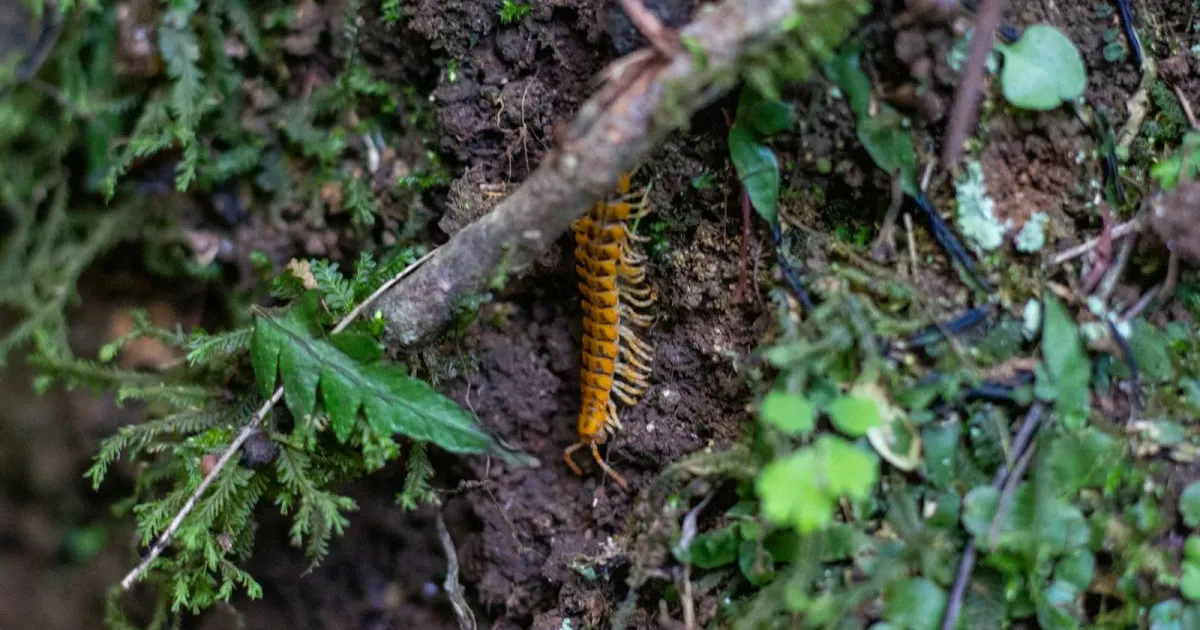
Both are long, both have lots of legs, and both tend to show up when you lift a damp board. That's where the similarity mostly ends. One is a quick predator. The other is a slow, plant-eating recycler.
The differences make sense once you see how each one makes a living. Here's how to tell them apart, and why their bodies are built the way they are.
Quick facts
Centipedes belong to the class Chilopoda, with nearly 3,000 known species (Britannica).
Millipedes belong to the class Diplopoda, with about 10,000 species (Britannica).
The largest centipede, Scolopendra gigantea of the American tropics, reaches about 11 inches (Britannica).
In 2021, scientists described Eumillipes persephone, the first millipede known with more than 1,000 legs, from 60 meters underground in Western Australia (Scientific Reports, 2021).
The adult house centipede has 15 pairs of legs (Penn State Extension).
Centipede vs millipede: what's the main difference?
The main difference is the number of legs on each body segment. A centipede has one pair per segment, and a millipede has two pairs on most segments.
The University of California's Integrated Pest Management program (UC IPM) uses that as its first ID tip. Britannica adds the detail that a millipede's first segment has no legs and the next three have one pair each. After that, every segment carries two pairs. Penn State Extension describes the same pattern.
You can often spot the difference without counting. UC IPM describes millipede legs as tiny. A house centipede's legs are long, and Penn State says its last pair can be nearly twice the length of its body.
At a glance
Legs per segment: centipedes have one pair; millipedes have two pairs on most segments.
Size: UC IPM says centipedes are usually over 1 inch long; millipedes run from 1/2 to 6 1/2 inches.
Speed: centipedes move fast; millipedes move slowly in a wave-like ripple.
Diet: centipedes hunt small animals; millipedes mostly eat decaying plants.
Defense: centipedes bite with venomous claws; millipedes curl up and release a defensive liquid.
Rear legs: a centipede's last pair points backward; a millipede's doesn't, per UC IPM.
Bites: centipedes can bite people; UC IPM says millipedes don't bite.
Do centipedes really have 100 legs?
No, centipedes don't have a fixed 100 legs, and millipedes almost never reach 1,000. Britannica says centipedes have from 14 to 177 pairs of legs, depending on the species.
The house centipede, the one most people meet indoors, has just 15 pairs, according to Penn State Extension.
Millipedes vary even more. Britannica says some have as many as 200 pairs. The name means "a thousand feet," from the Latin words for thousand and foot, as the 2021 Scientific Reports paper points out. For a long time no millipede came close.
That changed with Eumillipes persephone. A team led by Paul Marek described a female with 330 segments and 1,306 legs. It was found in a mineral exploration drill hole about 60 meters deep. The previous record holder, Illacme plenipes, had 750 legs.
Why are centipedes fast and millipedes slow?
Centipedes are fast because they chase prey, and millipedes are slow because they push through soil and leaf litter. Each body suits its job.
Britannica notes that house centipedes and stone centipedes are the fastest. Not every centipede sprints, though. Soil centipedes and the big scolopendrids move more slowly, and soil centipedes burrow.
A millipede moves in a wave. UC IPM describes its motion as wavelike, with the many short legs stepping in sequence. That's built for pushing, not speed. The Eumillipes persephone researchers explain that each added segment gives a bit more pushing power through soil. Its flexible segments also let it squeeze through narrow cracks underground.
What do centipedes and millipedes eat?
Centipedes eat other small animals, while millipedes mostly eat decaying plant matter. That split explains most of their other differences.
Britannica calls centipedes predators that hunt small invertebrates. Penn State lists the house centipede's prey as silverfish, firebrats, carpet beetle larvae, cockroaches, spiders and other small arthropods. A house full of house centipedes often means a house with plenty for them to eat, Penn State notes.
Millipedes are recyclers. Britannica says most of the roughly 10,000 species live in and eat decaying plants. A few injure living plants, and a few are predators or scavengers. UC IPM notes that large numbers of millipedes can damage seedlings or fruit lying on damp soil.
Both animals help a garden in their own way. UC IPM says centipedes usually play a beneficial role as predators, and millipedes help break down dead plant matter.
Are centipedes or millipedes dangerous?
Centipedes can bite, and the bite of a large species can hurt, but millipedes don't bite at all.
Centipedes carry a pair of venomous, jaw-like claws just behind the head, according to Britannica. They use them to subdue prey. UC IPM says some large centipedes can give painful bites, and Britannica notes the big scolopendrids can bite severely.
Millipedes defend themselves differently. Britannica says most tuck their head in and roll into a tight coil. Many also release a pungent, toxic liquid or gas from glands along their sides. UC IPM warns this liquid can irritate skin.
Wondering about other "scary" crawlers? Our posts on whether wolf spiders are poisonous and hornets vs wasps cover two more.
Why do centipedes and millipedes come inside?
Both come inside looking for moisture or shelter, but neither does well in a dry house. Damp places attract them.
Penn State says millipedes like cool, damp spots under leaves, rocks, boards, mulch and compost. They often migrate in cooler weather or after heavy rain, sometimes climbing walls to about six feet. Indoors, the dry air means they can't survive long.
House centipedes hide in dark, damp places by day and hunt at night. Penn State lists cracks in concrete, block walls, floor drains and crawl spaces. Its advice is to cut moisture with a dehumidifier, grade soil so water drains away from the foundation, and seal cracks.
For millipedes, Penn State suggests clearing compost piles, grass clippings and leaf mold away from the house. It also recommends removing mulch over plastic sheeting, which traps moisture.
Frequently asked questions
Which has more legs, a centipede or a millipede?
Millipedes usually have more legs than centipedes because millipedes have two pairs on most body segments. The record belongs to the millipede Eumillipes persephone, with 1,306 legs, described in 2021.
Are centipedes insects?
Centipedes are not classed as insects. Centipedes belong to the class Chilopoda and millipedes to the class Diplopoda, according to Britannica.
Is it good to have centipedes in your house?
House centipedes eat silverfish, cockroaches, spiders and other small pests, according to Penn State Extension. Penn State also notes that many house centipedes can be a sign of a larger pest problem indoors.
Can millipedes hurt you?
Millipedes don't bite, according to UC IPM. Many millipedes release a defensive liquid that can irritate skin, so it's best to move a millipede without bare hands.
Do millipedes curl up?
Yes, most millipedes curl into a tight coil when disturbed, head tucked in. Britannica describes this as their main defense, often paired with a pungent liquid.
How big can a centipede get?
The largest centipede, Scolopendra gigantea of the American tropics, grows to about 280 mm (11 inches), according to Britannica. The common house centipede's body is only 1 to 1.5 inches long.
More bug matchups: see moths vs butterflies, or browse all our animal comparisons.
Sources
Centipedes and Millipedes, UC Statewide Integrated Pest Management Program
House Centipedes, Penn State Extension
Millipedes, Penn State Extension
Centipede, Encyclopaedia Britannica
Millipede, Encyclopaedia Britannica
The first true millipede: 1306 legs long, Marek et al., Scientific Reports (2021)



Comments