
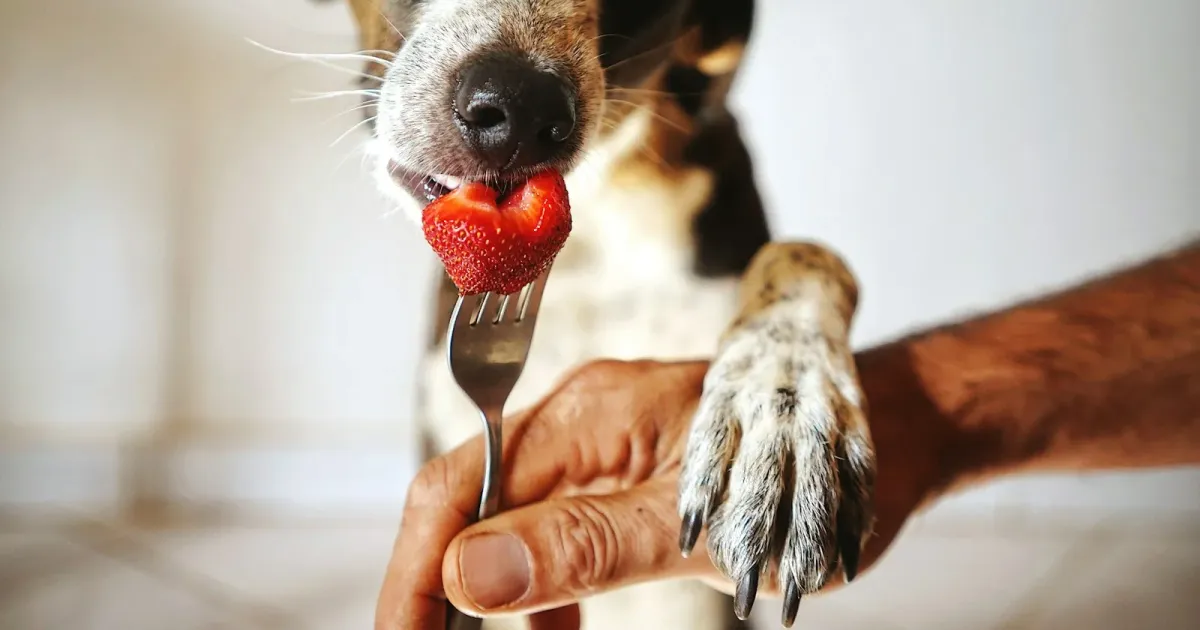
Can dogs eat strawberries? They can, and plenty of dogs will beg for one the moment the carton opens. The American Kennel Club answers the question with "yes, in moderation," and vets at Hill's and Purina agree.
The catch is in the details: how much, which parts and which forms. Below we explain why strawberries are safe when grapes are not, why your dog may find them so appealing, and how to serve them without an upset stomach.
Quick facts
One cup of strawberries has about 45 calories and covers an adult human's daily vitamin C needs (University of Maine Cooperative Extension).
Treats, strawberries included, should make up no more than 10% of a dog's daily calories (AKC).
Hill's suggests up to one strawberry a day for small dogs, two to three for medium dogs and up to a handful for large dogs (Hill's Pet Nutrition).
Dogs have about 1,700 taste buds, compared with about 9,000 in people (Psychology Today, Stanley Coren, 2011).
A ripe strawberry can hold up to 50 milligrams per kilogram of furaneol, the main compound behind its smell (Technical University of Munich, 2013).
Can dogs eat strawberries safely?
Yes. Strawberries are safe because they don't contain any compound known to poison dogs. That sets them apart from grapes and raisins, which the ASPCA warns can cause kidney damage. The ASPCA says tartaric acid is the suspected culprit in grapes, and dogs can't process it well.
Strawberries also lack the pits and cyanide-containing seeds that make some other fruits risky. The tiny seeds on the outside of the berry are eaten along with it. The AKC fruit and vegetable guide lists strawberries among the fruits dogs can eat, next to bananas, blueberries and apples.
So the risks with strawberries come from quantity and form. Too many can upset the gut, and some strawberry products carry ingredients that are dangerous on their own.
Why do dogs like strawberries?
Dogs can taste sweetness, and strawberries are full of a sweet-smelling compound that dog taste receptors respond to. In a 2011 Psychology Today column, psychologist Stanley Coren wrote that dogs' sweet receptors react to furaneol, a chemical found in many fruits.
Strawberries are a rich source. In 2013, researchers at the Technical University of Munich described furaneol as the key compound in strawberry aroma. They found ripe berries can contain up to 50 milligrams of it per kilogram.
Coren's explanation for the sweet tooth is evolutionary. Wild canids (the dog family, including wolves) eat mostly meat but top up their diet with whatever fruit is around, so a taste for ripe fruit made sense. Dogs taste less than we do overall, with roughly 1,700 taste buds to our 9,000, but sweet fruit still registers. If your dog also grazes on the lawn, our piece on why dogs eat grass covers that other plant habit.
Are strawberries good for dogs?
Strawberries can be a healthy treat, though they aren't a necessary part of a dog's diet. A balanced dog food already covers your dog's nutritional needs, so think of strawberries as a lower-calorie swap for richer snacks.
Here's what vet-reviewed sources say strawberries contain:
Fiber, which Hill's says helps digestion and makes a dog feel full.
Vitamin C, plus folate, potassium, manganese and vitamin K, according to Hill's.
Antioxidants, which Purina says protect cells from free radical damage.
Plenty of water, also noted by Purina.
The AKC adds that strawberries contain an enzyme that may help whiten a dog's teeth. The AKC page doesn't cite a study for this, so treat it as a possible small bonus at most.
Hill's points out that strawberries are lower in sugar and calories than many fruits. That's part of why they work well as a treat for dogs watching their weight, as long as the portions stay small.
How many strawberries can a dog eat?
Most dogs can have one to three strawberries a day, depending on size, and the AKC calls that a reasonable starting point. Smaller dogs need smaller portions.
Hill's breaks it down by size:
Small dogs: up to one strawberry a day.
Medium dogs: two to three strawberries a day.
Large dogs: up to a handful a day.
The bigger rule is the 10% treat limit. The AKC, Hill's and Purina all say treats should make up no more than 10% of a dog's daily calories. Every chew, biscuit and strawberry counts toward that total.
Start slowly the first time. Purina recommends watching for an upset stomach, digestive trouble, intense scratching or increased thirst after a new food. The AKC warns that too many strawberries can cause loose stools or diarrhea.
How to prepare strawberries for your dog
Wash them, pull off the green tops and cut them to a size your dog can't choke on. That's the whole routine, and each step has a reason.
Wash the berries well. Purina says this removes dirt and chemical residue.
Remove the stems and leaves. Hill's says strawberry leaves aren't toxic, but they're known to cause digestive problems such as diarrhea.
Cut them into small pieces. The AKC warns that whole berries can be a choking hazard for small breeds.
For very small dogs, mash or puree the strawberry and mix it into their food, as the AKC suggests.
Frozen strawberries are fine too. The AKC and Purina both list them as an option, cut to the right size. On a hot day, a few frozen pieces make a cold, crunchy treat.
Which strawberry products should dogs avoid?
Dogs should skip canned strawberries, strawberries in syrup, dried strawberries and strawberry desserts. The trouble is what gets added during processing.
Canned or syrup-packed berries. Purina says these carry excess sugar and calories, and some canned versions contain xylitol.
Dried and freeze-dried strawberries. Hill's says they're more calorie-dense once the water is gone and carry more sugar by volume.
Strawberry desserts, jams and sweetened yogurts. Hill's lists strawberry desserts among the forms to avoid because of the sugar.
Xylitol is the big danger. It's an artificial sweetener used in some sugar-free foods. The ASPCA says it can cause low blood sugar (hypoglycemia) and, depending on the amount, liver damage that may develop within 12 to 24 hours. Always check the label on anything strawberry flavored before sharing.
Dogs that are diabetic or overweight should get a different treat altogether, according to both the AKC and Hill's, because of the natural sugar in the fruit. Ask your vet what works for your dog.
Dogs that scavenge can also help themselves to a strawberry dessert left on a counter. Our article on why dogs eat poop explains that scavenging streak.
When to call a vet
Call your vet if your dog shows signs of an allergic reaction or ongoing stomach trouble after eating strawberries. Hill's lists these possible reactions:
Hives or swelling
Excessive scratching
Watery eyes
Vomiting
Diarrhea
A dog that ate a strawberry product containing xylitol needs help right away, even if it seems fine. The ASPCA says early signs include vomiting and lethargy, which can progress to seizures. Call your vet or the ASPCA Animal Poison Control Center at (888) 426-4435. The ASPCA says the line is open 24 hours a day, 365 days a year, and a consultation fee may apply.
Frequently asked questions
Can dogs have strawberries every day?
Dogs can have a small number of strawberries daily if the berries stay within the 10% treat limit. The AKC suggests one to three strawberries a day as a starting point, with fewer for small dogs.
Can dogs eat strawberry tops and leaves?
Strawberry leaves aren't toxic to dogs, but Hill's says they can cause digestive issues such as diarrhea. Remove the green tops and stems before giving your dog a strawberry.
Can dogs eat frozen strawberries?
Dogs can eat frozen strawberries, and both the AKC and Purina list them as a safe option. Cut frozen strawberries into small pieces first so they don't become a choking hazard.
Can puppies eat strawberries?
Puppies can eat strawberries in very small amounts. Purina suggests starting a puppy with a single strawberry, either pureed or frozen, and watching for stomach upset.
Can dogs eat strawberry yogurt or strawberry ice cream?
Dogs are better off without strawberry yogurt and strawberry ice cream, which Hill's groups with sugary strawberry desserts to avoid. Sugar-free versions may contain xylitol, which the ASPCA warns can cause low blood sugar and liver damage in dogs.
Are strawberries good for diabetic dogs?
Strawberries are not a good pick for diabetic dogs. The AKC and Hill's both advise choosing a different treat for diabetic or overweight dogs because of the fruit's natural sugar.
More on canine habits in our dogs category, including why dogs lick you.
Sources
Can Dogs Eat Strawberries?, American Kennel Club
Fruits and Vegetables Dogs Can or Can't Eat, American Kennel Club
Can Dogs Eat Strawberries?, Hill's Pet Nutrition
Animal Poison Control, ASPCA
Vegetables and Fruits for Health: Strawberries, University of Maine Cooperative Extension
How Good Is Your Dog's Sense of Taste?, Psychology Today
Molecular basis of strawberry aroma, ScienceDaily (Technical University of Munich)




Comments