
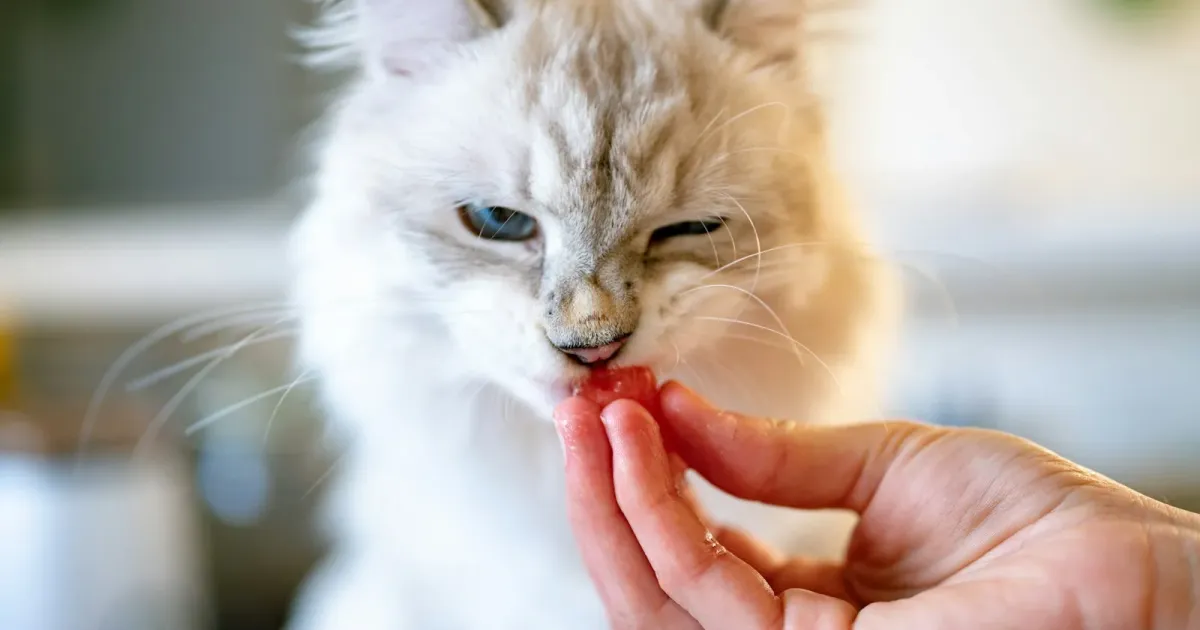
Why does my cat lick me? If you've asked that while a rough little tongue scrapes your knuckles, you're not alone. Cat licks feel odd, and they often come with no warning.
Most of the time, the answer is social. Cats that like each other groom each other. When your cat licks you, it is probably treating you as one of its group.
There are other reasons too, and a few are worth watching. Below, we go through what veterinarians and cat researchers have found.
Quick facts
Domestic cats spend up to a quarter of their waking hours grooming (National Geographic).
A cat's tongue is covered in hundreds of firm, backward-facing spines called papillae (PetMD).
A 2018 Georgia Tech study in PNAS found these spines are hollow and wick saliva deep into fur (NOVA, PBS).
A domestic cat spreads about 48 milliliters of saliva onto its fur each day (National Geographic).
In a 1998 study of 25 cats, higher-ranking cats groomed lower-ranking cats more often than the reverse (Journal of Ethology).
Why does my cat lick me? The main reasons
Cats lick people for social, sensory and sometimes medical reasons. PetMD's article on the topic, written by veterinary behaviorist Dr. Alison Gerken, lists seven:
Affection and bonding
Attention seeking
Marking you as part of the group
Comfort behavior left over from kittenhood
The taste of your skin
Anxiety relief
A medical problem such as nausea or pain
The UK charity Cats Protection gives a similar list. It adds that licking may just feel good, since it releases endorphins, the brain's feel-good chemicals. The sections below look at each reason in turn.
Is my cat licking me to show affection?
Often, yes. Licking a person looks a lot like allogrooming, the grooming cats do for other cats they're close to. PetMD says this kind of licking helps strengthen a social bond.
International Cat Care, a feline welfare charity, lists allogrooming among the friendly behaviors seen between cats that know each other well. Cats Protection describes it the same way: a way to show affection and make friends.
Cats usually groom each other on the head and neck. That's where a 1998 study by Ruud van den Bos in the Journal of Ethology saw most grooming land. So a cat licking your face, hair or the back of your hand may be doing a version of what it would do for a cat friend. If your cat also kneads you, read about why cats make biscuits, another habit that starts in kittenhood.
Is licking also about scent?
Licking also spreads scent. Cats Protection explains that licking transfers saliva, so the licked person or cat smells familiar and safe. PetMD calls this group identification. Your cat may be marking you as part of its social group.
In Cats Protection's words, the shared smell makes you seem familiar and trustworthy to the cat.
Does my cat lick me because I taste good?
Sometimes. PetMD notes that human sweat contains salts and sugars that cats may find appealing. A cat that licks you right after a workout, or licks lotion off your arm, may just like the taste.
That second case is a safety issue. PetMD warns not to let your cat lick skin after you've applied lotions or ointments, because some ingredients are toxic to cats. Wash up first, or cover the area. Food on your hands draws licks too. If you're tempted to share a spoonful of something, check our guide on whether cats can have peanut butter.
Why does my cat lick me and then bite me?
A cat that licks and then bites may be overstimulated, or it may be mixing grooming with a bit of rough play. The same pattern shows up between cats.
In van den Bos's 1998 study of 25 cats living together, aggressive behavior followed grooming in 35% of interactions. The groomer was usually the one that turned aggressive. He suggested allogrooming may help cats redirect tension in situations where open aggression would be too risky. That idea comes from one group of cats, so it's a hypothesis, not a rule.
The ASPCA describes a related problem, petting-induced aggression. Repeated stroking can become unpleasant for some cats. Watch for these warning signs before a bite:
Quickly turning the head toward your hand
A twitching or flipping tail
Ears flattening or swiveling back and forth
Restlessness
Dilated pupils
The ASPCA's advice: when your cat signals you to stop, stop.
Why does a cat's tongue feel like sandpaper?
A cat's tongue feels rough because it's covered in hundreds of tiny, stiff spines called papillae. PetMD says they point backward and feel like sandpaper on human skin.
In 2018, Alexis Noel and David Hu at Georgia Tech published a study of these spines in PNAS, the Proceedings of the National Academy of Sciences. They studied the tongues of domestic cats, bobcats, cougars, snow leopards, tigers and lions, according to National Geographic. Each papilla is about 2 mm tall and hollow, NOVA reports. The hollow tips hold saliva and wick it down into the fur.
That makes a cat's tongue a very good comb. National Geographic says grooming can also cool a cat as saliva evaporates. Thermal images showed a gap of up to 30°F between the skin and the outer fur. A tongue built to reach through dense fur will feel scratchy on bare skin.
When is licking a sign of stress or illness?
Licking can be a sign of stress or illness when it's sudden, constant or hard to interrupt. PetMD says anxious cats may lick to soothe themselves, and this can grow into a compulsive habit. Cats Protection also says excessive licking can mean a cat is unhappy.
When to see a vet
PetMD advises a vet visit if licking is excessive or starts suddenly. Contact your vet if you notice:
Licking that starts suddenly or keeps getting more intense
Constant licking of you, objects or the cat's own fur
Signs of nausea, pain or discomfort along with the licking
PetMD names nausea, pain and discomfort as medical triggers for excessive licking. A vet can rule those out before you treat it as a behavior issue.
How do I get my cat to stop licking me?
Redirect the licking calmly instead of punishing it. Both PetMD and Cats Protection say punishment adds stress and can make the behavior worse.
PetMD suggests these steps:
Cover the skin your cat likes to lick.
Get up and walk away when the licking starts.
Offer a toy or a game instead.
Add enrichment, such as play sessions and climbing spots.
Reward your cat when it relaxes with you without licking.
Cats Protection suggests offering a brushing session or play when your cat starts licking.
Frequently asked questions
Does my cat lick me because it loves me?
A cat licking you is usually a sign of a social bond. Cats groom other cats they're close to, and PetMD says licking people works the same way. It shows your cat sees you as part of its group.
Why does my cat lick my hair?
A cat licking your hair is likely grooming you the way it would groom another cat. In a 1998 study, cats aimed most grooming at the head and neck.
Why does my cat lick me when I pet her?
A cat that licks you during petting may be returning the grooming, as cats do with each other. If the licking turns to biting, the cat may be overstimulated. The ASPCA says to stop petting when a cat's tail twitches or its ears flatten.
Why does my cat lick my face?
A cat licking your face is usually social grooming aimed at the head, where cats groom each other most. Face licks also spread the cat's scent onto you. If you've used creams or lotions, gently stop the licking, since PetMD warns some ingredients are toxic to cats.
Is it safe to let my cat lick me?
Letting a healthy cat lick clean skin is usually fine, but avoid licks on skin with lotions or ointments. PetMD warns that some ingredients in these products are toxic to cats.
Why does my cat lick me and not other people?
A cat that licks only you likely has its strongest bond with you. Cats groom chosen companions, and licking spreads scent within the group. You may also be the person who rewards licking with attention.
Cats share their feelings in other ways too. Read why cats purr, or compare cat kisses with why dogs lick you. You'll find more in our cats section.
Sources
Why does my cat lick me? 7 common reasons, PetMD (Dr. Alison Gerken, DVM, DACVB; reviewed by Dr. Hannah Hart, DVM)
Why does my cat lick me?, Cats Protection (2021)
The social structure of cat life, International Cat Care
The function of allogrooming in domestic cats, Journal of Ethology (van den Bos, 1998)
Aggression in cats, ASPCA
How cat tongues work, and can inspire human tech, National Geographic (2018)
Cat tongues are covered in hundreds of body-cooling, moisture-wicking quill pens, NOVA, PBS (2018)
Freaked out by your cat's scratchy tongue? Don't be, NPR (2018)


Comments